llamaCVEVulnerability Intelligence
/
Red Hat OpenStack Platform 13

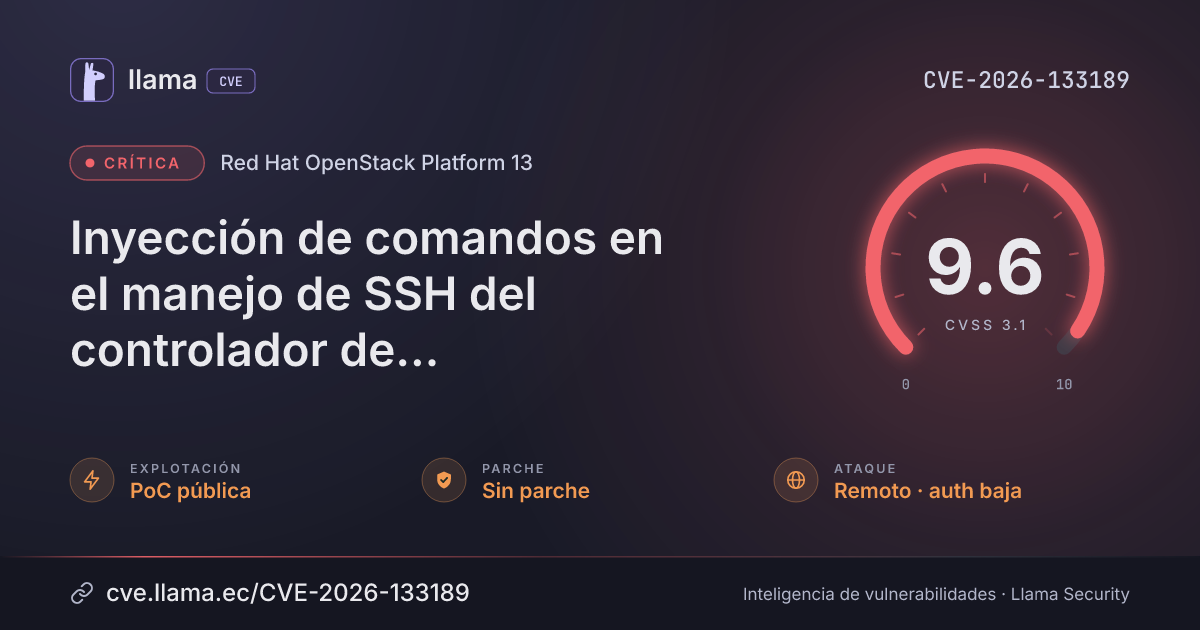
CVE-2026-133189

Red Hat OpenStack Platform 13 command injection in Cinder storage driver SSH handling

A low-privilege user can run commands over the network to read storage settings or alter other tenants' storage.

Texto original en inglés · Ver en español

Solo en configuraciones específicasSin parche publicadoOS command injection
Descargar PNG JSON
CVSS 3.1
9.6
Crítica
CVSS:3.1/AV:N/AC:L/PR:L/UI:N/S:C/C:N/I:H/A:H Fuente: CNA
ExplotaciónPoC públicaSSVC: PoC · no figura en CISA KEV
Exploits públicos0CISA-ADP reporta PoC; aún sin enlace público
ParcheSin parcheEl fabricante no ha publicado corrección
Exposición2 dDesde la divulgación, 19 nov 2026, 11:50 a. m.
Detección1 minDesde la divulgación hasta su ingreso al índice
Decisión SSVCSeguir de cerca
Monitorear y programar la remediación
Existe PoC pública, no automatizable e impacto técnico parcial. No hay versión corregida: aplique mitigaciones.
Que tu backlog no se convierta en tu incidente.Pide la ventana de mantenimiento antes del viernes.
Timeline

Ciclo de vida de la vulnerabilidad

Hoy
Divulgación
Publicada
Evaluación SSVC +1
Explotación
Remediación
Monitoreo
Detectada
Fuente: NIST NVD
Verificada
11:50 a. m.
12:21 p. m.
01:29 p. m.
02:42 p. m.
11:50 a. m.
12:33 a. m.
01:16 p. m.
01:59 a. m.
02:42 p. m.
FechaFaseEventoDetalle
Divulgación Publicada CVE-2026-133189 divulgada · CVSS 9.6 (CNA)
Monitoreo Detectada Ingresó al índice
Monitoreo Fuente: NIST NVD Registro visto por primera vez en NIST NVD
Divulgación Evaluación SSVC CISA-ADP · explotación PoC pública
Divulgación Modificada Última actualización del registro
Monitoreo Verificada Última verificación contra las fuentes
Resumen
Resumen generado por IA · CC-BY 4.0 · 19 nov 2026

The flaw is in the openstack-cinder package in Red Hat OpenStack Platform, where incomplete validation of shell metacharacters in Cinder's SSH-based storage-driver support lets an attacker with a low-privilege login reach it remotely over the network by supplying crafted connection information. Injected commands run with the privileges of Cinder's configured backend account, which can disclose storage configuration and, if that account has administrative rights, change storage used by other tenants and affect its integrity or availability.

¿Qué significa?The bug is an SSH command injection in Cinder storage drivers. The shared check_ssh_injection sanitizer does not validate all shell metacharacters, so crafted input can alter the commands sent over SSH to the storage array.
¿Quién está afectado?The advisory lists Red Hat OpenStack Platform 13 (Queens), 16.2, 17.1 and 18.0. It requires an SSH-based Cinder backend, such as IBM Storwize/SVC, to be actually configured, and it is not present in a default devstack. To check the setup, review the volume backend settings in cinder.conf for an SSH-based driver.
¿Qué hacer?The checked facts name no fixed version and no patch ids for this vulnerability. Until the vendor's advisory names a fix, the only mitigation given is to avoid or disable the affected SSH-based backend.
no-patchAvoiding or disabling the affected SSH-based backend removes this attack path. The advisory gives no other workaround.
Descripción original del registro (redhat)

A command injection vulnerability was found in OpenStack Cinder's SSH-based storage-driver support. Incomplete validation of shell metacharacters allows an authenticated user who owns a volume on an affected backend to supply crafted connection information and inject additional commands into the storage array's management interface. Commands execute with the privileges of Cinder's configured backend account. This can disclose storage configuration information and, where that account has administrative permissions, could allow changes that affect the integrity or availability of other tenants' storage.

Contexto

Condiciones y alcance

Condiciones necesarias para que el fallo sea explotable
01
Cinder driver uses SSH to reach the storage array and calls the shared check_ssh_injection sanitizer (e.g. IBM Storwize/SVC)“storage backend whose Cinder driver uses SSH”
02
An SSH-based Cinder backend is actually configured (not present in a default devstack)“It requires an SSH-based Cinder backend (e.g. Storwize/SVC) actually configured”
MitigaciónAvoiding or disabling the affected SSH-based backend removes this attack path
Vector CVSS 3.1

Desglose de métricas

Opción resaltada = valor del vector · izquierda = peor caso · CNA
Vector de ataqueAV:N
RedAdyacenteLocalFísica
ComplejidadAC:L
BajaAlta
PrivilegiosPR:L
NingunoBajosAltos
InteracciónUI:N
NingunaRequerida
AlcanceS:C
CambiadoSin cambio
ConfidencialidadC:N
AltoBajoNinguno
IntegridadI:H
AltoBajoNinguno
DisponibilidadA:H
AltoBajoNinguno
Score de explotaciónQué tan fácil y probable es que la exploten
10.0/ 10Muy alto
Vector 8.7 (muy fácil) · +1.3 por PoC pública.
Remediación

Estado del parche por paquete

Paquete / productoEstadoCorregida enDesde divulgaciónÚltima versión
openstack-cinder
Sin parche — — —
Explotación

Arsenal público

Sin exploits, módulos ni PoC públicos conocidos a la fecha de verificación.

Registro
MitigaciónThere is no complete mitigation established by this static review that preserves normal operation of an affected backend. Avoiding or disabling the affected SSH-based backend removes this attack path but also prevents normal use of that backend and requires operator planning. Reducing the storage account's privileges is an unverified deployment suggestion: the reviewed IBM Storwize/SVC driver documentation recommends an Administrator-role account, and compatibility with a narrower role was not established.redhat
Referencias
Fabricantehttps://lists.openstack.org/archives/list/openstack-discuss@lists.openstack.org/thread/GVGTCVPAK7FUP72SYT2Y3RHNX4JDFU4N/
Análisishttps://bugzilla.redhat.com/show_bug.cgi?id=2572315
Otrahttps://access.redhat.com/security/cve/CVE-2026-133189
Otrahttps://bugs.launchpad.net/cinder/+bug/2163356
Otrahttps://review.opendev.org/c/openstack/cinder/+/1014986

Las referencias externas se muestran para copiar: cve.llama.ec no lo redirige a otros sitios.