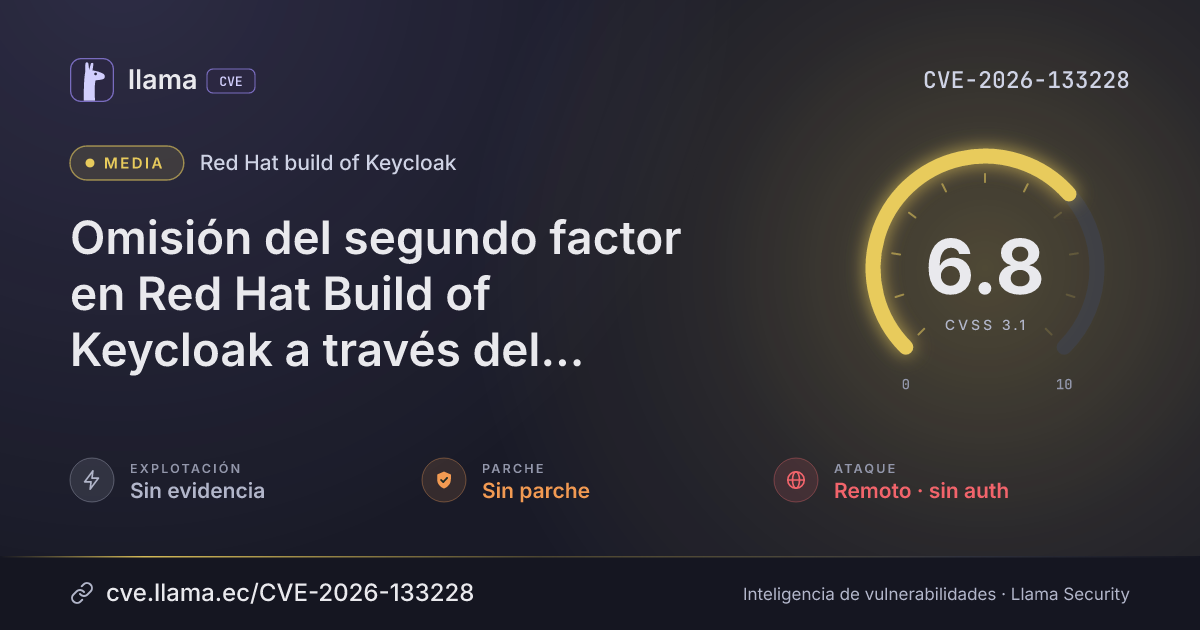
CVE-2026-133228
Red Hat Build of Keycloak second factor bypass via credential reset endpoint
A remote attacker with a user's password can get valid access tokens without the required second factor.
Texto original en inglés · Ver en español
CVSS:3.1/AV:N/AC:H/PR:N/UI:R/S:U/C:H/I:H/A:N
Fuente: CNA
Ciclo de vida de la vulnerabilidad
| Fecha | Fase | Evento | Detalle |
|---|---|---|---|
| Divulgación | Publicada | CVE-2026-133228 divulgada · CVSS 6.8 (CNA) | |
| Monitoreo | Detectada | Ingresó al índice | |
| Monitoreo | Fuente: NIST NVD | Registro visto por primera vez en NIST NVD | |
| Monitoreo | Verificada | Última verificación contra las fuentes |
Red Hat Build of Keycloak and Red Hat Single Sign-On 7 do not enforce a client's minimum authentication level when a login starts at the credential reset endpoint. A remote attacker who already has a user's password can move from the reset page to the standard login form, get valid access tokens, and reach protected services without completing the required second factor.
Descripción original del registro (redhat)
A flaw was found in Keycloak. When a client application enforces step-up authentication or multi-factor authentication (MFA) via a minimum authentication level, Keycloak fails to apply this requirement to login sessions initiated through the credential reset endpoint. An attacker who possesses a user's initial credentials (such as a password) can navigate from the reset interface back to the standard login form and authenticate without completing the required second factor. This flaw allows an attacker to obtain valid access tokens and gain unauthorized access to protected services without satisfying mandatory security controls.
Desglose de métricas
Estado del parche por paquete
| Paquete / producto | Estado | Corregida en | Desde divulgación | Última versión |
|---|---|---|---|---|
keycloak-services |
Sin parche | — | — | — |
rhbk/keycloak-rhel9 |
Sin parche | — | — | — |
rh-sso7-keycloak |
Sin parche | — | — | — |
Arsenal público
Sin exploits, módulos ni PoC públicos conocidos a la fecha de verificación.
https://bugzilla.redhat.com/show_bug.cgi?id=2577154https://access.redhat.com/security/cve/CVE-2026-133228Las referencias externas se muestran para copiar: cve.llama.ec no lo redirige a otros sitios.