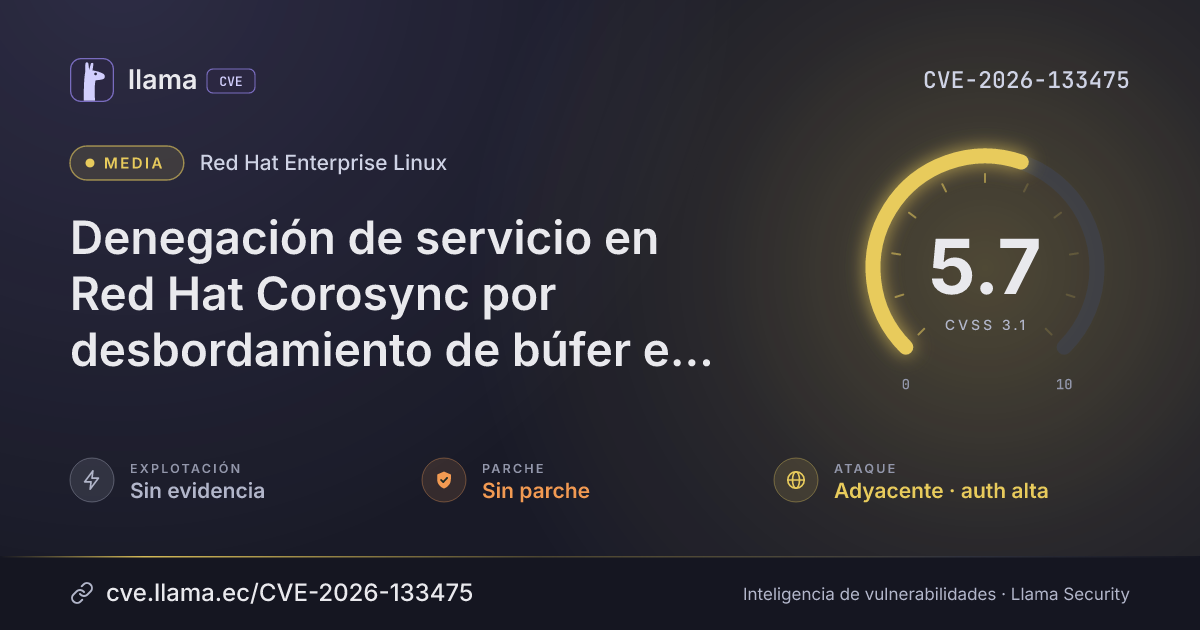
CVE-2026-133475
Red Hat denial of service in Corosync via heap overflow
A nearby attacker with high privileges can send a crafted token that corrupts memory and causes denial of service.
Texto original en inglés · Ver en español
CVSS:3.1/AV:A/AC:H/PR:H/UI:N/S:U/C:N/I:H/A:H
Fuente: CNA
Ciclo de vida de la vulnerabilidad
| Fecha | Fase | Evento | Detalle |
|---|---|---|---|
| Divulgación | Publicada | CVE-2026-133475 divulgada · CVSS 5.7 (CNA) | |
| Monitoreo | Detectada | Ingresó al índice | |
| Monitoreo | Fuente: NIST NVD | Registro visto por primera vez en NIST NVD | |
| Divulgación | Evaluación SSVC | CISA-ADP · explotación ninguna | |
| Divulgación | Modificada | Última actualización del registro | |
| Monitoreo | Verificada | Última verificación contra las fuentes |
Corosync, as packaged in Red Hat Enterprise Linux and several OpenShift Container Platform images, has a heap-based buffer overflow in how it handles membership commit tokens. An attacker on an adjacent network who has high-level privileges can send a crafted, oversized commit token to a node in the GATHER membership state, corrupting memory and causing a denial of service.
Descripción original del registro (redhat)
A heap-based buffer overflow was found in Corosync's Totem SRP membership commit token handling. The sanity check for memb_commit_token messages validates only minimum length and address-entry counts, not an upper bound against the fixed commit_token_storage buffer. A network-adjacent attacker who can deliver a crafted oversized commit token to a node in the GATHER membership state may overflow the heap-allocated totemsrp instance, leading to memory corruption and denial of service.
Desglose de métricas
Estado del parche por paquete
| Paquete / producto | Estado | Corregida en | Desde divulgación | Última versión |
|---|---|---|---|---|
corosync |
Sin parche | — | — | — |
openshift/ose-rhel-coreos-9 |
Sin parche | — | — | — |
rhcos |
Sin parche | — | — | — |
openshift/ose-rhel-coreos-10 |
Sin parche | — | — | — |
Arsenal público
Sin exploits, módulos ni PoC públicos conocidos a la fecha de verificación.
https://bugzilla.redhat.com/show_bug.cgi?id=2577435https://access.redhat.com/security/cve/CVE-2026-133475Las referencias externas se muestran para copiar: cve.llama.ec no lo redirige a otros sitios.