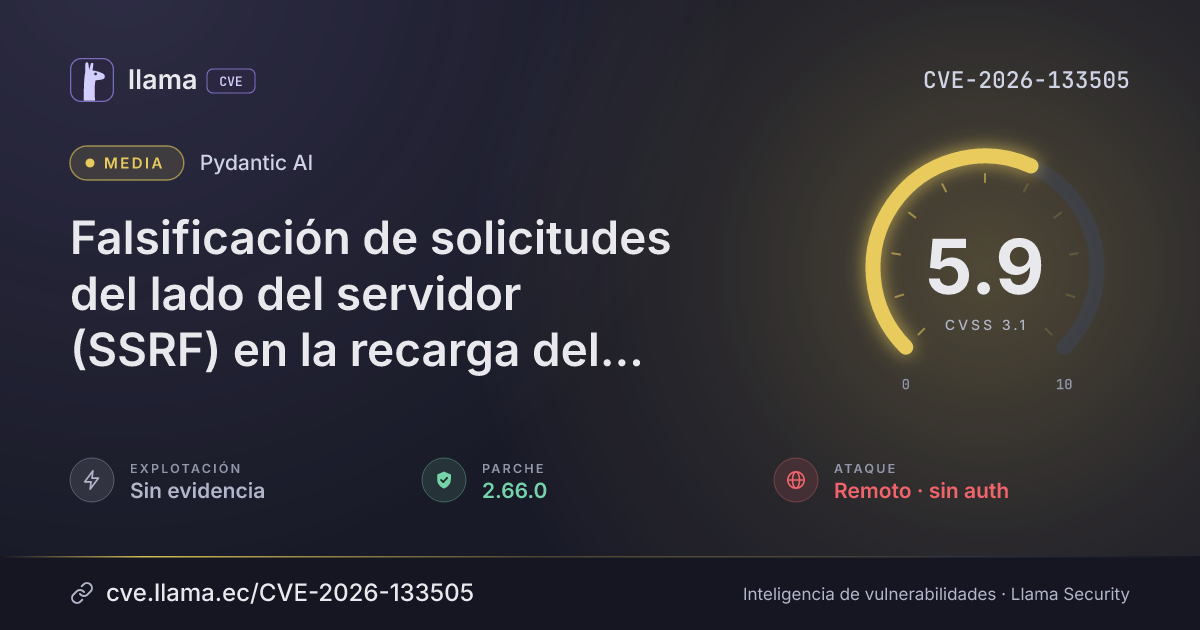
CVE-2026-133505
Pydantic AI server-side request forgery in message history reload
An attacker controlling tool output can make the app fetch internal URLs or read private files without logging in.
Texto original en inglés · Ver en español
CVSS:3.1/AV:N/AC:H/PR:N/UI:N/S:U/C:H/I:N/A:N
Fuente: CNA
Ciclo de vida de la vulnerabilidad
| Fecha | Fase | Evento | Detalle |
|---|---|---|---|
| Remediación | Parche 2.66.0 | pydantic-ai · -16 d desde divulgación | |
| Divulgación | Publicada | CVE-2026-133505 divulgada · CVSS 5.9 (CNA) | |
| Monitoreo | Detectada | Ingresó al índice | |
| Divulgación | Evaluación SSVC | CISA-ADP · explotación ninguna | |
| Divulgación | Modificada | Última actualización del registro | |
| Monitoreo | Fuente: ENISA EUVD | Registro visto por primera vez en ENISA EUVD | |
| Monitoreo | Fuente: NIST NVD | Registro visto por primera vez en NIST NVD | |
| Monitoreo | Verificada | Última verificación contra las fuentes |
The pydantic-ai and pydantic-ai-slim packages rebuild tool result data that looks like a file as a real file download or provider file reference when saved message history is reloaded. A remote attacker who controls data returned by a tool, such as from an MCP server or an external system, can make the application fetch a URL on its local network, or make the model provider read an s3:// object or uploaded file using the application's credentials, without logging in.
Descripción original del registro (Pydantic)
When message history is serialized and loaded again, a tool result that contains a JSON object in the serialized shape of one of Pydantic AI's file types is rebuilt as that file. A third party who controls data a tool returns, such as a record that an MCP server or a function tool returns from an external system, can use this to make the application download a URL on its local network, or make the model provider read an s3:// object or uploaded file with the application's credentials. Applications are affected when tool results can contain third-party data, message history containing those results is serialized and loaded again (stored history, history a UI adapter holds on the server, or Temporal, DBOS or Prefect durable execution), and the model is one Pydantic AI downloads files for, one that honors force_download, or one whose provider resolves non-HTTP file URLs or uploaded files. History that a client submits through the Vercel AI or AG-UI adapter in the default mode is not affected. The issue is fixed in pydantic-ai and pydantic-ai-slim 1.107.10 and 2.66.0.
Desglose de métricas
Rangos afectados
Estado del parche por paquete
| Paquete / producto | Estado | Corregida en | Desde divulgación | Última versión |
|---|---|---|---|---|
pypipydantic-ai |
Corregida | 2.66.0 | -16 d | 2.68.0 no afectada |
pypipydantic-ai-slim |
Corregida | 2.66.0 | -16 d | 2.71.0 no afectada |
2.66.0Arsenal público
Sin exploits, módulos ni PoC públicos conocidos a la fecha de verificación.
https://github.com/pydantic/pydantic-ai/security/advisories/GHSA-4cj4-hgwf-4hc4https://pydantic.dev/docs/ai/ui/overview/#trust-model-for-client-submitted-messagesLas referencias externas se muestran para copiar: cve.llama.ec no lo redirige a otros sitios.