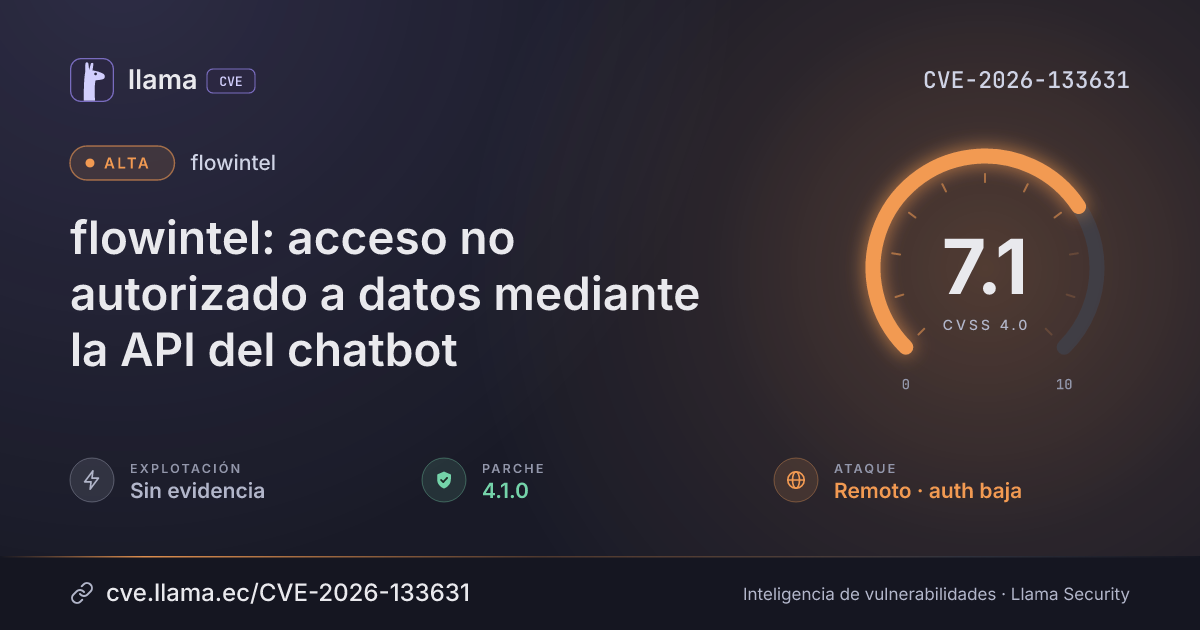
CVE-2026-133631
flowintel unauthorized data access via chatbot API
Low-privilege users can make the chatbot call admin endpoints to read or change restricted data.
Texto original en inglés · Ver en español
CVSS:4.0/AV:N/AC:L/AT:N/PR:L/UI:N/VC:H/VI:L/VA:N/SC:L/SI:N/SA:N
Fuente: CNA
Ciclo de vida de la vulnerabilidad
| Fecha | Fase | Evento | Detalle |
|---|---|---|---|
| Divulgación | Publicada | CVE-2026-133631 divulgada · CVSS 7.1 (CNA) | |
| Monitoreo | Detectada | Ingresó al índice | |
| Monitoreo | Fuente: NIST NVD | Registro visto por primera vez en NIST NVD | |
| Divulgación | Evaluación SSVC | CISA-ADP · explotación ninguna | |
| Divulgación | Modificada | Última actualización del registro | |
| Monitoreo | Verificada | Última verificación contra las fuentes |
FlowIntel contains several flaws. An authenticated user with access to a shared or imported note can reference private cases, pulling their data into AI reports, exports, and MISP sends, and a crafted case message can make the chatbot API tool call any FlowIntel endpoint, including administrative ones, to read restricted data or change it. Remote attackers with low-privilege logins can reach these flaws without any user action, and separately, any local user can see the Ollama token and case content in the process list during AI report generation.
Affects FlowIntel versions before 4.1.0 that resolve note variable references in shared or imported notes. No vendor severity rating is given. Fixed in 4.1.0.
Descripción original del registro (CIRCL)
FlowIntel contains multiple security flaws in its note variable resolution, chatbot API tooling, and AI report generation. - Note variable references (e.g. cross-case or cross-task lookups) were resolved using the viewing user's privileges rather than the destination case's audience. An authenticated user with access to a shared or imported note could embed references to private cases, causing sensitive case data to be pulled into AI report requests, exports, and MISP sends without the referenced case's audience having granted read access. - The chatbot API tool permitted the language model to invoke any FlowIntel API endpoint, including administrative routes and state-changing GET operations, without an allow-list or path validation. An attacker who can influence the model's instructions (e.g. via untrusted case content) could induce data modification or access restricted endpoints. - AI report generation passed the Ollama bearer token and full case content as command-line arguments to a child process, exposing them in the system process table to any local user. Affected versions: FlowIntel prior to 4.1.0.
Condiciones y alcance
Desglose de métricas
Rangos afectados
Estado del parche por paquete
| Paquete / producto | Estado | Corregida en | Desde divulgación | Última versión |
|---|---|---|---|---|
flowintel |
Corregida | 4.1.0 | — | — |
4.1.0Arsenal público
Sin exploits, módulos ni PoC públicos conocidos a la fecha de verificación.
https://github.com/flowintel/flowintel/commit/34d151b8dceb1fea925b353f04a9483aba0a22b1Las referencias externas se muestran para copiar: cve.llama.ec no lo redirige a otros sitios.