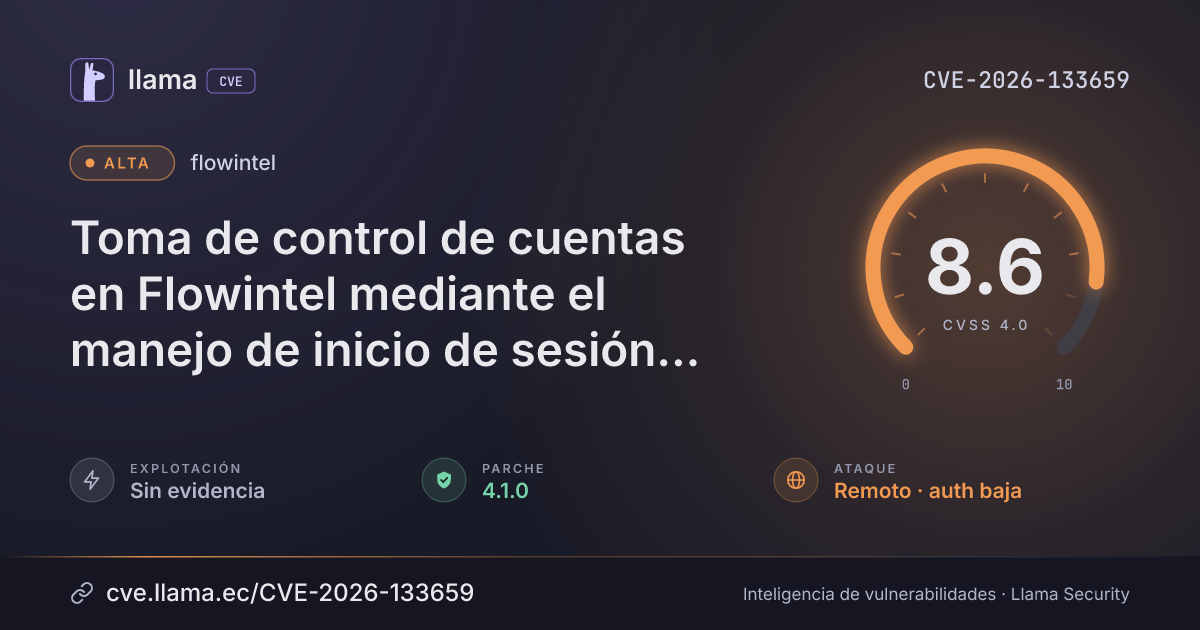
CVE-2026-133659
flowintel account takeover in SSO login handling
Remote attackers with a valid SSO identity can take over accounts, gain Editor roles, and read private cases.
Texto original en inglés · Ver en español
CVSS:4.0/AV:N/AC:L/AT:N/PR:L/UI:N/VC:H/VI:H/VA:N/SC:N/SI:N/SA:N
Fuente: CNA
Ciclo de vida de la vulnerabilidad
| Fecha | Fase | Evento | Detalle |
|---|---|---|---|
| Divulgación | Publicada | CVE-2026-133659 divulgada · CVSS 8.6 (CNA) | |
| Monitoreo | Detectada | Ingresó al índice | |
| Monitoreo | Fuente: NIST NVD | Registro visto por primera vez en NIST NVD | |
| Divulgación | Evaluación SSVC | CISA-ADP · explotación ninguna | |
| Divulgación | Modificada | Última actualización del registro | |
| Monitoreo | Fuente: ENISA EUVD | Registro visto por primera vez en ENISA EUVD | |
| Monitoreo | Verificada | Última verificación contra las fuentes |
Flowintel's single sign-on handling for Keycloak, Entra ID, and SimpleSAML has several trust flaws that let a remote attacker with a valid SSO identity, or membership in the relevant Entra tenant, take over other accounts, gain Editor or higher roles, and read private case data. The attack works over the network without any user action and does not require local administrator access.
Affects Flowintel before 4.1.0 when it uses Keycloak SSO, Entra ID role mapping, or default organisation creation. Fixed in 4.1.0.
Descripción original del registro (CIRCL)
Flowintel contains multiple SSO identity and organisation trust boundary violations that collectively allow account takeover, privilege escalation, and unauthorized access to private case data. - Keycloak SSO accepted unverified email claims, and all SSO providers (Keycloak, Entra ID, SimpleSAML) could resolve a claimed email address to an existing account that was created via a different sign-in method, enabling cross-provider account collision and unauthorized access to another user's account and data. - Entra ID role mapping relied on group display names, which tenant members could duplicate by creating a group with the same name as a privileged group (e.g. FlowintelAdmin), resulting in unauthorized role escalation. - SSO provisioning reused organisations whose display names matched user-controlled profile names, granting the new SSO user access to that organisation's private cases without explicit administrator assignment. - Case sharing via the API resolved organisations by name using a first-match query, so ambiguous names could silently resolve to the wrong organisation. Preconditions: an attacker must have a valid SSO identity (Keycloak, Entra ID, or SimpleSAML) or be a member of the relevant Entra tenant. No local administrator access is required. Security impact: unauthorized access to private case data, privilege escalation to Editor or higher roles, and account takeover across authentication providers. Affected versions: Flowintel prior to 4.1.0.
Condiciones y alcance
Desglose de métricas
Rangos afectados
Estado del parche por paquete
| Paquete / producto | Estado | Corregida en | Desde divulgación | Última versión |
|---|---|---|---|---|
flowintel |
Corregida | 4.1.0 | — | — |
4.1.0Arsenal público
Sin exploits, módulos ni PoC públicos conocidos a la fecha de verificación.
https://github.com/flowintel/flowintel/commit/a39038de93a46911e0d13283d5fa7812e114538bLas referencias externas se muestran para copiar: cve.llama.ec no lo redirige a otros sitios.