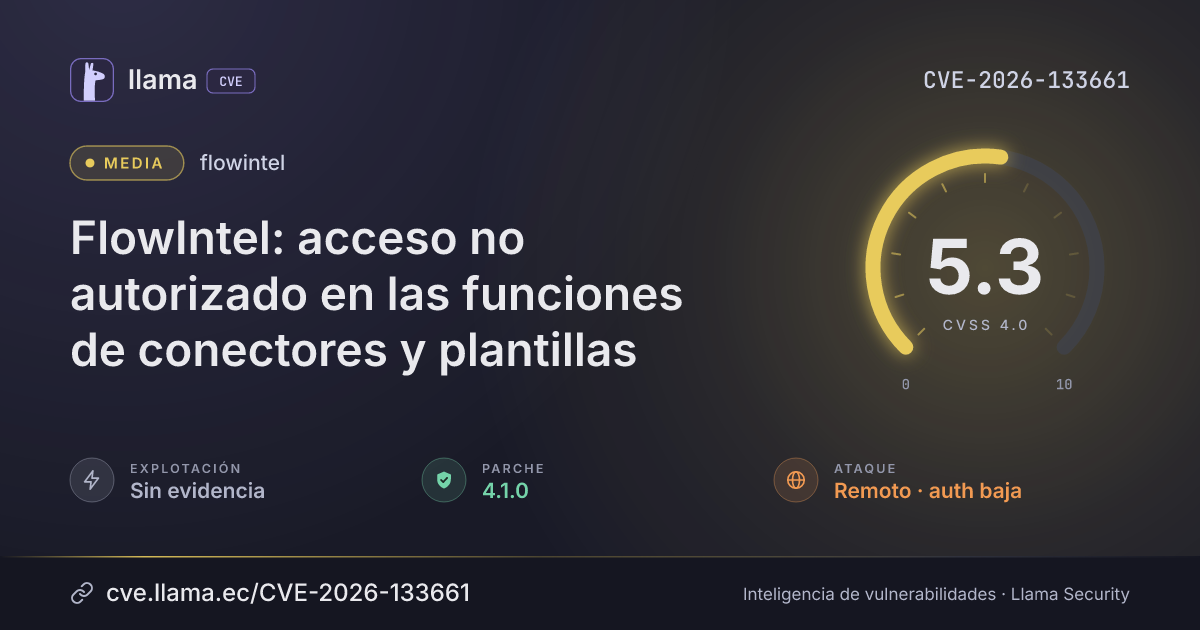
CVE-2026-133661
flowintel unauthorized access in connector and template features
A logged-in user can view restricted connector data, change credential scopes, and potentially expose credentials.
Texto original en inglés · Ver en español
CVSS:4.0/AV:N/AC:L/AT:N/PR:L/UI:N/VC:L/VI:L/VA:L/SC:N/SI:N/SA:N
Fuente: CNA
Ciclo de vida de la vulnerabilidad
| Fecha | Fase | Evento | Detalle |
|---|---|---|---|
| Divulgación | Publicada | CVE-2026-133661 divulgada · CVSS 5.3 (CNA) | |
| Monitoreo | Detectada | Ingresó al índice | |
| Monitoreo | Fuente: NIST NVD | Registro visto por primera vez en NIST NVD | |
| Divulgación | Evaluación SSVC | CISA-ADP · explotación ninguna | |
| Divulgación | Modificada | Última actualización del registro | |
| Monitoreo | Fuente: ENISA EUVD | Registro visto por primera vez en ENISA EUVD | |
| Monitoreo | Verificada | Última verificación contra las fuentes |
FlowIntel has several authorization flaws in its connector, MISP helper, and case template features. A logged-in user can use them to view connector data they should not see, change credential scopes, and potentially expose credentials. The flaws can be reached remotely over the network with low-privilege access and need no action from another user.
Descripción original del registro (CIRCL)
FlowIntel contains multiple authorization and credential management vulnerabilities affecting connector instances, MISP helper tools, and case templates. - Connector instance metadata, connectivity checks, and case listings accepted instance IDs without verifying if the acting user had visibility or ownership rights, allowing unauthorized access to sensitive configuration and data. - Case template serialization and creation processes exposed connector instances attached to templates regardless of the user's permissions, potentially leaking credentials or instance details to users who should not have access. - Editing connector instances allowed changes to URLs or sharing scopes without requiring re-authentication of API keys, enabling the reuse of another user's credentials in a new context or the leakage of shared keys to unauthorized endpoints. - Outbound MISP connector keys were incorrectly accepted for authenticating incoming alerts, bypassing the intended separation between outbound integration credentials and inbound alert source authentication. These issues allow authenticated users to access unauthorized connector data, manipulate credential scopes, and potentially exploit credential confusion between different security contexts. Affected versions: < 4.1.0
Desglose de métricas
Rangos afectados
Estado del parche por paquete
| Paquete / producto | Estado | Corregida en | Desde divulgación | Última versión |
|---|---|---|---|---|
flowintel |
Corregida | 4.1.0 | — | — |
4.1.0Arsenal público
Sin exploits, módulos ni PoC públicos conocidos a la fecha de verificación.
https://github.com/flowintel/flowintel/commit/11263af5a84f27cb342fa80343c708d44f42e840Las referencias externas se muestran para copiar: cve.llama.ec no lo redirige a otros sitios.