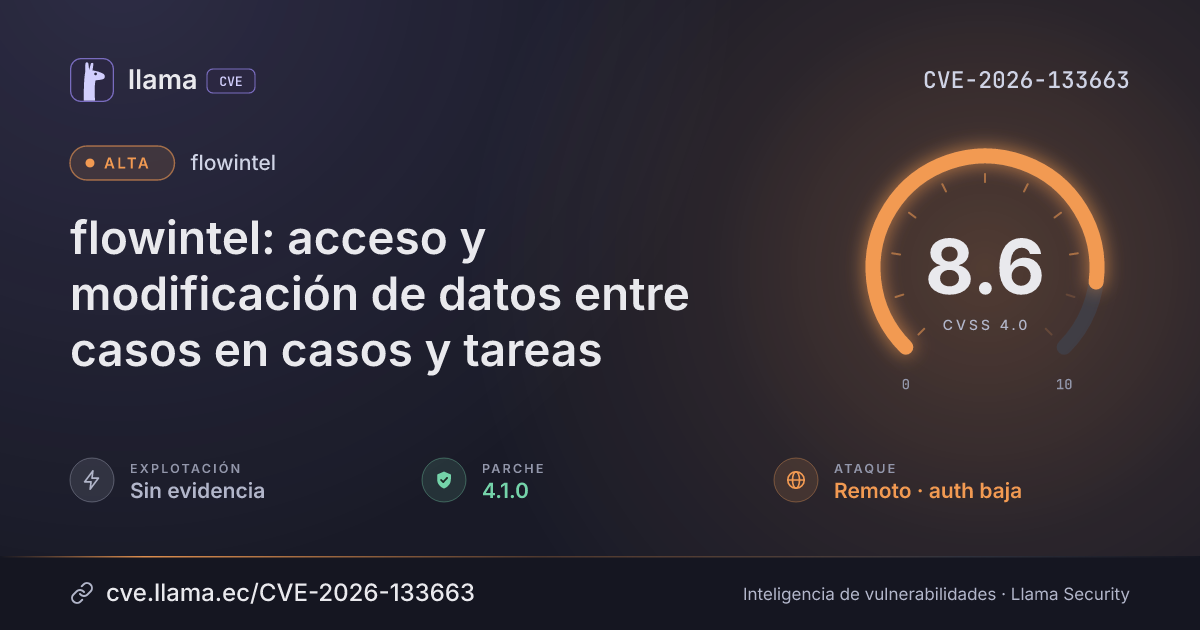
CVE-2026-133663
flowintel cross-case data access and modification in cases and tasks
A low-privilege user can read or change case and task records they are not authorized to access.
Texto original en inglés · Ver en español
CVSS:4.0/AV:N/AC:L/AT:N/PR:L/UI:N/VC:H/VI:H/VA:N/SC:N/SI:N/SA:N
Fuente: CNA
Ciclo de vida de la vulnerabilidad
| Fecha | Fase | Evento | Detalle |
|---|---|---|---|
| Divulgación | Publicada | CVE-2026-133663 divulgada · CVSS 8.6 (CNA) | |
| Monitoreo | Detectada | Ingresó al índice | |
| Monitoreo | Fuente: NIST NVD | Registro visto por primera vez en NIST NVD | |
| Divulgación | Evaluación SSVC | CISA-ADP · explotación ninguna | |
| Divulgación | Modificada | Última actualización del registro | |
| Monitoreo | Verificada | Última verificación contra las fuentes |
A flaw in flowintel lets an attacker with a low-privilege login reach it over the network and read or change records in cases and tasks they are not authorized to access. This can expose sensitive threat intelligence data and allow timeline entries and connector settings to be modified or deleted, and no user action is needed.
Descripción original del registro (CIRCL)
flowintel contains an Insecure Direct Object Reference (IDOR) vulnerability affecting multiple endpoints that manage child records of cases and tasks. An authenticated user with access to one case or task could read or modify records belonging to other cases by supplying identifiers of those records directly in the request. Affected operations include: - Reading task notes, subtasks, and URL tools by referencing their IDs without verifying they belong to the authorized task - Retrieving task assignees for a task belonging to a different case - Editing or deleting timeline events and timeline event links belonging to another case - Editing or removing case connectors belonging to another case - Invoking connector module operations (MISP, generic connectors, worker calls) by combining an authorized case with a connector link from a different case The root cause is that the application authorized the parent resource (case or task) in the URL but then fetched or operated on the child record independently without verifying the child's ownership relationship to the authorized parent. Security impact: an authenticated user can exfiltrate sensitive threat intelligence data from cases they do not have access to, and can modify or delete timeline entries, connector configurations, and other records in unauthorized cases, leading to data integrity loss and potential disruption of incident response workflows. Affected versions: flowintel prior to 4.1.0
Desglose de métricas
Rangos afectados
Estado del parche por paquete
| Paquete / producto | Estado | Corregida en | Desde divulgación | Última versión |
|---|---|---|---|---|
flowintel |
Corregida | 4.1.0 | — | — |
4.1.0Arsenal público
Sin exploits, módulos ni PoC públicos conocidos a la fecha de verificación.
https://github.com/flowintel/flowintel/commit/fecba79506dea2886118fe5cd686d4edfdef60aeLas referencias externas se muestran para copiar: cve.llama.ec no lo redirige a otros sitios.