llamaCVEVulnerability Intelligence
/
flowintel

CVE-2026-133665

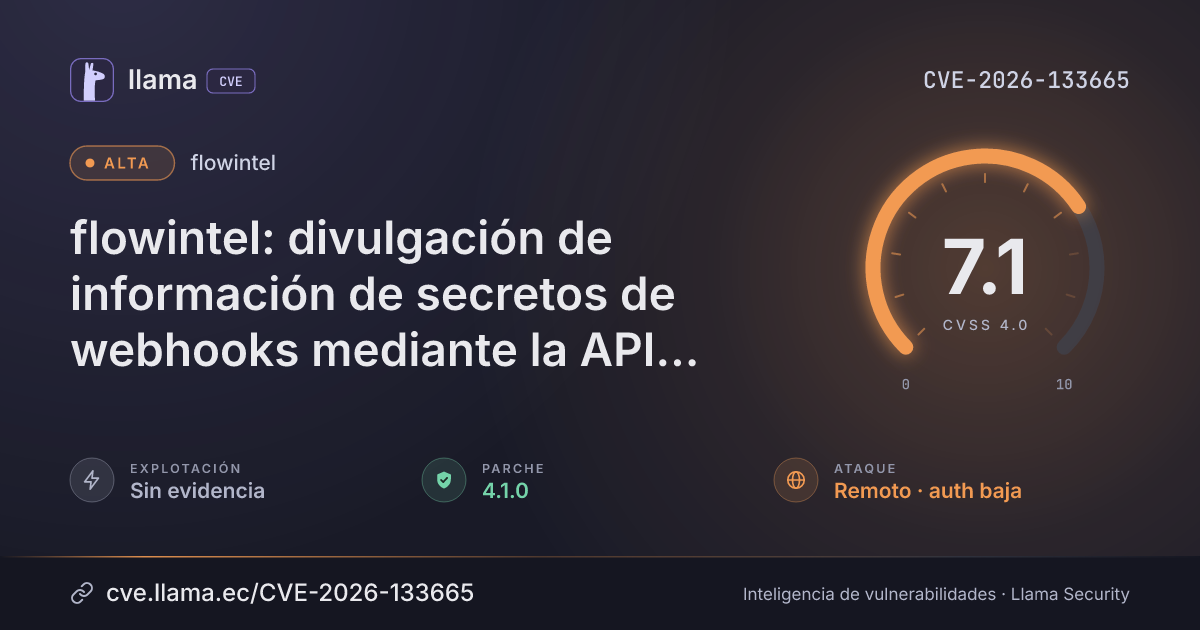
flowintel information disclosure of webhook secrets via alert API

A low-privilege user can read webhook URLs, signing secrets, and IMAP credentials meant only for administrators.

Texto original en inglés · Ver en español

Solo en configuraciones específicasParche disponibleinformation disclosure
Descargar PNG JSON
CVSS 4.0
7.1
Alta
CVSS:4.0/AV:N/AC:L/AT:N/PR:L/UI:N/VC:N/VI:H/VA:N/SC:N/SI:N/SA:N Fuente: CNA
ExplotaciónSin evidenciaSSVC: ninguna · no figura en CISA KEV
Exploits públicos0Ninguno conocido
Parche1 versión4.1.0
Exposición1 dDesde la divulgación, 20 nov 2026, 5:58 a. m.
Detección10 minDesde la divulgación hasta su ingreso al índice
Decisión SSVCSeguir
Remediar en la ventana regular de mantenimiento
Sin explotación conocida, no automatizable e impacto técnico parcial. Hay versiones corregidas disponibles.
Yo la vigilo, tú la programas. ¿Trato?Más vale un parche a tiempo que un incidente de madrugada.
Timeline

Ciclo de vida de la vulnerabilidad

Hoy
Divulgación
Publicada
Evaluación SSVC +1
Explotación
Remediación
Monitoreo
Detectada +1
Verificada
05:58 a. m.
06:08 a. m.
01:25 p. m.
02:44 p. m.
05:58 a. m.
02:09 p. m.
10:21 p. m.
06:32 a. m.
02:44 p. m.
FechaFaseEventoDetalle
Divulgación Publicada CVE-2026-133665 divulgada · CVSS 7.1 (CNA)
Monitoreo Detectada Ingresó al índice
Monitoreo Fuente: NIST NVD Registro visto por primera vez en NIST NVD
Divulgación Evaluación SSVC CISA-ADP · explotación ninguna
Divulgación Modificada Última actualización del registro
Monitoreo Verificada Última verificación contra las fuentes
Resumen
Resumen generado por IA · CC-BY 4.0 · 20 nov 2026

flowintel exposes webhook URLs, signing secrets, IMAP credentials, and delivery logs, which are meant only for administrators, to authenticated non-admin users through the notification page and alert API. An attacker with a low-privilege account can reach this remotely over the network and may use the credentials to access notification services, impersonate the application in webhook deliveries, or move further into the infrastructure.

Affects flowintel versions before 4.1.0 for any valid non-admin account, which can read webhook URLs, signing secrets, IMAP credentials and delivery logs. No vendor rating is given. Fixed in 4.1.0.

¿Qué significa?Non-admin users can read webhook URLs, which may contain active bearer tokens, along with webhook signing secrets, IMAP credentials and webhook delivery logs. The values can be read from the page source by any authenticated user.
¿Quién está afectado?Flowintel versions from 0 up to, but not including, 4.1.0 are in the affected range. The exposure requires a valid non-admin user account on flowintel, so compare the installed flowintel version with 4.1.0 and check whether non-admin accounts exist.
¿Qué hacer?Upgrade flowintel to version 4.1.0 or later, which is the fixed version listed for this vulnerability. The sources name no vendor patch identifiers.
Descripción original del registro (CIRCL)

flowintel contains an information disclosure vulnerability that allows authenticated non-administrative users to access sensitive configuration data and logs intended for administrators only. The notification page and alert API responses exposed sensitive fields, including webhook URLs, signing secrets, IMAP credentials, and delivery logs, in the initial data or JSON responses. Although the user interface hid the configuration form from non-admin users, the underlying data remained accessible via the page source or API endpoints. This exposure included historical webhook URLs that may contain active bearer tokens. An attacker with a valid non-admin account could retrieve these credentials and logs, potentially leading to unauthorized access to notification services, impersonation of the application in webhook deliveries, or further lateral movement within the infrastructure. Affected versions: flowintel < 4.1.0

Contexto

Condiciones y alcance

Condiciones necesarias para que el fallo sea explotable
01
A valid non-admin user account on flowintel“Any authenticated user could read those values from the page source.”
Vector CVSS 4.0

Desglose de métricas

Opción resaltada = valor del vector · izquierda = peor caso · CNA
Vector de ataqueAV:N
RedAdyacenteLocalFísica
ComplejidadAC:L
BajaAlta
Requisitos de ataqueAT:N
NingunoPresentes
PrivilegiosPR:L
NingunoBajosAltos
InteracciónUI:N
NingunaPasivaActiva
Confid. (sistema)VC:N
AltoBajoNinguno
Integridad (sistema)VI:H
AltoBajoNinguno
Disponib. (sistema)VA:N
AltoBajoNinguno
Confid. (posterior)SC:N
AltoBajoNinguno
Integridad (posterior)SI:N
AltoBajoNinguno
Disponib. (posterior)SA:N
AltoBajoNinguno
Score de explotaciónQué tan fácil y probable es que la exploten
8.3/ 10Alto
Vector 8.3 (muy fácil) · sin evidencia de explotación.
Versiones

Rangos afectados

Afectada Corregida
flowintel< 4.1.0
4.1.0
Remediación

Estado del parche por paquete

Paquete / productoEstadoCorregida enDesde divulgaciónÚltima versión
flowintel
Corregida 4.1.0 — —
Versiones corregidas4.1.0
Explotación

Arsenal público

Sin exploits, módulos ni PoC públicos conocidos a la fecha de verificación.

Registro
EscenarioGENERALCIRCL
solutionThe vulnerability is remediated by enforcing role-based access control on data serialization and template rendering. Non-admin users are now restricted to receiving only public enable flags and do not have access to webhook URLs, secrets, or delivery logs. The shared alert serializer explicitly removes sensitive fields for non-admin users, ensuring that both the notification page and the alerts API preserve administrative diagnostics while protecting sensitive data from unauthorized access.CIRCL
Referencias
Parchehttps://github.com/flowintel/flowintel/commit/1445157891add7c04a63e0014cd96bf9802cac66

Las referencias externas se muestran para copiar: cve.llama.ec no lo redirige a otros sitios.