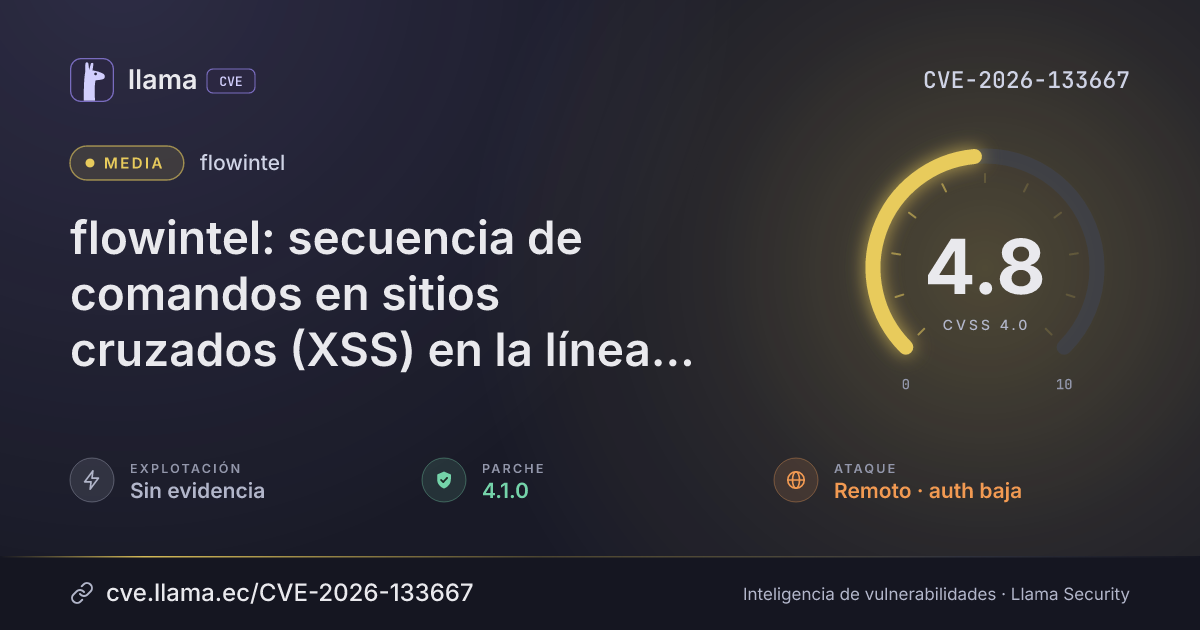
CVE-2026-133667
flowintel cross-site scripting in case timeline and search
An attacker can plant script in case notes that runs in victims' browsers, exposing case data or acting as them.
Texto original en inglés · Ver en español
CVSS:4.0/AV:N/AC:L/AT:N/PR:L/UI:A/VC:L/VI:L/VA:N/SC:N/SI:L/SA:N
Fuente: CNA
Ciclo de vida de la vulnerabilidad
| Fecha | Fase | Evento | Detalle |
|---|---|---|---|
| Divulgación | Publicada | CVE-2026-133667 divulgada · CVSS 4.8 (CNA) | |
| Monitoreo | Detectada | Ingresó al índice | |
| Monitoreo | Fuente: NIST NVD | Registro visto por primera vez en NIST NVD | |
| Divulgación | Evaluación SSVC | CISA-ADP · explotación ninguna | |
| Divulgación | Modificada | Última actualización del registro | |
| Monitoreo | Verificada | Última verificación contra las fuentes |
flowintel contains several flaws that let an authenticated attacker on the network inject HTML or script into pages other users view. The attacker plants crafted text in case notes or imported MISP attributes, and it runs when a victim opens the case timeline, runs a search, or requests certain analyser selection endpoints. Successful exploitation enables DOM-based cross-site scripting in the victim's browser, potentially exposing case data, manipulating the session, or performing actions under the victim's identity.
Descripción original del registro (CIRCL)
flowintel contains multiple related flaws that allow an authenticated attacker to inject arbitrary HTML or script into pages viewed by other users. - Timeline rendering: the timeline library's autolinking feature rewrote already-sanitised case notes and imported MISP attribute values into generated HTML link elements. Crafted text containing quote characters could break out of the generated attribute context, altering the surrounding markup and enabling script execution in the victim's browser. - Search highlighting: the highlight injection logic used a regular expression to locate text between angle brackets and spliced <mark> elements into the resulting string. Because the pattern could match inside HTML attribute values, the rewrite could corrupt or inject content into attributes of already-sanitised markup, again leading to DOM-based cross-site scripting. - Content-Type confusion: three analyser selection endpoints returned session-stored JSON strings with a text/html content type. A browser receiving such a response will parse and render the body as HTML, so any HTML or script embedded in the stored value is executed in the victim's context. Preconditions: the attacker must be an authenticated user with the ability to create or import case content (notes, MISP attributes) containing specially crafted quote or angle-bracket sequences. The victim must subsequently open the affected case timeline, run a search, or request one of the selection endpoints. Impact: successful exploitation yields DOM-based cross-site scripting in the victim's browser session, potentially allowing disclosure of case data, session manipulation, or execution of arbitrary actions under the victim's identity. Affected versions: flowintel prior to 4.1.0.
Desglose de métricas
Rangos afectados
Estado del parche por paquete
| Paquete / producto | Estado | Corregida en | Desde divulgación | Última versión |
|---|---|---|---|---|
flowintel |
Corregida | 4.1.0 | — | — |
4.1.0Arsenal público
Sin exploits, módulos ni PoC públicos conocidos a la fecha de verificación.
https://github.com/flowintel/flowintel/commit/5f745040d79d2f08d4a06512a91313c5a4eb346bLas referencias externas se muestran para copiar: cve.llama.ec no lo redirige a otros sitios.