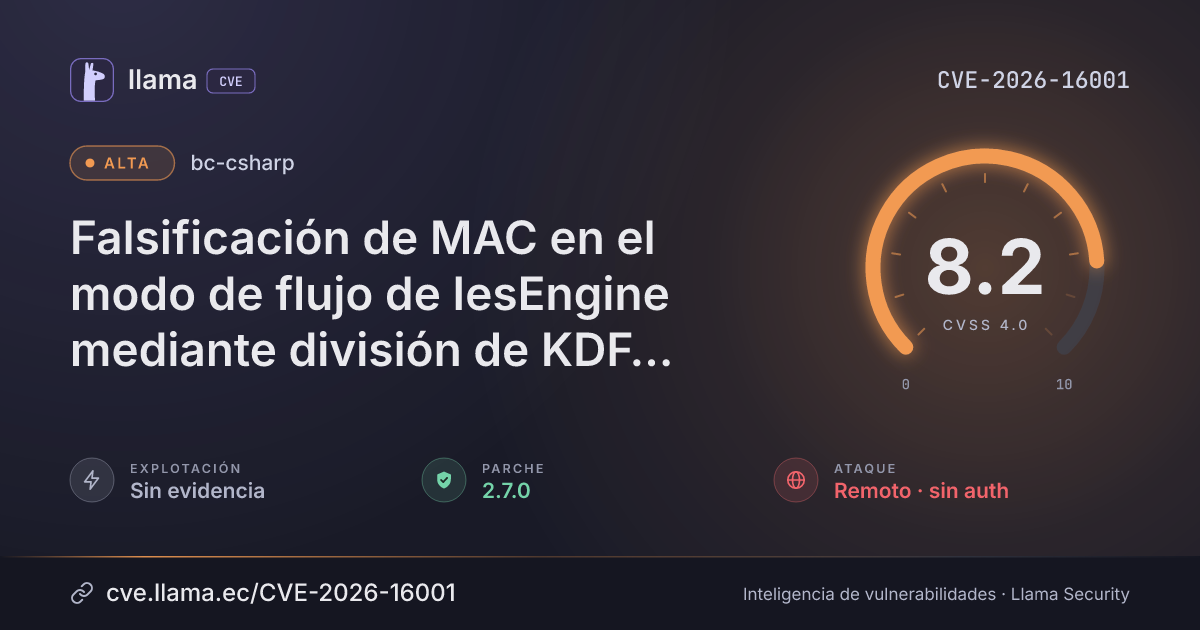
CVE-2026-16001
IesEngine stream-mode MAC forgery via length-dependent KDF split
CVSS:4.0/AV:N/AC:L/AT:P/PR:N/UI:N/VC:N/VI:H/VA:N/SC:N/SI:N/SA:N
Fuente: CNA
Ciclo de vida de la vulnerabilidad
| Fecha | Fase | Evento | Detalle |
|---|---|---|---|
| Divulgación | Publicada | CVE-2026-16001 divulgada · CVSS 8.2 (CNA) | |
| Divulgación | Evaluación SSVC | CISA-ADP · explotación ninguna | |
| Divulgación | Modificada | Última actualización del registro | |
| Monitoreo | Detectada | Ingresó al índice | |
| Monitoreo | Fuente: OSV | Registro visto por primera vez en OSV | |
| Monitoreo | Fuente: NIST NVD | Registro visto por primera vez en NIST NVD |
Exposure of the message authentication key through the encryption keystream in the stream mode of IesEngine (an IesEngine constructed without a block cipher) in Legion of the Bouncy Castle Inc. bc-csharp before 2.7.0 allows a remote attacker who has observed one encrypted message with known plaintext to forge shorter messages of their choosing that the recipient accepts as authentic, via a crafted ciphertext and MAC tag, because the MAC key was taken from the key derivation output directly after a keystream as long as the message, while the derivation input depends only on the static key pair and fixed parameters. The keystream revealed by that one message therefore contains the MAC key for every sufficiently shorter message.
Desglose de métricas
Rangos afectados
Estado del parche por paquete
| Paquete / producto | Estado | Corregida en | Desde divulgación | Última versión |
|---|---|---|---|---|
bc-csharp |
Corregida | 2.7.0 | — | — |
2.7.0Arsenal público
Sin exploits, módulos ni PoC públicos conocidos a la fecha de verificación.
https://github.com/bcgit/bc-csharp/wiki/CVE-2026-16001https://github.com/bcgit/bc-csharp/commit/f881400b761134160ec2a05fd27c3e569453788dLas referencias externas se muestran para copiar: cve.llama.ec no lo redirige a otros sitios.