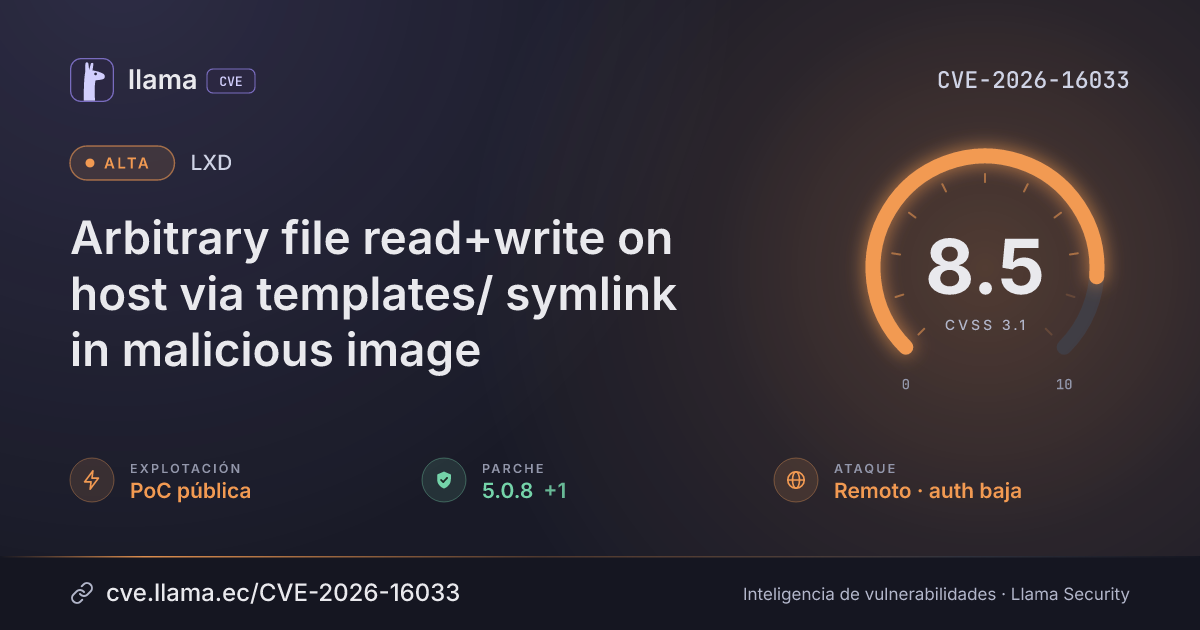
CVE-2026-16033
Arbitrary file read+write on host via templates/ symlink in malicious image
CVSS:3.1/AV:N/AC:L/PR:L/UI:N/S:C/C:H/I:L/A:N
Fuente: CNA
Ciclo de vida de la vulnerabilidad
| Fecha | Fase | Evento | Detalle |
|---|---|---|---|
| Divulgación | Publicada | CVE-2026-16033 divulgada · CVSS 8.5 (CNA) | |
| Divulgación | Evaluación SSVC | CISA-ADP · explotación PoC pública | |
| Divulgación | Modificada | Última actualización del registro | |
| Monitoreo | Detectada | Ingresó al índice | |
| Monitoreo | Fuente: OSV | Registro visto por primera vez en OSV | |
| Monitoreo | Verificada | Última verificación contra las fuentes |
A path traversal vulnerability in LXD allows an attacker to achieve arbitrary host file read or unconstrained file creation. When processing image metadata templates, LXD fails to properly sanitize or restrict template file paths from escaping the instance templates directory (specifically affecting virtual machine / QEMU driver execution paths). An attacker can exploit this flaw by providing a crafted image archive with malicious template directives containing path traversal sequences, causing LXD to access or write files outside the intended template directory on the host system.
Only the LXD virtual machine driver is affected, in versions 4.0.0 through 5.0.7; the LXC container driver is not. Fixed in 4.0.12 and 5.0.8.
Condiciones y alcance
Desglose de métricas
Rangos afectados
Estado del parche por paquete
| Paquete / producto | Estado | Corregida en | Desde divulgación | Última versión |
|---|---|---|---|---|
LXD |
Corregida | 4.0.12, 5.0.8 | — | — |
4.0.125.0.8Arsenal público
Sin exploits, módulos ni PoC públicos conocidos a la fecha de verificación.
https://github.com/canonical/lxd/security/advisories/GHSA-9hcm-hxh5-7xxhLas referencias externas se muestran para copiar: cve.llama.ec no lo redirige a otros sitios.