llamaCVEVulnerability Intelligence
/
RouterOS

CVE-2026-16347

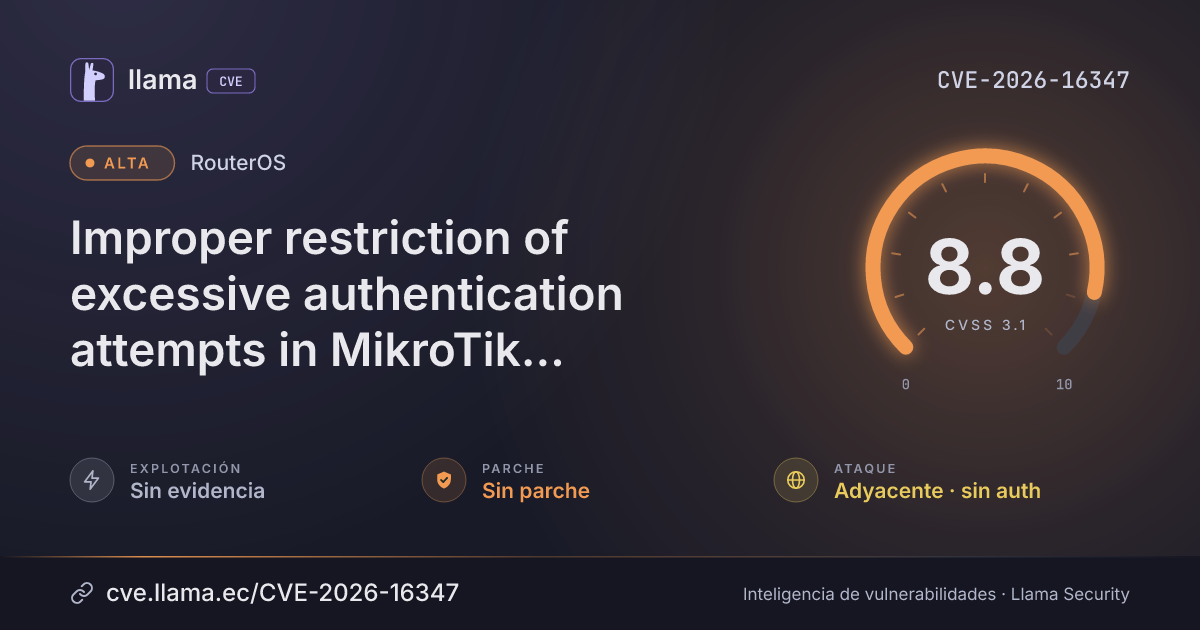
Improper restriction of excessive authentication attempts in MikroTik RouterOS and Cloud Hosted Router

Sin parche publicadobrute-force weakness
Descargar PNG JSON
CVSS 3.1
8.8
Alta
CVSS:3.1/AV:A/AC:L/PR:N/UI:N/S:U/C:H/I:H/A:H Fuente: CNA
ExplotaciónSin evidenciaSSVC: none · no figura en CISA KEV
Exploits públicos0Ninguno conocido
ParcheSin parcheEl fabricante no ha publicado corrección
Exposición113 dDesde la divulgación, 28 jul 2026, 2:59 p. m.
Detección111 dDesde la divulgación hasta su ingreso al índice
Decisión SSVCSeguir de cerca
Monitorear y programar la remediación
Sin explotación conocida, no automatizable e impacto técnico total. No hay versión corregida: aplique mitigaciones.
Timeline

Ciclo de vida de la vulnerabilidad

Hoy
Divulgación
Publicada
Evaluación SSVC +1
Explotación
Remediación
Monitoreo
Detectada
28 jul 26
29 jul 26
17 nov 26
19 nov 26
28 jul 26
26 ago 26
23 sept 26
22 oct 26
19 nov 26
FechaFaseEventoDetalle
Divulgación Publicada CVE-2026-16347 divulgada · CVSS 8.8 (CNA)
Divulgación Evaluación SSVC CISA-ADP · explotación ninguna
Divulgación Modificada Última actualización del registro
Monitoreo Detectada Ingresó al índice
Resumen

MikroTik RouterOS contains a weakness in its API authentication handling that lacks effective safeguards against excessive login attempts. The system does not enforce meaningful rate-limiting, account lockout, or source-based restrictions, allowing repeated authentication failures to proceed without defensive response. In some versions, a fixed per-connection delay is present, but it can be bypassed through concurrent sessions, resulting in continued high-volume attempts. This deficiency increases the risk that an attacker could eventually obtain valid credentials and gain unauthorized access to administrative services.

Vector CVSS 3.1

Desglose de métricas

Opción resaltada = valor del vector · izquierda = peor caso · CNA
Vector de ataqueAV:A
RedAdyacenteLocalFísica
ComplejidadAC:L
BajaAlta
PrivilegiosPR:N
NingunoBajosAltos
InteracciónUI:N
NingunaRequerida
AlcanceS:U
CambiadoSin cambio
ConfidencialidadC:H
AltoBajoNinguno
IntegridadI:H
AltoBajoNinguno
DisponibilidadA:H
AltoBajoNinguno
Versiones

Rangos afectados

Afectada Corregida
RouterOS · Cloud Hosted Routertodas
Remediación

Estado del parche por paquete

Paquete / productoEstadoCorregida enDesde divulgaciónÚltima versión
RouterOS
Sin parche — — —
Cloud Hosted Router
Sin parche — — —
Explotación

Arsenal público

Sin exploits, módulos ni PoC públicos conocidos a la fecha de verificación.

Registro
EscenarioGENERALicscert
MitigaciónNo fix is currently available from MikroTik. Until a fix is available, MikroTik recommends that users adopt the following mitigations: Use a strong VPN or other additional protection layer if the API is exposed to public networks. * Configure the unsuccessful-attempt time range (0.1 to 0.5 seconds) in /ip service for all services, including the API, once available. * Connect initially from a trusted network (LAN) port only, then configure the router per your security requirements. * Restrict/limit access to management services from untrusted networks. * Apply firewall rules to control and restrict access to management services where possible. * Use long, randomly generated passwords rather than weak or default-simple ones, to keep the brute-force search space impractically large. * Keep the default randomly generated device password, or replace it with an equally strong one, since minimum complexity isn't enforced by default. Users are encouraged to reach out to MikroTik (https://mikrotik.com/support) for further support.icscert
Referencias
Otrahttps://www.cisa.gov/news-events/ics-advisories/icsa-26-209-05

Las referencias externas se muestran para copiar: cve.llama.ec no lo redirige a otros sitios.