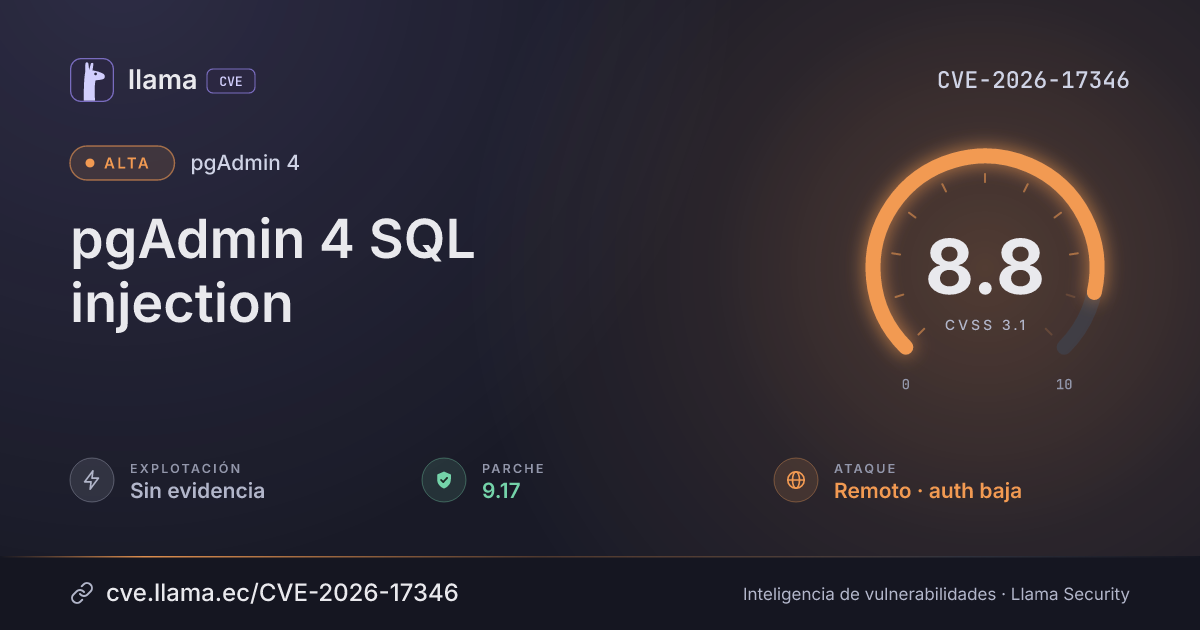
CVSS:3.1/AV:N/AC:L/PR:L/UI:N/S:U/C:H/I:H/A:H
Fuente: CNA
Ciclo de vida de la vulnerabilidad
| Fecha | Fase | Evento | Detalle |
|---|---|---|---|
| Divulgación | Evaluación SSVC | CISA-ADP · explotación ninguna | |
| Divulgación | Publicada | CVE-2026-17346 divulgada · CVSS 8.8 (CNA) | |
| Divulgación | Modificada | Última actualización del registro | |
| Monitoreo | Detectada | Ingresó al índice |
The fix for CVE-2026-12044 in pgAdmin 4 9.16 hardened qtLiteral and switched sixteen COMMENT ON / pgstattuple / pgstatindex templates to it, but missed several sinks that had been placed in test_sql_string_literal_lint.py's ALLOWLIST on the incorrect assumption that schema, table, publication, and subscription names sourced from pg_catalog via the browser tree could never contain an apostrophe. PostgreSQL permits arbitrary characters in quoted identifiers, so a low-privileged user able to CREATE TABLE, CREATE PUBLICATION, or CREATE SUBSCRIPTION can plant an apostrophe'd object name that breaks out of the unescaped '{{ name }}' template interpolation the moment any user (including a higher-privileged one) opens that object's Statistics or Dependencies tab, allowing arbitrary SQL statement injection in the viewing user's database session. Affected sinks: the Index Statistics query for all-indexes listing (coll_stats.sql, both the 16_plus and default PostgreSQL-version template variants -- distinct from the single-index stats.sql path already fixed in CVE-2026-12044), and the publication and subscription dependencies.sql / get_position.sql templates (both the pg and ppas/EPAS dialect variants for publications). Fix switches all of these templates to qtLiteral(conn) for name interpolation, and updates publications/__init__.py and subscriptions/__init__.py to pass conn=self.conn into the dependencies.sql render_template call so the qtLiteral filter has a connection to quote against. The corresponding ALLOWLIST entries in test_sql_string_literal_lint.py are removed now that these sinks are properly escaped rather than merely assumed safe. A behavioral regression test renders each fixed template with a stacked-statement apostrophe payload and asserts both that the object name appears exactly as qtLiteral-escaped and that the rendered SQL parses as exactly one statement, verifying the assertion genuinely fails against the pre-patch raw-interpolation form. This issue affects pgAdmin 4: the Index Statistics sink from 1.0, and the Publications/Subscriptions sinks from 5.0, both before 9.17.
Desglose de métricas
Rangos afectados
Estado del parche por paquete
| Paquete / producto | Estado | Corregida en | Desde divulgación | Última versión |
|---|---|---|---|---|
pgAdmin |
Corregida | 9.17 | — | — |
9.17Arsenal público
Sin exploits, módulos ni PoC públicos conocidos a la fecha de verificación.
https://github.com/pgadmin-org/pgadmin4/commit/73b3218992cc37af6e10b7e54eaeed6ec293c6b2https://github.com/pgadmin-org/pgadmin4/commit/f75452bfd0f786d0c071638919d48fc1d76f987dhttps://github.com/pgadmin-org/pgadmin4/issues/10193Las referencias externas se muestran para copiar: cve.llama.ec no lo redirige a otros sitios.