llamaCVEVulnerability Intelligence
/
pgAdmin 4

CVE-2026-17347

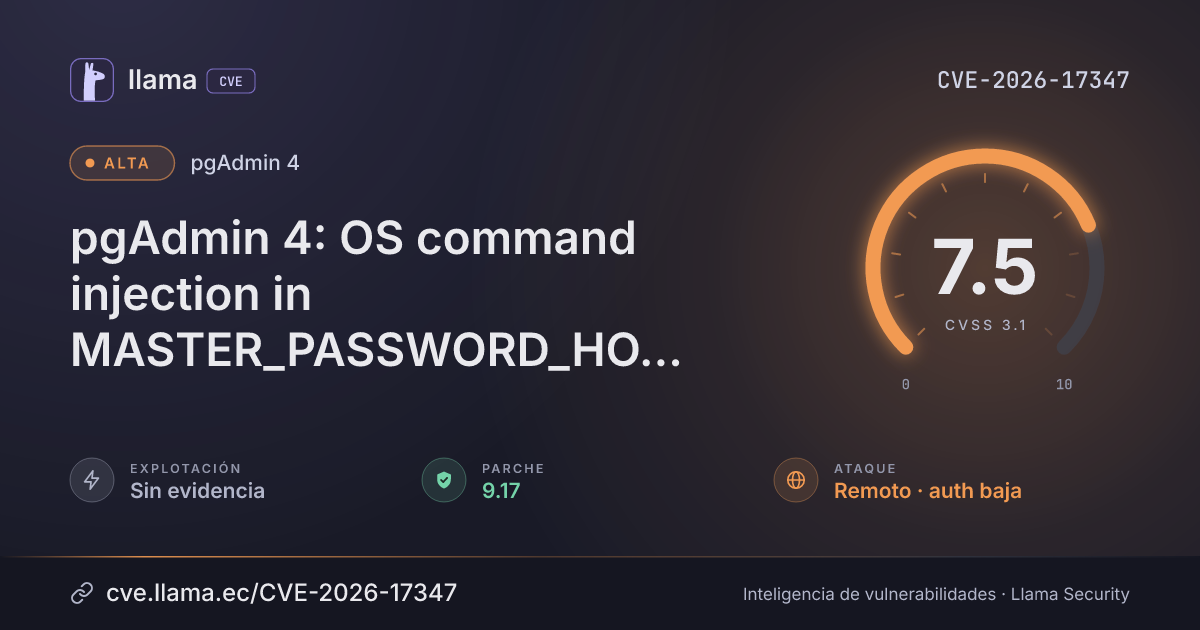
pgAdmin 4: OS command injection in MASTER_PASSWORD_HOOK via untrusted username substitution

Parche disponibleOS command injection
Descargar PNG JSON
CVSS 3.1
7.5
Alta
CVSS:3.1/AV:N/AC:H/PR:L/UI:N/S:U/C:H/I:H/A:H Fuente: CNA
ExplotaciónSin evidenciaSSVC: none · no figura en CISA KEV
Exploits públicos0Ninguno conocido
Parche1 versión9.17
Exposición110 dDesde la divulgación, 31 jul 2026, 10:59 a. m.
Detección108 dDesde la divulgación hasta su ingreso al índice
Decisión SSVCSeguir de cerca
Monitorear y programar la remediación
Sin explotación conocida, no automatizable e impacto técnico total. Hay versiones corregidas disponibles.
Timeline

Ciclo de vida de la vulnerabilidad

Hoy
Divulgación
Evaluación SSVC +1
Modificada
Explotación
Remediación
Monitoreo
Detectada
31 jul 26
1 ago 26
17 nov 26
19 nov 26
31 jul 26
27 ago 26
24 sept 26
22 oct 26
19 nov 26
FechaFaseEventoDetalle
Divulgación Evaluación SSVC CISA-ADP · explotación ninguna
Divulgación Publicada CVE-2026-17347 divulgada · CVSS 7.5 (CNA)
Divulgación Modificada Última actualización del registro
Monitoreo Detectada Ingresó al índice
Resumen

The MASTER_PASSWORD_HOOK setting, introduced in pgAdmin 4 7.2, lets an administrator configure an external command that returns a per-user encryption key, with %u in the configured string replaced by the current user's name. The previous implementation substituted the username directly into the command string and executed the result with subprocess.Popen(..., shell=True). Because the username can originate from an external authentication source (OAuth/OIDC claims, Kerberos, webserver auth) rather than a value pgAdmin fully controls, a username containing shell metacharacters (';', '$()', backticks, pipes, '&&', newlines) allowed an authenticated user to execute arbitrary commands as the pgAdmin service account in any deployment where the configured hook string uses %u. Fix tokenises the trusted, administrator-configured hook string into an argument vector first (using shlex in POSIX-quoting mode, with backslash-escaping disabled so Windows-style paths are not mis-parsed), substitutes the untrusted username into the individual argv elements, and executes with shell=False. The username is therefore always confined to a single argv element; any shell metacharacters it contains are inert. Administrators whose MASTER_PASSWORD_HOOK previously relied on shell features (pipes, redirection, environment-variable expansion, globbing) within the hook string itself must move that logic into the invoked script, since it is no longer interpreted by a shell. This issue affects pgAdmin 4: from 7.2 before 9.17.

Vector CVSS 3.1

Desglose de métricas

Opción resaltada = valor del vector · izquierda = peor caso · CNA
Vector de ataqueAV:N
RedAdyacenteLocalFísica
ComplejidadAC:H
BajaAlta
PrivilegiosPR:L
NingunoBajosAltos
InteracciónUI:N
NingunaRequerida
AlcanceS:U
CambiadoSin cambio
ConfidencialidadC:H
AltoBajoNinguno
IntegridadI:H
AltoBajoNinguno
DisponibilidadA:H
AltoBajoNinguno
Versiones

Rangos afectados

Afectada Corregida
pgAdmin 4≥ 7.2 < 9.17
7.2
9.17
Remediación

Estado del parche por paquete

Paquete / productoEstadoCorregida enDesde divulgaciónÚltima versión
pgAdmin
Corregida 9.17 — —
Versiones corregidas9.17
Explotación

Arsenal público

Sin exploits, módulos ni PoC públicos conocidos a la fecha de verificación.

Registro
EscenarioThreat model (per reporter's submitted rating): an authenticated pgAdmin user whose username is sourced from an external identity provider (OAuth/OIDC, Kerberos, or webserver auth passed through to pgAdmin) in a deployment where MASTER_PASSWORD_HOOK's configured string contains %u. Attack Complexity is High because exploitation depends on this non-default configuration (hook enabled with %u, combined with an external-auth username source under attacker influence) rather than being reachable in a default deployment. Scope is Unchanged: the resulting command execution runs as the pgAdmin service account, which is the same security authority the web application process itself already runs under -- it is a consequence of pgAdmin's own process, not a boundary crossing into an unrelated authority. Confidentiality/Integrity/Availability are High because arbitrary command execution as that account can read, modify, or destroy anything the account can reach.PostgreSQL
EscenarioSame reasoning as the CVSS 3.1 entry: authenticated low-privilege user with an externally-sourced username triggers arbitrary OS command execution as the pgAdmin service account, contingent on the non-default MASTER_PASSWORD_HOOK/%u configuration (AT:N here refers to no additional authentication target beyond the login itself; the configuration dependency is captured via AC:H in the 3.1 vector and is implicit in this scenario). VC:H/VI:H/VA:H for the service account's own reach; SC:N/SI:N/SA:N since that reach is the application's own process authority, not a distinct subsequent system.PostgreSQL
Referencias
Parchehttps://github.com/pgadmin-org/pgadmin4/commit/ea7e798aac27174d2bacee1d6e136bed76a95e23
Parchehttps://github.com/pgadmin-org/pgadmin4/commit/e7a85767314e7b0fe0b35fe80b9c1af38f48dff6
Reportehttps://github.com/pgadmin-org/pgadmin4/issues/10191

Las referencias externas se muestran para copiar: cve.llama.ec no lo redirige a otros sitios.