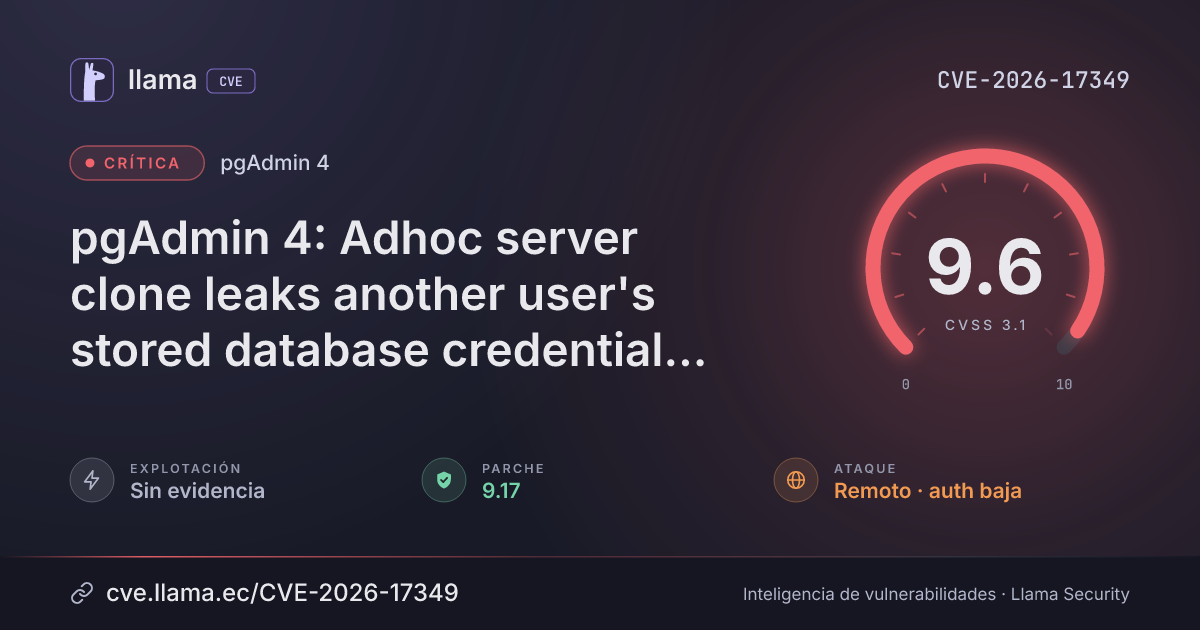
CVE-2026-17349
pgAdmin 4: Adhoc server clone leaks another user's stored database credentials and ownership to a non-owner
CVSS:3.1/AV:N/AC:L/PR:L/UI:N/S:C/C:H/I:H/A:N
Fuente: CNA
Ciclo de vida de la vulnerabilidad
| Fecha | Fase | Evento | Detalle |
|---|---|---|---|
| Divulgación | Evaluación SSVC | CISA-ADP · explotación ninguna | |
| Divulgación | Publicada | CVE-2026-17349 divulgada · CVSS 9.6 (CNA) | |
| Divulgación | Modificada | Última actualización del registro | |
| Monitoreo | Detectada | Ingresó al índice |
/misc/workspace/adhoc_connect_server, part of the Workspaces feature introduced in pgAdmin 4 9.0, when passed the id of an existing server, clones that server via Server.clone(), which copies every column from the source row, including user_id, shared, shared_username, and the stored credential fields password, save_password, and tunnel_password. When a non-owner triggered an adhoc connect against another user's (in practice, typically an administrator's) shared server, the clone inherited that user's ownership, shared flag, and stored database credentials verbatim. pgAdmin persisted this cross-tenant, credential-bearing server row before the connection was even attempted, so it survived even when the connection subsequently failed. The non-owner could then open the newly-owned clone and pgAdmin would connect using the source user's stored database password on the non-owner's behalf, granting the non-owner use of database credentials -- and whatever database privileges they confer -- that were never their own. Fix forces the cloned adhoc record's ownership fields (user_id, shared, shared_username) and stored credential fields (password, save_password, tunnel_password) to belong to the calling user and be cleared/private before committing, regardless of the source server's ownership, sharing state, or stored credentials. A regression test asserts that an adhoc connect triggered by a non-owner against another user's shared server persists a row owned by the caller, not shared, and without the source's stored credentials. This issue affects pgAdmin 4: from 9.0 before 9.17.
Desglose de métricas
Rangos afectados
Estado del parche por paquete
| Paquete / producto | Estado | Corregida en | Desde divulgación | Última versión |
|---|---|---|---|---|
pgAdmin |
Corregida | 9.17 | — | — |
9.17Arsenal público
Sin exploits, módulos ni PoC públicos conocidos a la fecha de verificación.
https://github.com/pgadmin-org/pgadmin4/commit/64a9cdbd6a240a962144f84418beaf9e66419779https://github.com/pgadmin-org/pgadmin4/issues/10200https://github.com/pgadmin-org/pgadmin4/commit/a7e74a6ed685bc34e1f77a8b6a94d00fa3dff815Las referencias externas se muestran para copiar: cve.llama.ec no lo redirige a otros sitios.