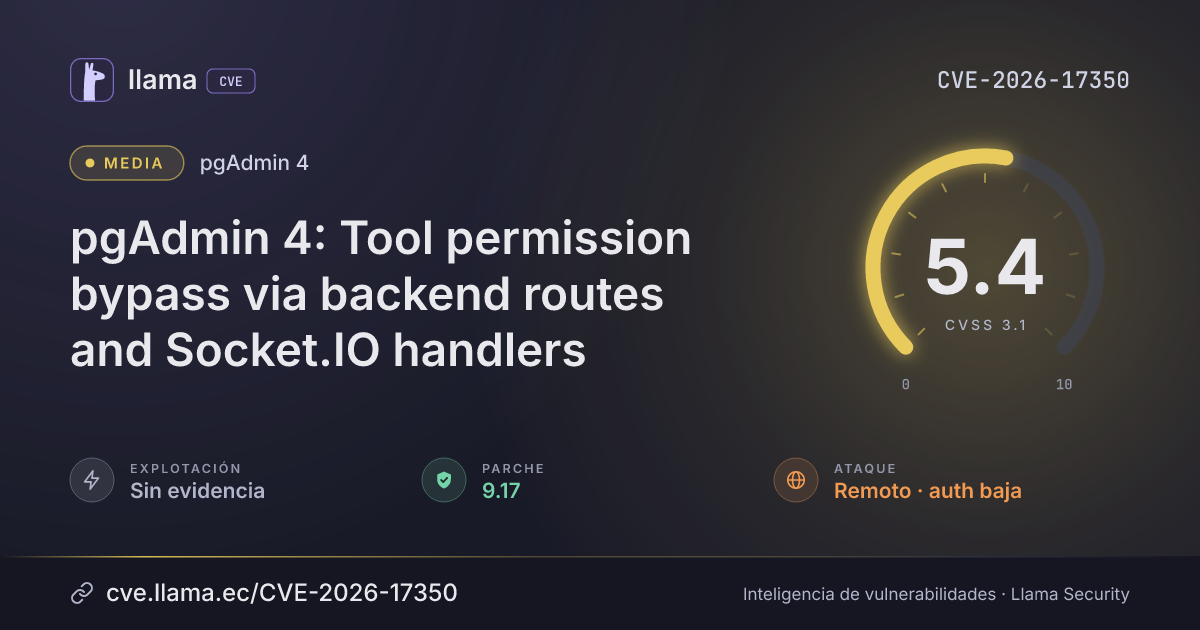
CVE-2026-17350
pgAdmin 4: Tool permission bypass via backend routes and Socket.IO handlers
CVSS:3.1/AV:N/AC:L/PR:L/UI:N/S:U/C:L/I:L/A:N
Fuente: CNA
Ciclo de vida de la vulnerabilidad
| Fecha | Fase | Evento | Detalle |
|---|---|---|---|
| Divulgación | Publicada | CVE-2026-17350 divulgada · CVSS 5.4 (CNA) | |
| Divulgación | Evaluación SSVC | CISA-ADP · explotación ninguna | |
| Divulgación | Modificada | Última actualización del registro | |
| Monitoreo | Detectada | Ingresó al índice |
The per-tool permission system (custom roles / role-based tool permissions, introduced in pgAdmin 4 9.3) did not enforce its permission check consistently. In SERVER mode, pgAdmin 4 gates each tool behind a per-tool Flask-Security permission, but the permission decorator (permissions_required) was applied only to a single "front door" route per tool. Every other backend route and Socket.IO handler in that tool's workflow relied solely on pga_login_required/socket_login_required, which check authentication but not the tool permission. The reporter verified three cases against a test build: (1) a user without tools_query_tool permission received 403 on the protected sqleditor initialization route, but the same session went on to connect the server, initialize the viewdata backend chain, and retrieve real table row content; (2) a user without tools_grant_wizard received 403 on the protected acl route, but the same session still enumerated grantable objects, generated GRANT SQL, and successfully applied it -- confirmed database-side via has_table_privilege(); (3) a user without tools_schema_diff received 403 on the protected panel route, but the same session initialized schema diff, enumerated and connected databases, and obtained real DDL differences via the compare_database Socket.IO handler. The reporter also confirmed a related but distinct issue: a non-owner triggering /misc/workspace/adhoc_connect_server against an administrator-owned shared server caused pgAdmin to persist a new server row still owned by the administrator (user_id/shared unchanged from the source), even though the connection attempt itself reported failure. During remediation, the same front-door-only permission gap was found to also affect the ERD, PSQL, and Debugger tools, and the Backup, Restore, Maintenance, and Import/Export blueprints, none of which were part of the original report; these were fixed using the same pattern as an extension of the reported defect class. An authenticated user who had valid pgAdmin login and a stored, working database connection, but had been explicitly denied a specific tool's permission by an administrator, could therefore still drive that tool end-to-end through its other routes and sockets, including obtaining an interactive psql session over the /pty Socket.IO namespace and invoking backup/restore/maintenance/import-export jobs. Because the bypass only restores access to tools operating over the user's own already-authenticated database connection, it does not grant the user any database privilege they did not already hold; it circumvents pgAdmin's own tool-level access-control policy (an organisational segregation-of-duties control, separate from database-level authorization), letting a user reach a pgAdmin feature an administrator intended to withhold from them, using capabilities their existing database role already permits through other means. Socket.IO event handlers had no permission-aware equivalent of permissions_required; only socket_login_required existed, checking authentication but not the tool permission. Fix adds a socket_permissions_required decorator (mirroring permissions_required, honouring the Administrator bypass, reading permissions via has_permission()) and applies it, alongside permissions_required, as the outermost decorator on every backend route and Socket.IO handler for the affected tools. Regression tests assert 403 on every gated route and socket handler for a permission-less user. This issue affects pgAdmin 4 in SERVER mode: from 9.3 before 9.17.
Desglose de métricas
Rangos afectados
Estado del parche por paquete
| Paquete / producto | Estado | Corregida en | Desde divulgación | Última versión |
|---|---|---|---|---|
pgAdmin |
Corregida | 9.17 | — | — |
9.17Arsenal público
Sin exploits, módulos ni PoC públicos conocidos a la fecha de verificación.
https://github.com/pgadmin-org/pgadmin4/commit/461c3afba92baad37c70a6fbd52d205d13a9de53https://github.com/pgadmin-org/pgadmin4/commit/d36bd8dc96812c716664feac533d240544e70adchttps://github.com/pgadmin-org/pgadmin4/commit/ba1984718ad703011740ad48cb9b82402b89cc2chttps://github.com/pgadmin-org/pgadmin4/commit/64a9cdbd6a240a962144f84418beaf9e66419779https://github.com/pgadmin-org/pgadmin4/issues/10190Las referencias externas se muestran para copiar: cve.llama.ec no lo redirige a otros sitios.