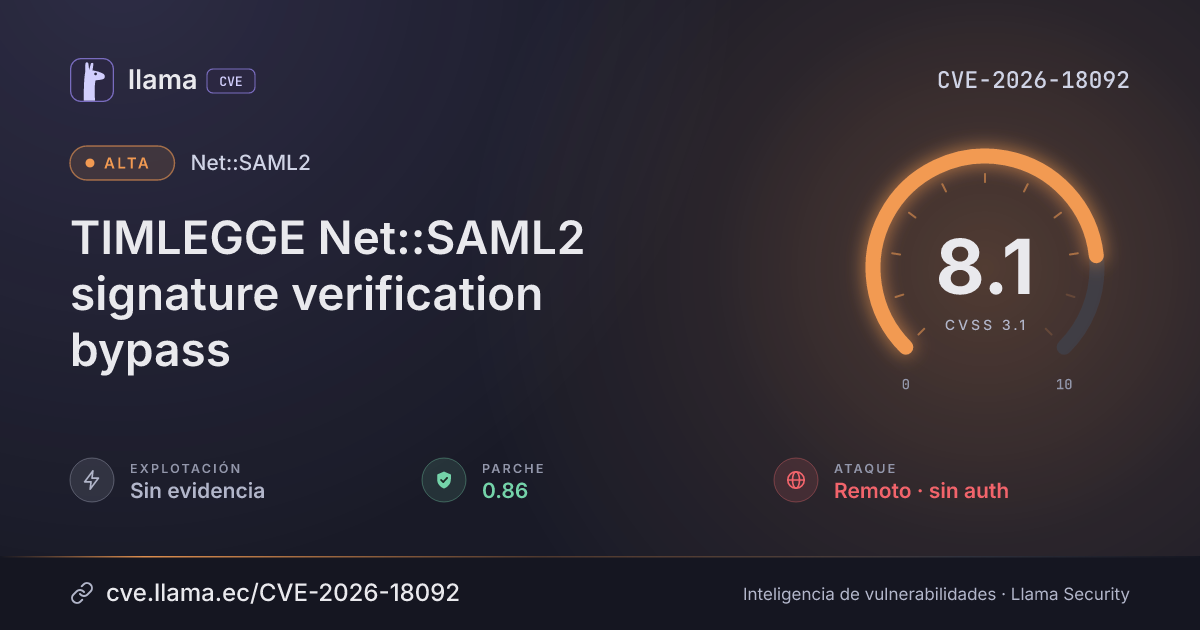
CVE-2026-18092
TIMLEGGE Net::SAML2 signature verification bypass
CVSS:3.1/AV:N/AC:L/PR:N/UI:R/S:U/C:N/I:H/A:H
Fuente: CISA-ADP
Ciclo de vida de la vulnerabilidad
| Fecha | Fase | Evento | Detalle |
|---|---|---|---|
| Divulgación | Publicada | CVE-2026-18092 divulgada · CVSS 8.1 (CISA-ADP) | |
| Divulgación | Evaluación SSVC | CISA-ADP · explotación ninguna | |
| Divulgación | Modificada | Última actualización del registro | |
| Monitoreo | Detectada | Ingresó al índice |
Net::SAML2 versions before 0.86 for Perl allow SAML authentication bypass via XML signature wrapping because new_from_xml reads assertion identity with document-wide XPath instead of the signed subtree. new_from_xml reads the NameID, attribute values, SessionIndex, audience and other identity fields with document-wide XPath, such as //saml:Assertion/saml:AttributeStatement/saml:Attribute and //saml:Subject/saml:NameID, which select the first matching element in document order rather than the element covered by the verified signature. handle_response confirms that a signature is present and, when a cacert is configured, that it chains to the CA, but XML::Sig verifies only the element named by the signature's Reference URI, so unsigned sibling assertions in the same document are not covered. An attacker who holds any one IdP-signed assertion can add an unsigned attacker-authored assertion earlier in document order; the signature still verifies and the document-order XPath returns the attacker's NameID and attributes. Any caller that passes an untrusted Response to new_from_xml can accept identity fields from an assertion the IdP never signed, even when a cacert trust anchor is configured, so a party holding one valid IdP-signed assertion can authenticate as an arbitrary user.
Desglose de métricas
Rangos afectados
Estado del parche por paquete
| Paquete / producto | Estado | Corregida en | Desde divulgación | Última versión |
|---|---|---|---|---|
Net::SAML2 |
Corregida | 0.86 | — | — |
0.86Arsenal público
Sin exploits, módulos ni PoC públicos conocidos a la fecha de verificación.
https://github.com/perl-net-saml2/perl-Net-SAML2/commit/201fead7f42b83f40c84bf4a311a25b09acd18f9.patchhttps://metacpan.org/release/TIMLEGGE/Net-SAML2-0.86/changesLas referencias externas se muestran para copiar: cve.llama.ec no lo redirige a otros sitios.