llamaCVEVulnerability Intelligence
/
Red Hat OpenShift AI 2.25

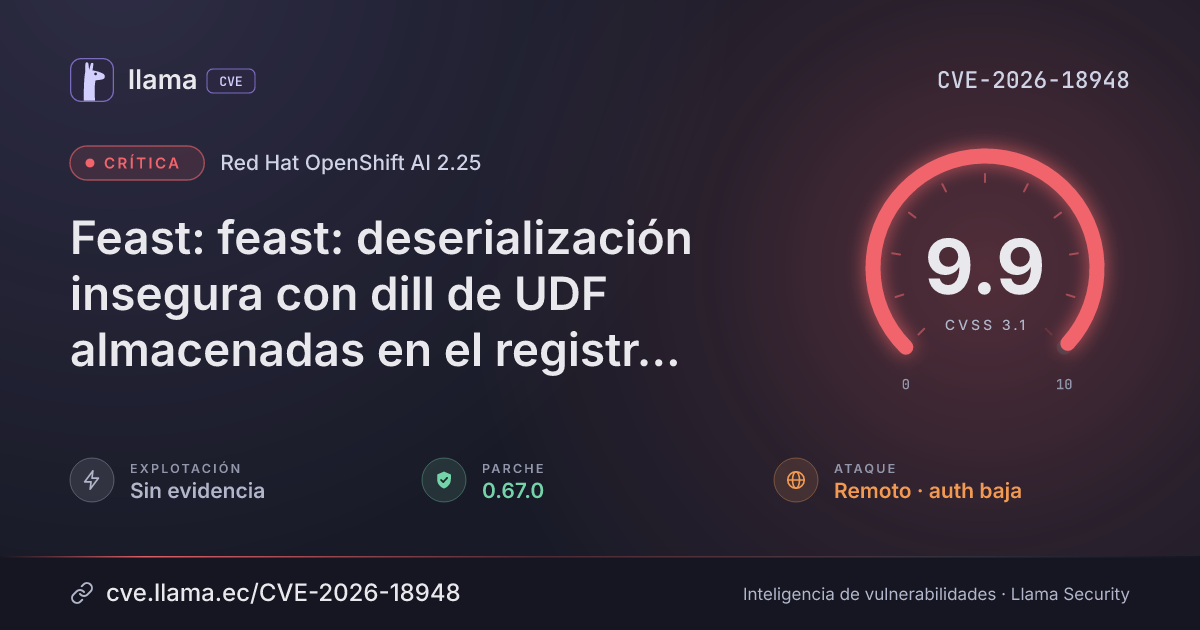
CVE-2026-18948

Feast: feast: unsafe dill deserialization of registry-stored udfs — rce on feature server and registry server

Texto original en inglés · Ver en español

Solo en configuraciones específicasParche disponibleunsafe deserialization
Descargar PNG JSON
CVSS 3.1
9.9
Crítica
CVSS:3.1/AV:N/AC:L/PR:L/UI:N/S:C/C:H/I:H/A:H Fuente: CNA
ExplotaciónSin evidenciaSSVC: ninguna · no figura en CISA KEV
Exploits públicos0Ninguno conocido
Parche1 versiónPrimer parche a 64 d de la divulgación
Exposición102 dDesde la divulgación, 10 ago 2026, 3:44 p. m.
Detección73 dDesde la divulgación hasta su ingreso al índice
Decisión SSVCSeguir de cerca
Monitorear y programar la remediación
Sin explotación conocida, no automatizable e impacto técnico total. Hay versiones corregidas disponibles.
Esto huele a fin de semana trabajando si lo ignoras.Si fuera un examen, esto vale media nota.
Timeline

Ciclo de vida de la vulnerabilidad

Hoy
Divulgación
Publicada
Evaluación SSVC
Modificada
Explotación
Remediación
Parche 0.67.0
Monitoreo
Detectada
Fuente: OSV
Verificada
10 ago 26
11 ago 26
13 oct 26
22 oct 26
3 nov 26
19 nov 26
21 nov 26
10 ago 26
5 sept 26
1 oct 26
27 oct 26
21 nov 26
FechaFaseEventoDetalle
Divulgación Publicada CVE-2026-18948 divulgada · CVSS 9.9 (CNA)
Divulgación Evaluación SSVC CISA-ADP · explotación ninguna
Remediación Parche 0.67.0 feast · 64 d desde divulgación
Monitoreo Detectada Ingresó al índice
Monitoreo Fuente: OSV Registro visto por primera vez en OSV
Divulgación Modificada Última actualización del registro
Monitoreo Verificada Última verificación contra las fuentes
Resumen

A flaw was found in Feast. The system improperly deserializes user-defined functions (UDFs) stored in its registry, which are serialized using the 'dill' library. This allows a remote attacker to store a malicious UDF, leading to unauthenticated arbitrary code execution on the feature server in default configurations. An authenticated attacker can also achieve arbitrary code execution on the registry server by bypassing authorization checks during deserialization. This vulnerability can result in cross-tenant data access and lateral movement within the system.

Affects feast before 0.67.0: feature servers running the default no_auth configuration, and registry servers with auth.type kubernetes or oidc. Fixed in 0.67.0.

¿Qué significa?A user-defined function (UDF) stored in the Feast registry is deserialized with dill without safe checks, so crafted content can run code on the feature server or registry server pod.
¿Quién está afectado?Feast versions before 0.67.0 are affected. Feature servers using the default no_auth configuration are described as affected, and registry servers with auth.type kubernetes or oidc are affected for any authenticated principal. To check, look at the installed feast version and the auth.type setting in the Feast configuration generated by the operator.
¿Qué hacer?Upgrade feast to 0.67.0, the fixed version named for this vulnerability.
disagreeThe advisory description says the feature server attack needs no authentication, while the CVSS vector records privileges required as low (PR:L). Both statements appear in the sources, and the facts do not resolve which is correct.
Contexto

Condiciones y alcance

Condiciones necesarias para que el fallo sea explotable
01
Feature server running with default no_auth configuration, so storing a UDF requires no authentication.“When combined with F-04 (default no_auth), step 1 requires no authentication at all.”
02
Registry server with auth.type kubernetes or oidc enabled; the attacker must be an authenticated principal.“Even with auth.type: kubernetes/oidc enabled, any authenticated principal regardless of Feast permissions achieves RCE on the registry-server pod.”
¿Quién debe revisar?Teams running Feast feature or registry servers, including Red Hat OpenShift AI feature servers, especially those with on-demand, stream or batch feature views that store Python UDFs in the registry.
MitigaciónEnforce auth.type kubernetes in the operator-generated Feast configuration and deny registry writes by default.
Discrepancias entre fuentesdescription-says-unauthenticated-vector-says-PR:L
Vector CVSS 3.1

Desglose de métricas

Opción resaltada = valor del vector · izquierda = peor caso · CNA
Vector de ataqueAV:N
RedAdyacenteLocalFísica
ComplejidadAC:L
BajaAlta
PrivilegiosPR:L
NingunoBajosAltos
InteracciónUI:N
NingunaRequerida
AlcanceS:C
CambiadoSin cambio
ConfidencialidadC:H
AltoBajoNinguno
IntegridadI:H
AltoBajoNinguno
DisponibilidadA:H
AltoBajoNinguno
Score de explotaciónQué tan fácil y probable es que la exploten
8.7/ 10Muy alto
Vector 8.7 (muy fácil) · sin evidencia de explotación.
Versiones

Rangos afectados

Afectada Corregida Última
feast< 0.67.0
0.67.0
0.68.0
Remediación

Estado del parche por paquete

Paquete / productoEstadoCorregida enDesde divulgaciónÚltima versión
pypifeast
Corregida 0.67.0 64 d 0.68.0 no afectada
Versiones corregidas0.67.0
Explotación

Arsenal público

Sin exploits, módulos ni PoC públicos conocidos a la fecha de verificación.

Registro
MitigaciónConfigure Feast to enforce `auth.type: kubernetes` in the operator-generated configuration and deny registry writes by default. This measure limits the attack surface by requiring proper authentication and authorization for registry modifications, preventing the deserialization of malicious user-defined functions.redhat
Referencias
Advisoryhttps://access.redhat.com/errata/RHSA-2026:53261
Advisoryhttps://access.redhat.com/errata/RHSA-2026:53262
Advisoryhttps://access.redhat.com/errata/RHSA-2026:53263
Advisoryhttps://access.redhat.com/errata/RHSA-2026:60520
Análisishttps://bugzilla.redhat.com/show_bug.cgi?id=2511167
Otrahttps://access.redhat.com/security/cve/CVE-2026-18948

Las referencias externas se muestran para copiar: cve.llama.ec no lo redirige a otros sitios.