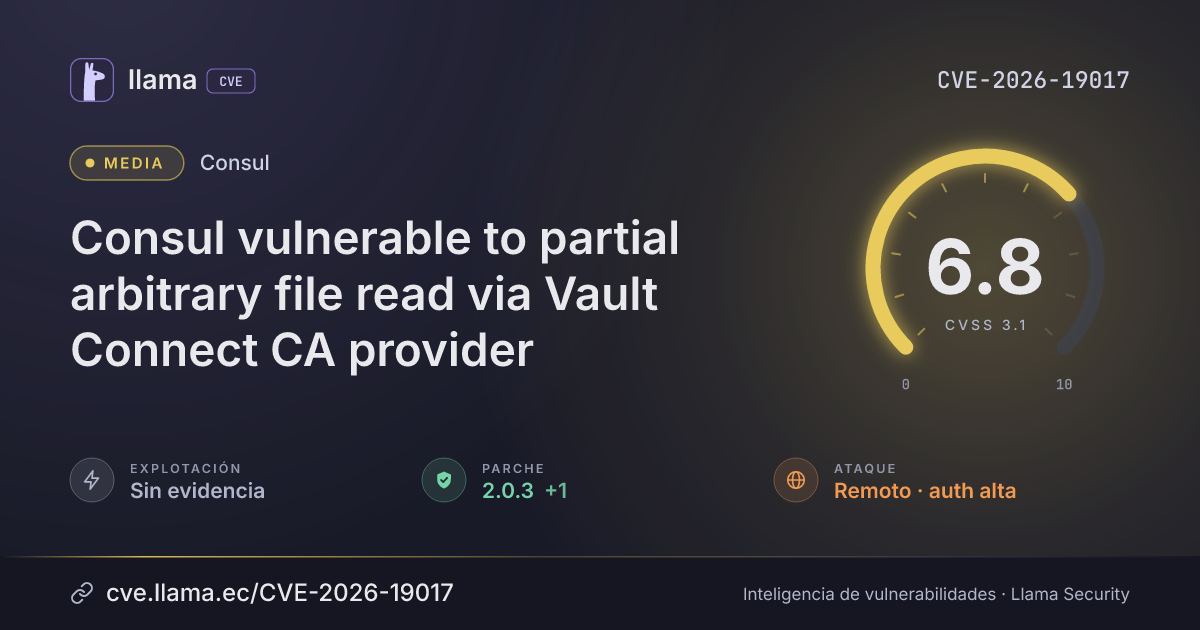
CVE-2026-19017
Consul vulnerable to partial arbitrary file read via Vault Connect CA provider
CVSS:3.1/AV:N/AC:L/PR:H/UI:N/S:C/C:H/I:N/A:N
Fuente: CNA
Ciclo de vida de la vulnerabilidad
| Fecha | Fase | Evento | Detalle |
|---|---|---|---|
| Divulgación | Publicada | CVE-2026-19017 divulgada · CVSS 6.8 (CNA) | |
| Divulgación | Evaluación SSVC | CISA-ADP · explotación ninguna | |
| Divulgación | Modificada | Última actualización del registro | |
| Monitoreo | Detectada | Ingresó al índice |
Consul Community Edition and Consul Enterprise 1.18.21 through 2.0.2 are vulnerable to a partial arbitrary file read when configured to use the Vault Connect CA provider with JWT or AppRole authentication. A privileged attacker with `operator:write` permission may direct Consul to read and forward credential files outside the intended scope, potentially leading to the exfiltration of sensitive secrets from the Consul server host. This vulnerability, CVE-2026-19017, is fixed in Consul 2.0.3 and Consul Enterprise 1.21.17, 1.22.11, and 2.0.3.
Desglose de métricas
Rangos afectados
Estado del parche por paquete
| Paquete / producto | Estado | Corregida en | Desde divulgación | Última versión |
|---|---|---|---|---|
Consul |
Corregida | 2.0.3 | — | — |
Consul Enterprise |
Corregida | 1.21.17 | — | — |
1.21.172.0.3Arsenal público
Sin exploits, módulos ni PoC públicos conocidos a la fecha de verificación.
https://discuss.hashicorp.com/t/hcsec-2026-25-multiple-vulnerabilities-impacting-hashicorp-consul/77629Las referencias externas se muestran para copiar: cve.llama.ec no lo redirige a otros sitios.