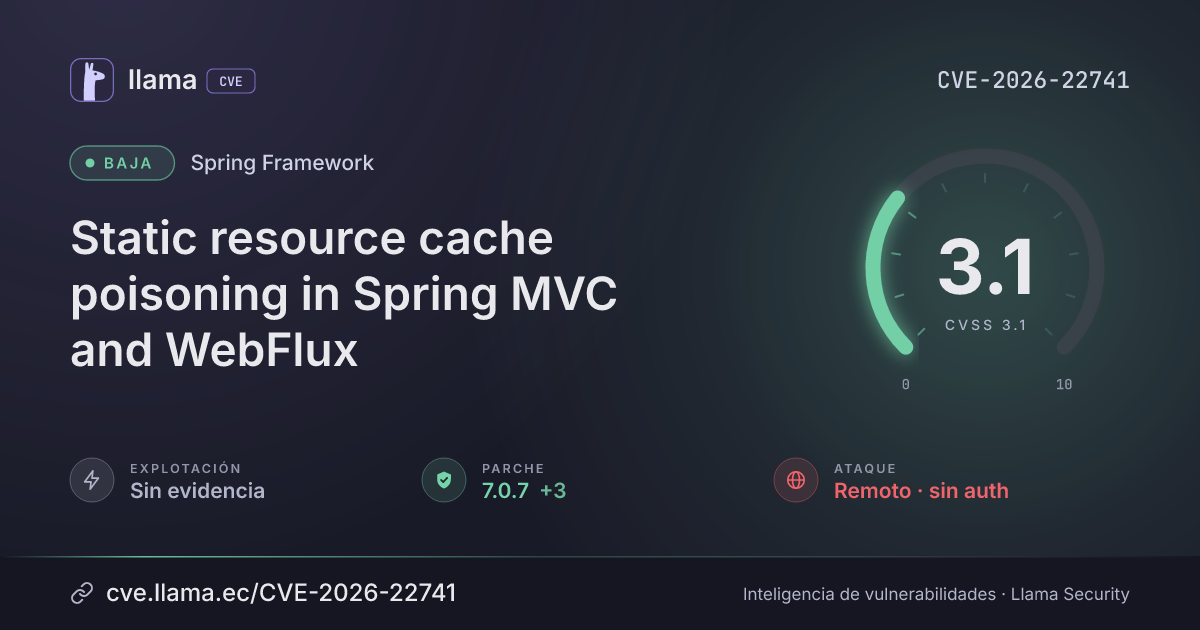
CVE-2026-22741
Static resource cache poisoning in Spring MVC and WebFlux
CVSS:3.1/AV:N/AC:H/PR:N/UI:R/S:U/C:N/I:N/A:L
Fuente: CNA
Ciclo de vida de la vulnerabilidad
| Fecha | Fase | Evento | Detalle |
|---|---|---|---|
| Remediación | Parche 6.2.18 | org.springframework:spring-webflux · -12 d desde divulgación | |
| Remediación | Parche 7.0.7 | org.springframework:spring-webflux · -12 d desde divulgación | |
| Divulgación | Publicada | CVE-2026-22741 divulgada · CVSS 3.1 (CNA) | |
| Divulgación | Evaluación SSVC | CISA-ADP · explotación ninguna | |
| Divulgación | Modificada | Última actualización del registro | |
| Monitoreo | Detectada | Ingresó al índice |
Spring MVC and WebFlux applications are vulnerable to cache poisoning when resolving static resources. More precisely, an application can be vulnerable when all the following are true: * the application is using Spring MVC or Spring WebFlux * the application is configuring the resource chain support https://docs.spring.io/spring-framework/reference/web/webmvc/mvc-config/static-resources.html#page-title with caching enabled * the application adds support for encoded resources resolution * the resource cache must be empty when the attacker has access to the application When all the conditions above are met, the attacker can send malicious requests and poison the resource cache with resources using the wrong encoding. This can cause a denial of service by breaking the front-end application for clients.
Desglose de métricas
Rangos afectados
Estado del parche por paquete
| Paquete / producto | Estado | Corregida en | Desde divulgación | Última versión |
|---|---|---|---|---|
mavenorg.springframework:spring-webflux |
Corregida | 6.2.18, 7.0.7 | -12 d · -12 d | 7.1.0 no afectada |
mavenorg.springframework:spring-webmvc |
Corregida | 6.2.18, 7.0.7 | -12 d · -12 d | 7.1.0 no afectada |
5.3.486.1.276.2.187.0.7Arsenal público
Sin exploits, módulos ni PoC públicos conocidos a la fecha de verificación.
https://spring.io/security/cve-2026-22741https://nvd.nist.gov/vuln-metrics/cvss/v3-calculator?vector=AV:N/AC:H/PR:N/UI:R/S:U/C:N/I:N/A:L&version=3.1Las referencias externas se muestran para copiar: cve.llama.ec no lo redirige a otros sitios.