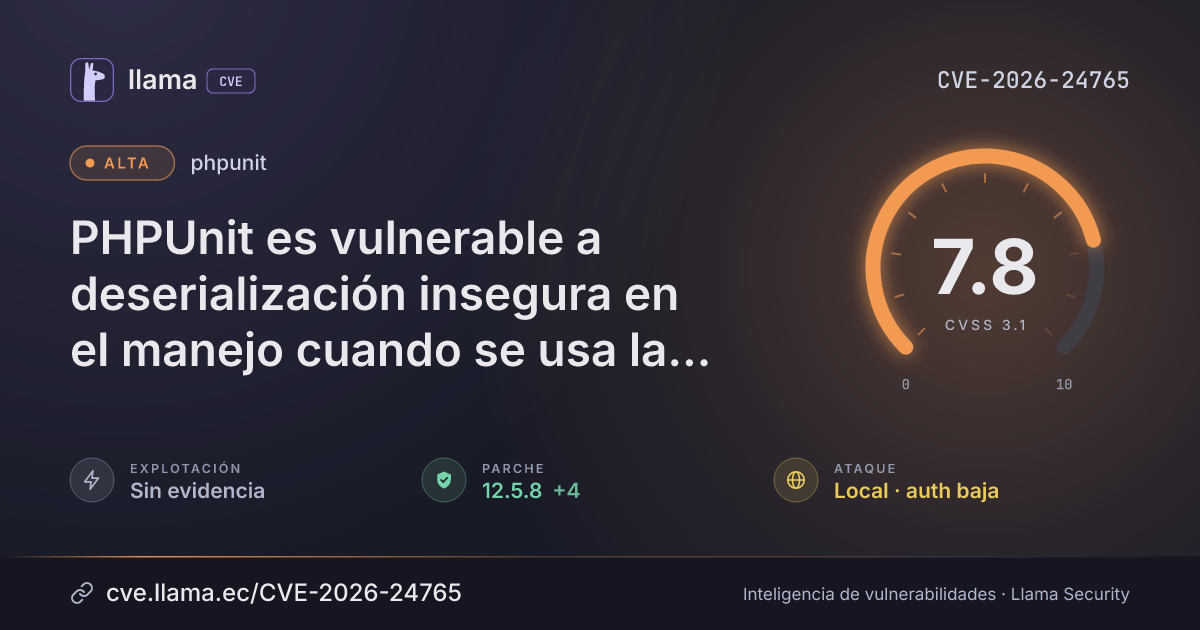
CVE-2026-24765
PHPUnit Vulnerable to Unsafe Deserialization in PHPT Code Coverage Handling
Texto original en inglés · Ver en español
CVSS:3.1/AV:L/AC:L/PR:L/UI:N/S:U/C:H/I:H/A:H
Fuente: CNA
Ciclo de vida de la vulnerabilidad
| Fecha | Fase | Evento | Detalle |
|---|---|---|---|
| Divulgación | Publicada | CVE-2026-24765 divulgada · CVSS 7.8 (CNA) | |
| Divulgación | Evaluación SSVC | CISA-ADP · explotación ninguna | |
| Divulgación | Modificada | Última actualización del registro | |
| Monitoreo | Detectada | Ingresó al índice |
PHPUnit is a testing framework for PHP. A vulnerability has been discovered in versions prior to 12.5.8, 11.5.50, 10.5.62, 9.6.33, and 8.5.52 involving unsafe deserialization of code coverage data in PHPT test execution. The vulnerability exists in the `cleanupForCoverage()` method, which deserializes code coverage files without validation, potentially allowing remote code execution if malicious `.coverage` files are present prior to the execution of the PHPT test. The vulnerability occurs when a `.coverage` file, which should not exist before test execution, is deserialized without the `allowed_classes` parameter restriction. An attacker with local file write access can place a malicious serialized object with a `__wakeup()` method into the file system, leading to arbitrary code execution during test runs with code coverage instrumentation enabled. This vulnerability requires local file write access to the location where PHPUnit stores or expects code coverage files for PHPT tests. This can occur through CI/CD pipeline attacks, the local development environment, and/or compromised dependencies. Rather than just silently sanitizing the input via `['allowed_classes' => false]`, the maintainer has chosen to make the anomalous state explicit by treating pre-existing `.coverage` files for PHPT tests as an error condition. Starting in versions in versions 12.5.8, 11.5.50, 10.5.62, 9.6.33, when a `.coverage` file is detected for a PHPT test prior to execution, PHPUnit will emit a clear error message identifying the anomalous state. Organizations can reduce the effective risk of this vulnerability through proper CI/CD configuration, including ephemeral runners, code review enforcement, branch protection, artifact isolation, and access control.
Desglose de métricas
Rangos afectados
Estado del parche por paquete
| Paquete / producto | Estado | Corregida en | Desde divulgación | Última versión |
|---|---|---|---|---|
phpunit |
Corregida | 8.5.52, 9.6.33, 10.5.62, 11.5.50, 12.5.8 | — | — |
8.5.529.6.3310.5.6211.5.5012.5.8Arsenal público
Sin exploits, módulos ni PoC públicos conocidos a la fecha de verificación.
https://github.com/sebastianbergmann/phpunit/security/advisories/GHSA-vvj3-c3rp-c85phttps://github.com/sebastianbergmann/phpunit/commit/3141742e00620e2968d3d2e732d320de76685fdahttps://github.com/sebastianbergmann/phpunit/releases/tag/10.5.63https://github.com/sebastianbergmann/phpunit/releases/tag/11.5.50https://github.com/sebastianbergmann/phpunit/releases/tag/12.5.8https://github.com/sebastianbergmann/phpunit/releases/tag/8.5.52https://github.com/sebastianbergmann/phpunit/releases/tag/9.6.33https://lists.debian.org/debian-lts-announce/2026/02/msg00009.htmlLas referencias externas se muestran para copiar: cve.llama.ec no lo redirige a otros sitios.