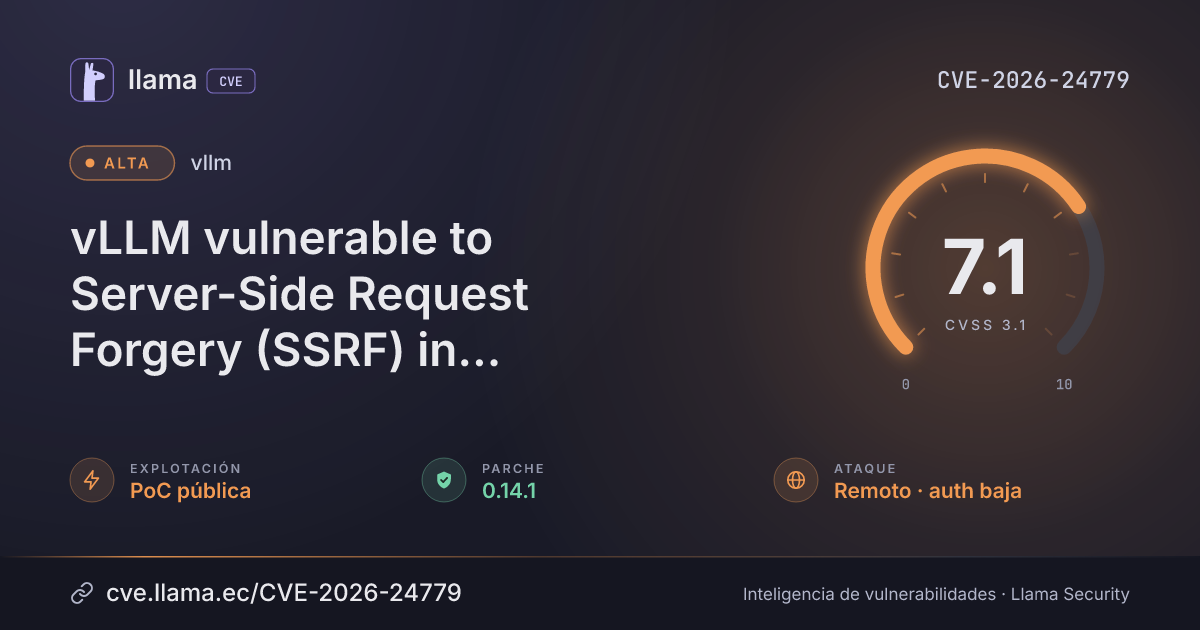
CVE-2026-24779
vLLM vulnerable to Server-Side Request Forgery (SSRF) in MediaConnector
CVSS:3.1/AV:N/AC:L/PR:L/UI:N/S:U/C:H/I:N/A:L
Fuente: CNA
CVSS:3.1/AV:N/AC:L/PR:L/UI:N/S:U/C:H/I:N/A:LCiclo de vida de la vulnerabilidad
| Fecha | Fase | Evento | Detalle |
|---|---|---|---|
| Remediación | Parche 0.14.1 | vllm · -3 d desde divulgación | |
| Divulgación | Publicada | CVE-2026-24779 divulgada · CVSS 7.1 (CNA) | |
| Divulgación | Evaluación SSVC | CISA-ADP · explotación PoC pública | |
| Divulgación | Modificada | Última actualización del registro | |
| Monitoreo | Detectada | Ingresó al índice |
vLLM is an inference and serving engine for large language models (LLMs). Prior to version 0.14.1, a Server-Side Request Forgery (SSRF) vulnerability exists in the `MediaConnector` class within the vLLM project's multimodal feature set. The load_from_url and load_from_url_async methods obtain and process media from URLs provided by users, using different Python parsing libraries when restricting the target host. These two parsing libraries have different interpretations of backslashes, which allows the host name restriction to be bypassed. This allows an attacker to coerce the vLLM server into making arbitrary requests to internal network resources. This vulnerability is particularly critical in containerized environments like `llm-d`, where a compromised vLLM pod could be used to scan the internal network, interact with other pods, and potentially cause denial of service or access sensitive data. For example, an attacker could make the vLLM pod send malicious requests to an internal `llm-d` management endpoint, leading to system instability by falsely reporting metrics like the KV cache state. Version 0.14.1 contains a patch for the issue.
Desglose de métricas
Rangos afectados
Estado del parche por paquete
| Paquete / producto | Estado | Corregida en | Desde divulgación | Última versión |
|---|---|---|---|---|
pypivllm |
Corregida | 0.14.1 | -3 d | 0.33.0 no afectada |
0.14.1Arsenal público
Sin exploits, módulos ni PoC públicos conocidos a la fecha de verificación.
https://access.redhat.com/errata/RHSA-2026:3461https://access.redhat.com/errata/RHSA-2026:3462https://access.redhat.com/errata/RHSA-2026:30089https://access.redhat.com/errata/RHSA-2026:30088https://access.redhat.com/errata/RHSA-2026:30087https://access.redhat.com/errata/RHSA-2026:10184https://access.redhat.com/errata/RHSA-2026:42644https://github.com/vllm-project/vllm/security/advisories/GHSA-qh4c-xf7m-gxfchttps://bugzilla.redhat.com/show_bug.cgi?id=2433624https://github.com/vllm-project/vllm/pull/32746https://github.com/vllm-project/vllm/commit/f46d576c54fb8aeec5fc70560e850bed38ef17d7https://access.redhat.com/security/cve/CVE-2026-24779Ver 1 referencias más
https://security.access.redhat.com/data/csaf/v2/vex/2026/cve-2026-24779.jsonLas referencias externas se muestran para copiar: cve.llama.ec no lo redirige a otros sitios.