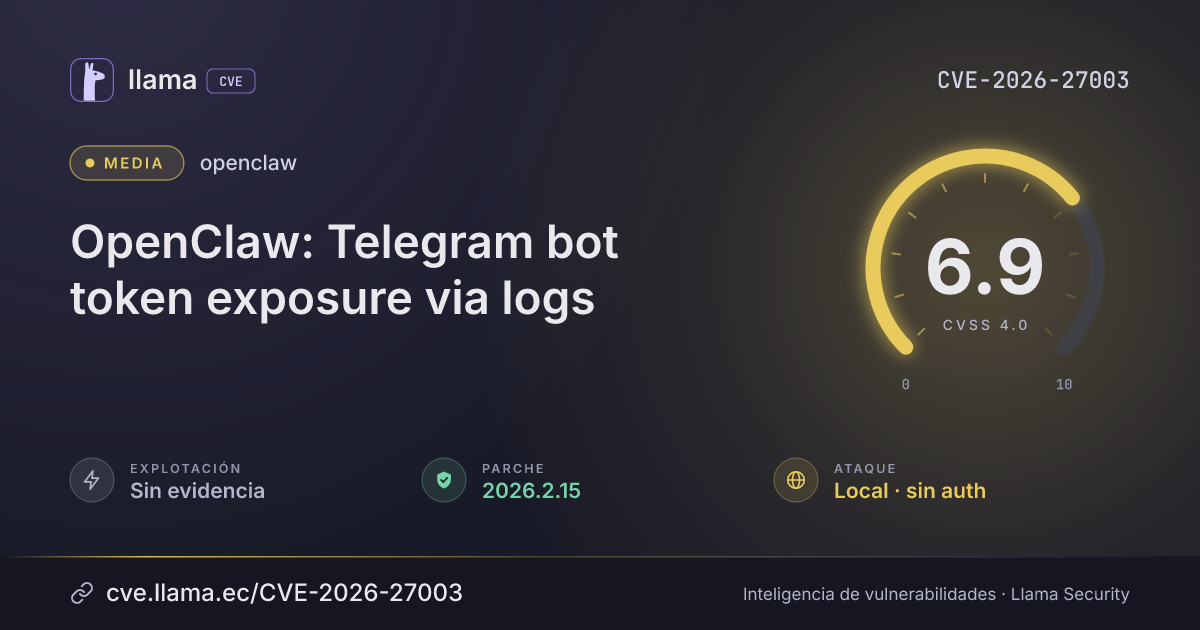
CVE-2026-27003
OpenClaw: Telegram bot token exposure via logs
CVSS:4.0/AV:L/AC:L/AT:N/PR:N/UI:N/VC:H/VI:N/VA:N/SC:N/SI:N/SA:N
Fuente: CNA
Ciclo de vida de la vulnerabilidad
| Fecha | Fase | Evento | Detalle |
|---|---|---|---|
| Remediación | Parche 2026.2.15 | openclaw · -3 d desde divulgación | |
| Divulgación | Publicada | CVE-2026-27003 divulgada · CVSS 6.9 (CNA) | |
| Divulgación | Evaluación SSVC | CISA-ADP · explotación ninguna | |
| Divulgación | Modificada | Última actualización del registro | |
| Monitoreo | Detectada | Ingresó al índice |
OpenClaw is a personal AI assistant. Telegram bot tokens can appear in error messages and stack traces (for example, when request URLs include `https://api.telegram.org/bot<token>/...`). Prior to version 2026.2.15, OpenClaw logged these strings without redaction, which could leak the bot token into logs, crash reports, CI output, or support bundles. Disclosure of a Telegram bot token allows an attacker to impersonate the bot and take over Bot API access. Users should upgrade to version 2026.2.15 to obtain a fix and rotate the Telegram bot token if it may have been exposed.
Desglose de métricas
Rangos afectados
Estado del parche por paquete
| Paquete / producto | Estado | Corregida en | Desde divulgación | Última versión |
|---|---|---|---|---|
npmopenclaw |
Corregida | 2026.2.15 | -3 d | 2026.11.3 no afectada |
2026.2.15Arsenal público
Sin exploits, módulos ni PoC públicos conocidos a la fecha de verificación.
https://github.com/openclaw/openclaw/security/advisories/GHSA-chf7-jq6g-qrwvhttps://github.com/openclaw/openclaw/commit/cf69907015b659e5025efb735ee31bd05c4ee3d5Las referencias externas se muestran para copiar: cve.llama.ec no lo redirige a otros sitios.