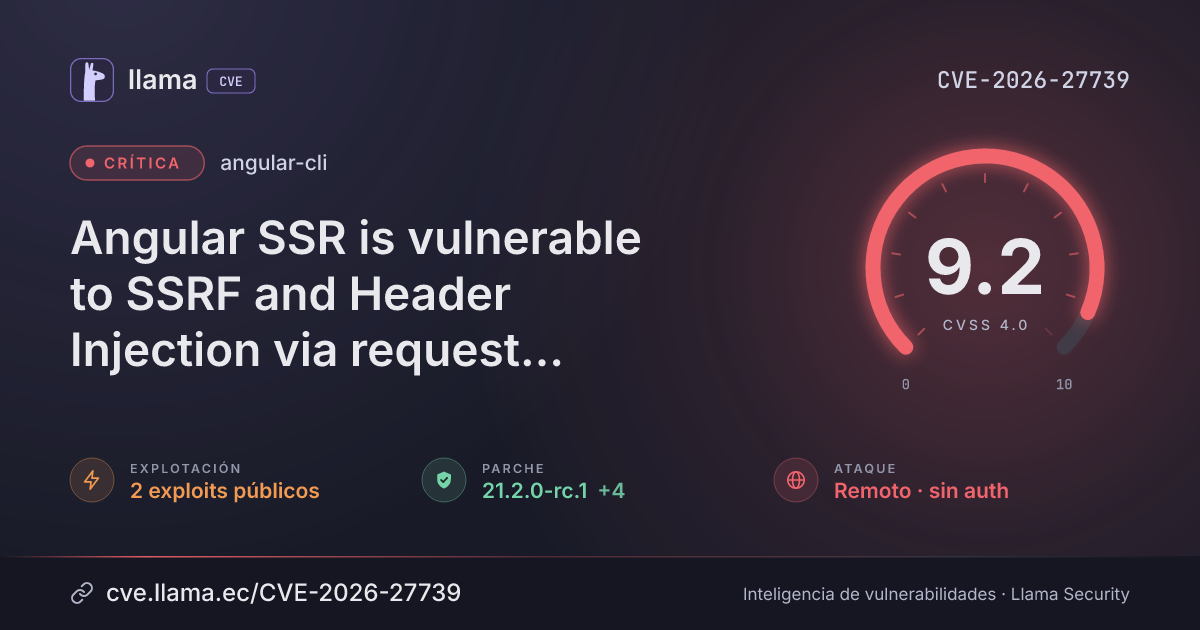
CVE-2026-27739
Angular SSR is vulnerable to SSRF and Header Injection via request handling pipeline
CVSS:4.0/AV:N/AC:L/AT:N/PR:N/UI:N/VC:H/VI:L/VA:N/SC:H/SI:L/SA:N
Fuente: CNA
Ciclo de vida de la vulnerabilidad
| Fecha | Fase | Evento | Detalle |
|---|---|---|---|
| Remediación | Parche 19.2.21 | @angular/ssr · -2 d desde divulgación | |
| Remediación | Parche 20.3.17 | @angular/ssr · -2 d desde divulgación | |
| Remediación | Parche 21.1.5 | @angular/ssr · -2 d desde divulgación | |
| Remediación | Parche 21.2.0-rc.1 | @angular/ssr · -2 d desde divulgación | |
| Divulgación | Publicada | CVE-2026-27739 divulgada · CVSS 9.2 (CNA) | |
| Divulgación | Evaluación SSVC | CISA-ADP · explotación ninguna | |
| Divulgación | Modificada | Última actualización del registro | |
| Monitoreo | Detectada | Ingresó al índice |
The Angular SSR is a server-rise rendering tool for Angular applications. Versions prior to 21.2.0-rc.1, 21.1.5, 20.3.17, and 19.2.21 have a Server-Side Request Forgery (SSRF) vulnerability in the Angular SSR request handling pipeline. The vulnerability exists because Angular’s internal URL reconstruction logic directly trusts and consumes user-controlled HTTP headers specifically the Host and `X-Forwarded-*` family to determine the application's base origin without any validation of the destination domain. Specifically, the framework didn't have checks for the host domain, path and character sanitization, and port validation. This vulnerability manifests in two primary ways: implicit relative URL resolution and explicit manual construction. When successfully exploited, this vulnerability allows for arbitrary internal request steering. This can lead to credential exfiltration, internal network probing, and a confidentiality breach. In order to be vulnerable, the victim application must use Angular SSR (Server-Side Rendering), the application must perform `HttpClient` requests using relative URLs OR manually construct URLs using the unvalidated `Host` / `X-Forwarded-*` headers using the `REQUEST` object, the application server must be reachable by an attacker who can influence these headers without strict validation from a front-facing proxy, and the infrastructure (Cloud, CDN, or Load Balancer) must not sanitize or validate incoming headers. Versions 21.2.0-rc.1, 21.1.5, 20.3.17, and 19.2.21 contain a patch. Some workarounds are available. Avoid using `req.headers` for URL construction. Instead, use trusted variables for base API paths. Those who cannot upgrade immediately should implement a middleware in their `server.ts` to enforce numeric ports and validated hostnames.
Desglose de métricas
Rangos afectados
Estado del parche por paquete
| Paquete / producto | Estado | Corregida en | Desde divulgación | Última versión |
|---|---|---|---|---|
npm@angular/ssr |
Corregida | 19.2.21, 20.3.17, 21.1.5, 21.2.0-rc.1 | -2 d · -2 d · -2 d · -2 d | 22.2.7 no afectada |
npm@nguniversal/common |
Sin parche | — | — | 16.2.0 afectada |
npm@nguniversal/express-engine |
Sin parche | — | — | 16.2.0 afectada |
19.2.2120.3.1721.1.521.2.0-rc.021.2.0-rc.1Arsenal público
Ver los 2 repositorios de GitHub
Los repositorios públicos incluyen exploits, escáneres, laboratorios y reglas de detección. No ejecute código de terceros sin revisarlo en un entorno aislado.
https://github.com/angular/angular-cli/security/advisories/GHSA-x288-3778-4hhxhttps://angular.dev/best-practices/security#preventing-server-side-request-forgery-ssrfhttps://github.com/Mr-Red-007/CVE-2026-27739-POChttps://github.com/mr-redoo7/CVE-2026-27739-POChttps://github.com/angular/angular-cli/pull/32516https://developer.mozilla.org/en-US/docs/Web/Security/Attacks/SSRFLas referencias externas se muestran para copiar: cve.llama.ec no lo redirige a otros sitios.