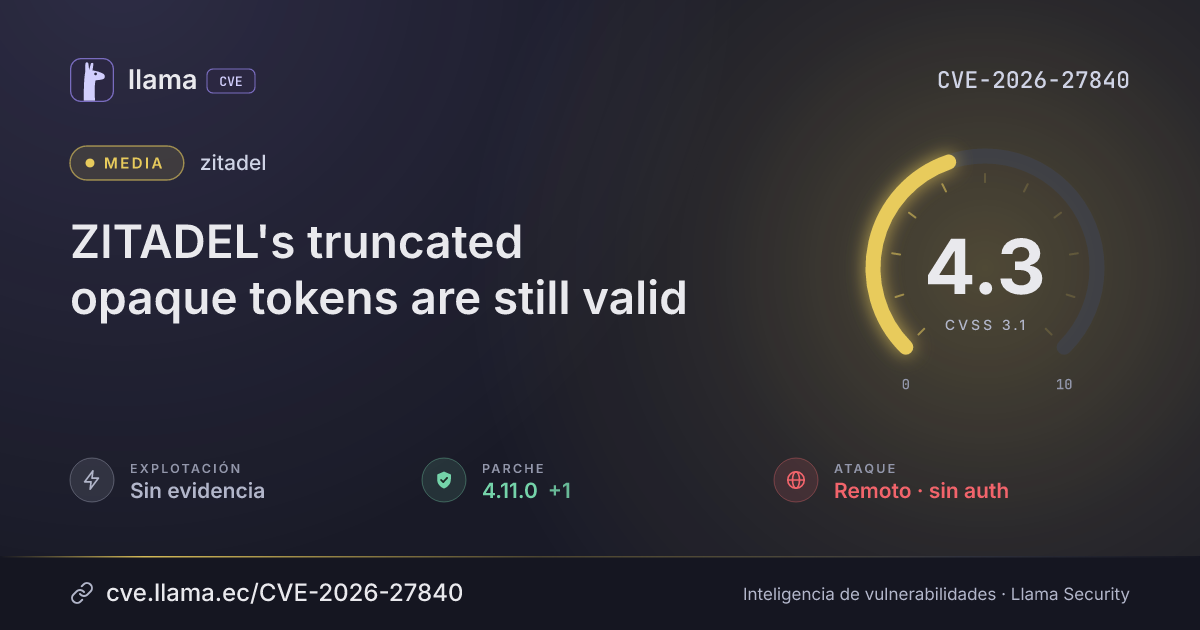
CVE-2026-27840
ZITADEL's truncated opaque tokens are still valid
CVSS:3.1/AV:N/AC:L/PR:N/UI:R/S:U/C:N/I:L/A:N
Fuente: CNA
Ciclo de vida de la vulnerabilidad
| Fecha | Fase | Evento | Detalle |
|---|---|---|---|
| Divulgación | Publicada | CVE-2026-27840 divulgada · CVSS 4.3 (CNA) | |
| Divulgación | Evaluación SSVC | CISA-ADP · explotación ninguna | |
| Divulgación | Modificada | Última actualización del registro | |
| Monitoreo | Detectada | Ingresó al índice |
ZITADEL is an open source identity management platform. Starting in version 2.31.0 and prior to versions 3.4.7 and 4.11.0, opaque OIDC access tokens in the v2 format truncated to 80 characters are still considered valid. Zitadel uses a symmetric AES encryption for opaque tokens. The cleartext payload is a concatenation of a couple of identifiers, such as a token ID and user ID. Internally Zitadel has 2 different versions of token payloads. v1 tokens are no longer created, but are still verified as to not invalidate existing session after upgrade. The cleartext payload has a format of `<token_id>:<user_id>`. v2 tokens distinguished further where the `token_id` is of the format `v2_<oidc_session_id>-at_<access_token_id>`. V1 token authZ/N session data is retrieved from the database using the (simple) `token_id` value and `user_id` value. The `user_id` (called `subject` in some parts of our code) was used as being the trusted user ID. V2 token authZ/N session data is retrieved from the database using the `oidc_session_id` and `access_token_id` and in this case the `user_id` from the token is ignored and taken from the session data in the database. By truncating the token to 80 chars, the user_id is now missing from the cleartext of the v2 token. The back-end still accepts this for above reasons. This issue is not considered exploitable, but may look awkward when reproduced. The patch in versions 4.11.0 and 3.4.7 resolves the issue by verifying the `user_id` from the token against the session data from the database. No known workarounds are available.
Desglose de métricas
Rangos afectados
Estado del parche por paquete
| Paquete / producto | Estado | Corregida en | Desde divulgación | Última versión |
|---|---|---|---|---|
gogithub.com/zitadel/zitadel |
Sin parche | — | — | v1.87.5 afectada |
3.4.74.11.0Arsenal público
Sin exploits, módulos ni PoC públicos conocidos a la fecha de verificación.
https://github.com/zitadel/zitadel/security/advisories/GHSA-6mq3-xmgp-pjm5https://github.com/zitadel/zitadel/releases/tag/v3.4.7https://github.com/zitadel/zitadel/releases/tag/v4.11.0Las referencias externas se muestran para copiar: cve.llama.ec no lo redirige a otros sitios.