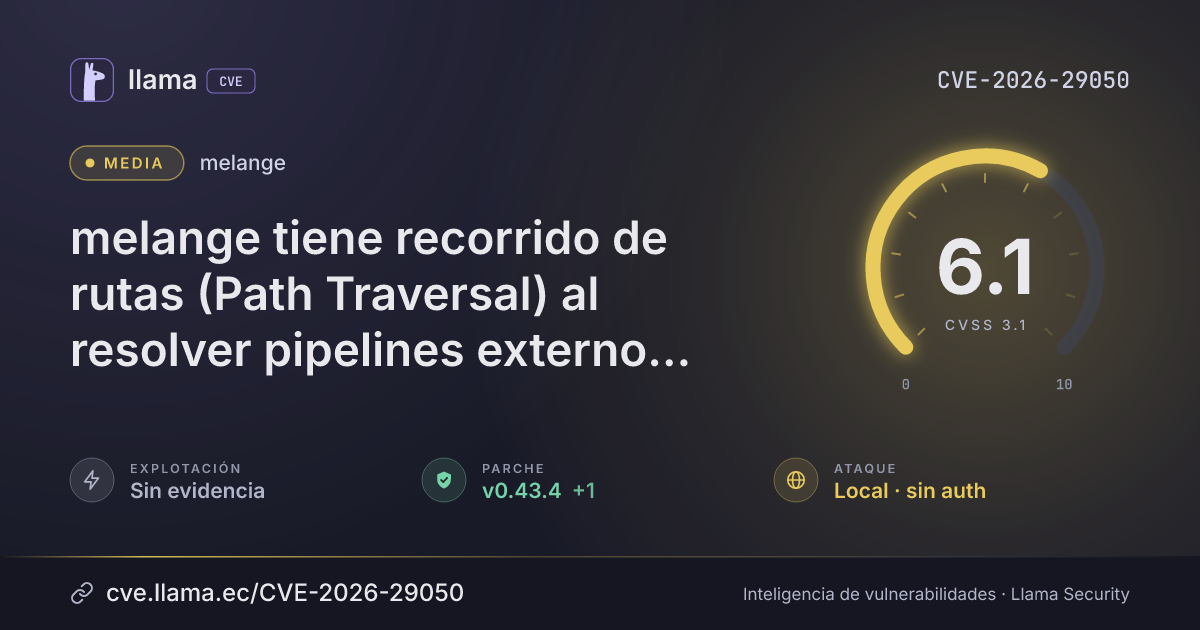
CVE-2026-29050
melange has Path Traversal When Resolving External Pipelines via Unvalidated pipeline[].uses
CVSS:3.1/AV:L/AC:L/PR:N/UI:R/S:U/C:H/I:L/A:N
Fuente: CNA
Ciclo de vida de la vulnerabilidad
| Fecha | Fase | Evento | Detalle |
|---|---|---|---|
| Remediación | Parche v0.43.4 | chainguard.dev/melange · -55 d desde divulgación | |
| Divulgación | Publicada | CVE-2026-29050 divulgada · CVSS 6.1 (CNA) | |
| Divulgación | Evaluación SSVC | CISA-ADP · explotación ninguna | |
| Divulgación | Modificada | Última actualización del registro | |
| Monitoreo | Detectada | Ingresó al índice |
melange allows users to build apk packages using declarative pipelines. Starting in version 0.32.0 and prior to version 0.43.4, an attacker who can influence a melange configuration file — for example through pull-request-driven CI or build-as-a-service scenarios — could set `pipeline[].uses` to a value containing `../` sequences or an absolute path. The `(*Compiled).compilePipeline` function in `pkg/build/compile.go` passed `uses` directly to `filepath.Join(pipelineDir, uses + ".yaml")` without validating the value, so the resolved path could escape each `--pipeline-dir` and read an arbitrary YAML-parseable file visible to the melange process. Because the loaded file is subsequently interpreted as a melange pipeline and its `runs:` block is executed via `/bin/sh -c` in the build sandbox, this additionally allowed shell commands sourced from an out-of-tree file to run during the build, bypassing the review boundary that normally covers the in-tree pipeline definition. The issue is fixed in melange v0.43.4 via commit 5829ca4. The fix rejects `uses` values that are absolute paths or contain `..`, and verifies (via `filepath.Rel` after `filepath.Clean`) that the resolved target remains within the pipeline directory. As a workaround, only run `melange build` against configuration files from trusted sources. In CI systems that build user-supplied melange configs, gate builds behind manual review of `pipeline[].uses` values and reject any containing `..` or leading `/`.
Desglose de métricas
Rangos afectados
Estado del parche por paquete
| Paquete / producto | Estado | Corregida en | Desde divulgación | Última versión |
|---|---|---|---|---|
gochainguard.dev/melange |
Corregida | v0.43.4 | -55 d | v0.64.1 no afectada |
0.43.4v0.43.4Arsenal público
Sin exploits, módulos ni PoC públicos conocidos a la fecha de verificación.
https://github.com/chainguard-dev/melange/security/advisories/GHSA-98f2-w9h9-7fp9Las referencias externas se muestran para copiar: cve.llama.ec no lo redirige a otros sitios.