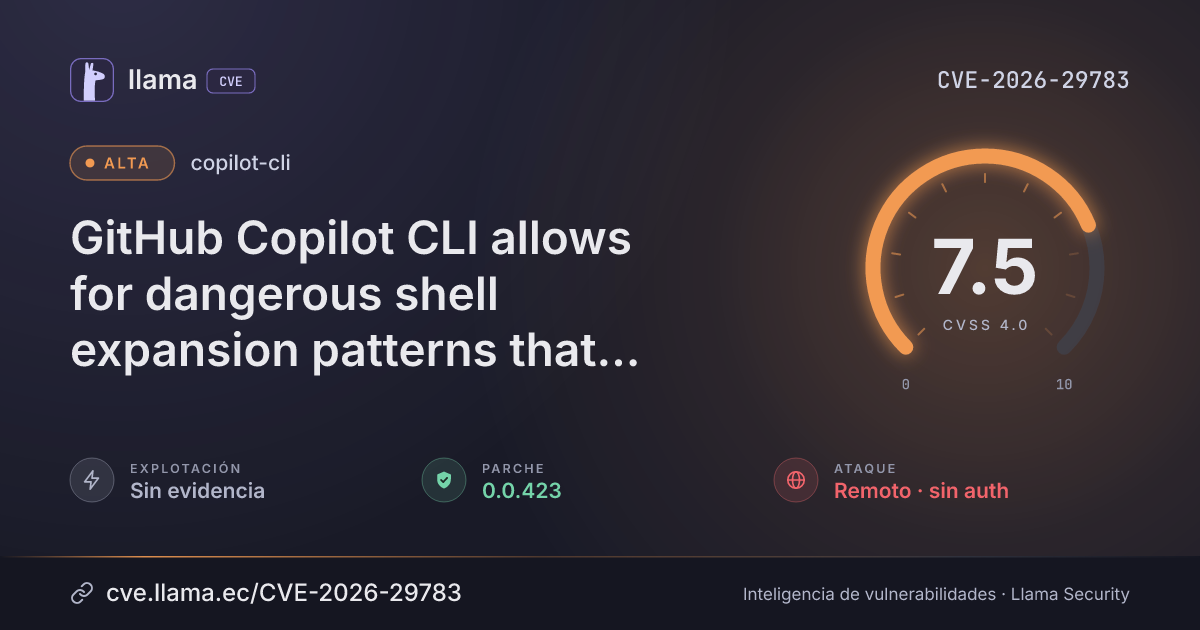
CVE-2026-29783
GitHub Copilot CLI allows for dangerous shell expansion patterns that enable arbitrary command execution
CVSS:4.0/AV:N/AC:L/AT:P/PR:N/UI:A/VC:H/VI:H/VA:H/SC:N/SI:N/SA:N
Fuente: CNA
Ciclo de vida de la vulnerabilidad
| Fecha | Fase | Evento | Detalle |
|---|---|---|---|
| Divulgación | Publicada | CVE-2026-29783 divulgada · CVSS 7.5 (CNA) | |
| Remediación | Parche 0.0.423 | @github/copilot · 0 d desde divulgación | |
| Divulgación | Evaluación SSVC | CISA-ADP · explotación ninguna | |
| Monitoreo | Detectada | Ingresó al índice | |
| Divulgación | Modificada | Última actualización del registro | |
| Monitoreo | Verificada | Última verificación contra las fuentes |
The shell tool within GitHub Copilot CLI versions prior to and including 0.0.422 can allow arbitrary code execution through crafted bash parameter expansion patterns. An attacker who can influence the commands executed by the agent (e.g., via prompt injection through repository files, MCP server responses, or user instructions) can exploit bash parameter transformation operators to execute hidden commands, bypassing the safety assessment that classifies commands as "read-only." This has been patched in version 0.0.423. The vulnerability stems from how the CLI's shell safety assessment evaluates commands before execution. The safety layer parses and classifies shell commands as either read-only (safe) or write-capable (requires user approval). However, several bash parameter expansion features can embed executable code within arguments to otherwise read-only commands, causing them to appear safe while actually performing arbitrary operations. The specific dangerous patterns are ${var@P}, ${var=value} / ${var:=value}, ${!var}, and nested $(cmd) or <(cmd) inside ${...} expansions. An attacker who can influence command text sent to the shell tool - for example, through prompt injection via malicious repository content (README files, code comments, issue bodies), compromised or malicious MCP server responses, or crafted user instructions containing obfuscated commands - could achieve arbitrary code execution on the user's workstation. This is possible even in permission modes that require user approval for write operations, since the commands can appear to use only read-only utilities to ultimately trigger write operations. Successful exploitation could lead to data exfiltration, file modification, or further system compromise.
Condiciones y alcance
Desglose de métricas
Rangos afectados
Estado del parche por paquete
| Paquete / producto | Estado | Corregida en | Desde divulgación | Última versión |
|---|---|---|---|---|
npm@github/copilot |
Corregida | 0.0.423 | 0 d | 1.0.112 no afectada |
0.0.423Arsenal público
Sin exploits, módulos ni PoC públicos conocidos a la fecha de verificación.
https://github.com/github/copilot-cli/security/advisories/GHSA-g8r9-g2v8-jv6fhttps://github.com/github/copilot-cli/releases/tag/v0.0.423Las referencias externas se muestran para copiar: cve.llama.ec no lo redirige a otros sitios.