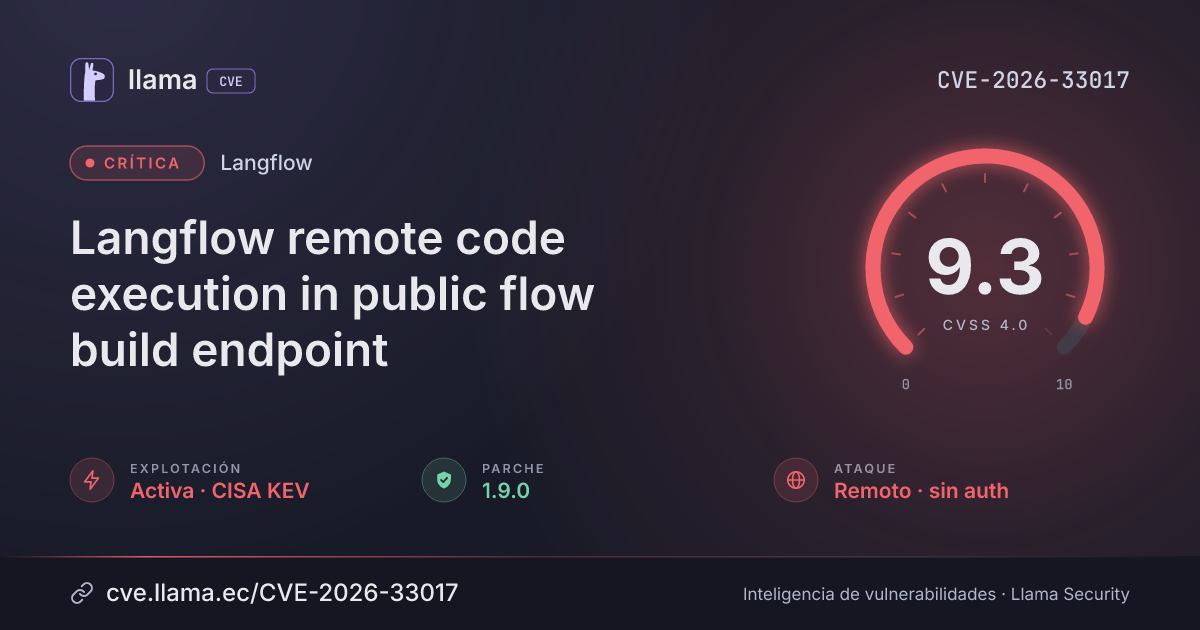
CVE-2026-33017
Langflow remote code execution in public flow build endpoint
An unauthenticated attacker can run arbitrary code on the server and take full control of the affected system.
CVSS:4.0/AV:N/AC:L/AT:N/PR:N/UI:N/VC:H/VI:H/VA:H/SC:L/SI:L/SA:L
Fuente: CNA
Ciclo de vida de la vulnerabilidad
| Fecha | Fase | Evento | Detalle |
|---|---|---|---|
| Divulgación | Publicada | CVE-2026-33017 divulgada · CVSS 9.3 (CNA) | |
| Explotación | CISA KEV | Agregada al catálogo de vulnerabilidades explotadas | |
| Remediación | Plazo KEV | Fecha límite de remediación para agencias federales (EE. UU.) | |
| Remediación | Parche 1.9.0 | langflow · 25 d desde divulgación | |
| Divulgación | Modificada | Última actualización del registro | |
| Explotación | Umbral EPSS | La probabilidad de explotación supera el 10 % | |
| Monitoreo | Detectada | Ingresó al índice | |
| Monitoreo | Verificada | Última verificación contra las fuentes |
Langflow, the AI agent and workflow builder, lets an attacker run arbitrary code on the server remotely without logging in, by sending crafted flow data to the public flow build endpoint. This can lead to full server compromise and theft of files, environment secrets and stored credentials, and the flaw is being exploited in attacks.
Affects Langflow (pip) 1.8.2 and earlier on instances with at least one public flow whose UUID is known to an attacker. Fixed in 1.9.0.
Descripción original del registro
Langflow is a tool for building and deploying AI-powered agents and workflows. In versions prior to 1.9.0, the POST /api/v1/build_public_tmp/{flow_id}/flow endpoint allows building public flows without requiring authentication. When the optional data parameter is supplied, the endpoint uses attacker-controlled flow data (containing arbitrary Python code in node definitions) instead of the stored flow data from the database. This code is passed to exec() with zero sandboxing, resulting in unauthenticated remote code execution. This is distinct from CVE-2025-3248, which fixed /api/v1/validate/code by adding authentication. The build_public_tmp endpoint is designed to be unauthenticated (for public flows) but incorrectly accepts attacker-supplied flow data containing arbitrary executable code. This issue has been fixed in version 1.9.0.
Condiciones y alcance
Desglose de métricas
Rangos afectados
Estado del parche por paquete
| Paquete / producto | Estado | Corregida en | Desde divulgación | Última versión |
|---|---|---|---|---|
pypilangflow |
Corregida | 1.9.0 | 25 d | 1.13.2 no afectada |
1.9.0Arsenal público
Sin exploits, módulos ni PoC públicos conocidos a la fecha de verificación.
https://github.com/langflow-ai/langflow/security/advisories/GHSA-vwmf-pq79-vjvxhttps://github.com/langflow-ai/langflow/commit/73b6612e3ef25fdae0a752d75b0fabd47328d4f0https://github.com/advisories/GHSA-rvqx-wpfh-mfx7Las referencias externas se muestran para copiar: cve.llama.ec no lo redirige a otros sitios.