CVE-2026-33634
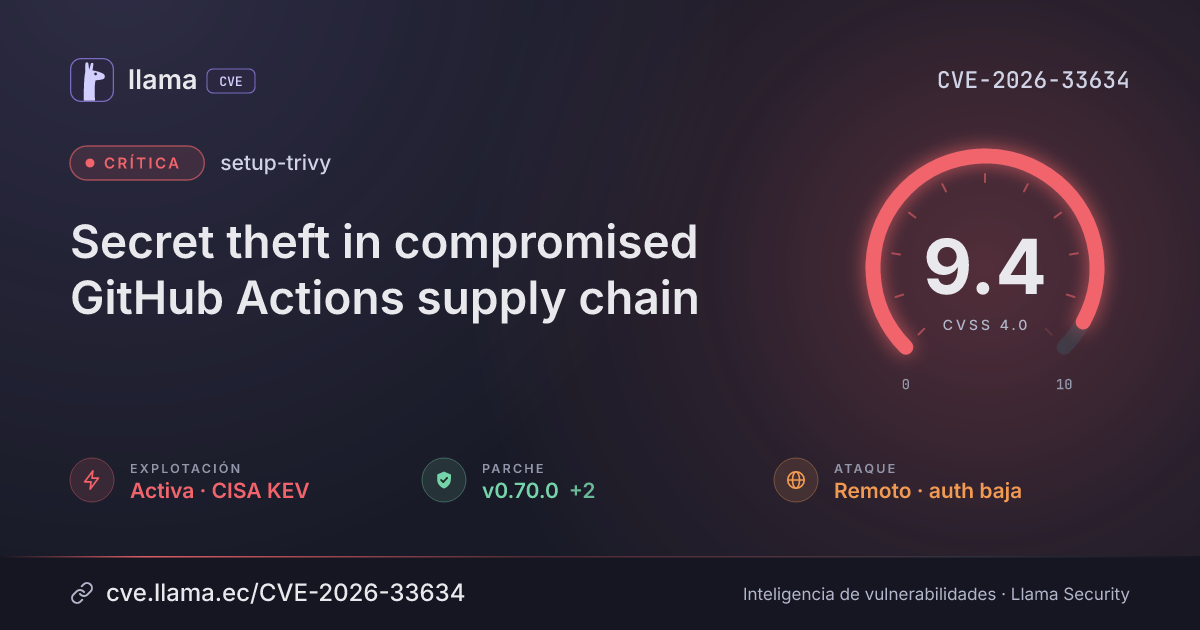
Secret theft in compromised GitHub Actions supply chain
An attacker could steal credentials and other secrets from pipelines that pulled or ran the compromised releases.
CVSS:4.0/AV:N/AC:L/AT:N/PR:L/UI:N/VC:H/VI:H/VA:H/SC:H/SI:H/SA:H
Fuente: CNA
CVSS:3.1/AV:N/AC:L/PR:L/UI:N/S:U/C:H/I:H/A:HCiclo de vida de la vulnerabilidad
| Fecha | Fase | Evento | Detalle |
|---|---|---|---|
| Divulgación | Publicada | CVE-2026-33634 divulgada · CVSS 9.4 (CNA) | |
| Explotación | CISA KEV | Agregada al catálogo de vulnerabilidades explotadas | |
| Divulgación | Modificada | Última actualización del registro | |
| Remediación | Plazo KEV | Fecha límite de remediación para agencias federales (EE. UU.) | |
| Monitoreo | Detectada | Ingresó al índice | |
| Explotación | Umbral EPSS | La probabilidad de explotación supera el 10 % | |
| Monitoreo | Verificada | Última verificación contra las fuentes |
Trivy, a security scanner from aquasecurity, and its GitHub Actions trivy-action and setup-trivy were tampered with in a supply chain attack, as were the downstream LiteLLM and telnyx packages. The malicious releases ran credential-stealing malware that harvested secrets such as SSH keys, cloud and Kubernetes credentials, tokens, and .env files from CI runners and sent them to attacker infrastructure. The flaw is reachable remotely over the network with only low-level access needed and no user interaction, and it is listed as exploited in attacks by CISA.
Affects Trivy v0.69.4, trivy-action tags 0.0.1–0.34.2, unpinned setup-trivy, and some Docker Hub images, plus LiteLLM 1.82.7–1.82.8 and telnyx 4.87.1–4.87.2. Fixed in trivy-action 0.35.0 and setup-trivy 0.2.6.
Descripción original del registro
Trivy is a security scanner. On March 19, 2026, a threat actor used compromised credentials to publish a malicious Trivy v0.69.4 release, force-push 76 of 77 version tags in `aquasecurity/trivy-action` to credential-stealing malware, and replace all 7 tags in `aquasecurity/setup-trivy` with malicious commits. This incident is a continuation of the supply chain attack that began in late February 2026. Following the initial disclosure on March 1, credential rotation was performed but was not atomic (not all credentials were revoked simultaneously). The attacker could have use a valid token to exfiltrate newly rotated secrets during the rotation window (which lasted a few days). This could have allowed the attacker to retain access and execute the March 19 attack. Affected components include the `aquasecurity/trivy` Go / Container image version 0.69.4, the `aquasecurity/trivy-action` GitHub Action versions 0.0.1 – 0.34.2 (76/77), and the`aquasecurity/setup-trivy` GitHub Action versions 0.2.0 – 0.2.6, prior to the recreation of 0.2.6 with a safe commit. Known safe versions include versions 0.69.2 and 0.69.3 of the Trivy binary, version 0.35.0 of trivy-action, and version 0.2.6 of setup-trivy. Additionally, take other mitigations to ensure the safety of secrets. If there is any possibility that a compromised version ran in one's environment, all secrets accessible to affected pipelines must be treated as exposed and rotated immediately. Check whether one's organization pulled or executed Trivy v0.69.4 from any source. Remove any affected artifacts immediately. Review all workflows using `aquasecurity/trivy-action` or `aquasecurity/setup-trivy`. Those who referenced a version tag rather than a full commit SHA should check workflow run logs from March 19–20, 2026 for signs of compromise. Look for repositories named `tpcp-docs` in one's GitHub organization. The presence of such a repository may indicate that the fallback exfiltration mechanism was triggered and secrets were successfully stolen. Pin GitHub Actions to full, immutable commit SHA hashes, don't use mutable version tags.
Condiciones y alcance
Desglose de métricas
Rangos afectados
Estado del parche por paquete
| Paquete / producto | Estado | Corregida en | Desde divulgación | Última versión |
|---|---|---|---|---|
gogithub.com/aquasecurity/trivy |
Sin parche | — | — | v0.76.2 afectada |
0.2.60.35.0Arsenal público
Sin exploits, módulos ni PoC públicos conocidos a la fecha de verificación.
https://github.com/aquasecurity/trivy/security/advisories/GHSA-69fq-xp46-6x23https://github.com/team-telnyx/telnyx-python/security/advisories/GHSA-955r-262c-33jchttps://docs.litellm.ai/blog/security-update-march-2026https://github.com/BerriAI/litellm/issues/24518https://futuresearch.ai/blog/litellm-pypi-supply-chain-attackhttps://github.com/aquasecurity/trivy/discussions/10425https://github.com/pypa/advisory-database/tree/main/vulns/litellm/PYSEC-2026-2.yamlhttps://inspector.pypi.io/project/litellm/1.82.7/packages/79/5f/b6998d42c6ccd32d36e12661f2734602e72a576d52a51f4245aef0b20b4d/litellm-1.82.7-py3-none-any.whl/litellm/proxy/proxy_server.py#line.130https://inspector.pypi.io/project/litellm/1.82.8/packages/f6/2c/731b614e6cee0bca1e010a36fd381fba69ee836fe3cb6753ba23ef2b9601/litellm-1.82.8.tar.gz/litellm-1.82.8/litellm_init.pth#line.1https://www.wiz.io/blog/teampcp-attack-kics-github-actionLas referencias externas se muestran para copiar: cve.llama.ec no lo redirige a otros sitios.