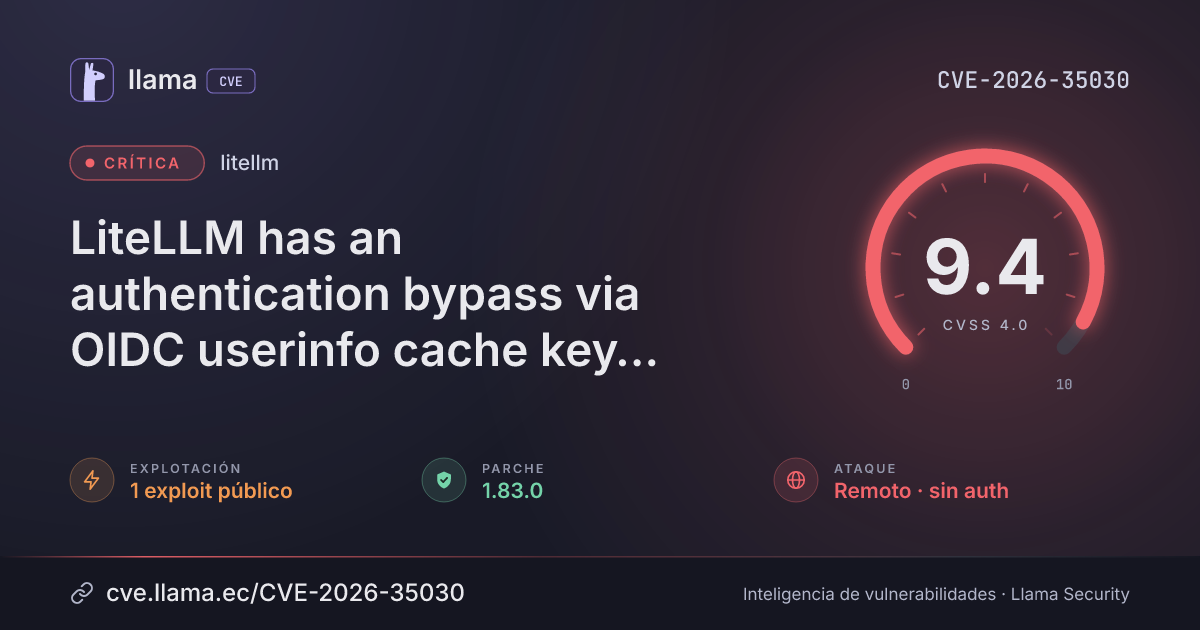
CVE-2026-35030
LiteLLM has an authentication bypass via OIDC userinfo cache key collision
CVSS:4.0/AV:N/AC:L/AT:P/PR:N/UI:N/VC:H/VI:H/VA:N/SC:H/SI:H/SA:N
Fuente: CNA
CVSS:3.1/AV:N/AC:L/PR:N/UI:N/S:U/C:H/I:H/A:NCVSS:3.1/AV:N/AC:L/PR:N/UI:N/S:U/C:H/I:H/A:NCiclo de vida de la vulnerabilidad
| Fecha | Fase | Evento | Detalle |
|---|---|---|---|
| Remediación | Parche 1.83.0 | litellm · -6 d desde divulgación | |
| Divulgación | Publicada | CVE-2026-35030 divulgada · CVSS 9.4 (CNA) | |
| Divulgación | Evaluación SSVC | CISA-ADP · explotación ninguna | |
| Divulgación | Modificada | Última actualización del registro | |
| Monitoreo | Detectada | Ingresó al índice |
LiteLLM is a proxy server (AI Gateway) to call LLM APIs in OpenAI (or native) format. Prior to 1.83.0, when JWT authentication is enabled (enable_jwt_auth: true), the OIDC userinfo cache uses token[:20] as the cache key. JWT headers produced by the same signing algorithm generate identical first 20 characters. This configuration option is not enabled by default. Most instances are not affected. An unauthenticated attacker can craft a token whose first 20 characters match a legitimate user's cached token. On cache hit, the attacker inherits the legitimate user's identity and permissions. This affects deployments with JWT/OIDC authentication enabled. Fixed in v1.83.0.
Desglose de métricas
Rangos afectados
Estado del parche por paquete
| Paquete / producto | Estado | Corregida en | Desde divulgación | Última versión |
|---|---|---|---|---|
pypilitellm |
Corregida | 1.83.0 | -6 d | 1.109.1 no afectada |
1.83.0Arsenal público
Ver los 1 repositorios de GitHub
Los repositorios públicos incluyen exploits, escáneres, laboratorios y reglas de detección. No ejecute código de terceros sin revisarlo en un entorno aislado.
https://access.redhat.com/errata/RHSA-2026:13545https://access.redhat.com/errata/RHSA-2026:28960https://access.redhat.com/errata/RHSA-2026:30056https://github.com/BerriAI/litellm/security/advisories/GHSA-jjhc-v7c2-5hh6https://bugzilla.redhat.com/show_bug.cgi?id=2455509https://github.com/learner202649/CVE-2026-35030-PoChttps://access.redhat.com/security/cve/CVE-2026-35030https://security.access.redhat.com/data/csaf/v2/vex/2026/cve-2026-35030.jsonLas referencias externas se muestran para copiar: cve.llama.ec no lo redirige a otros sitios.