OpenClaw
CVE-2026-35628
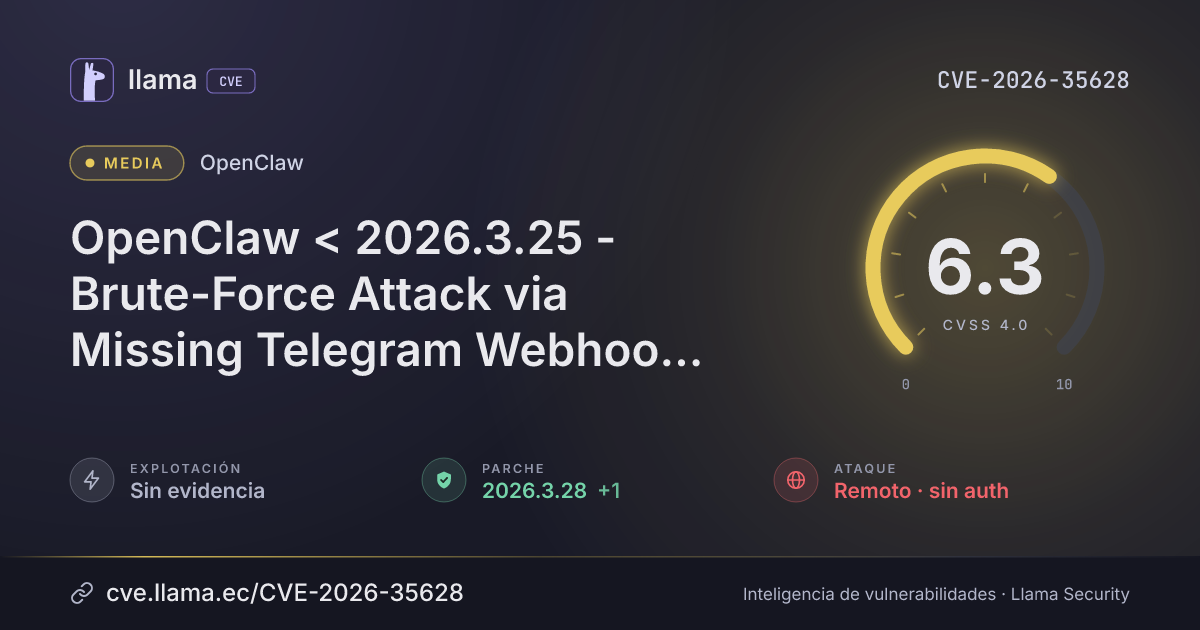
OpenClaw < 2026.3.25 - Brute-Force Attack via Missing Telegram Webhook Rate Limiting
Parche disponiblebrute-force weakness
CVSS 4.0
6.3
Media
CVSS:4.0/AV:N/AC:H/AT:N/PR:N/UI:N/VC:L/VI:L/VA:N/SC:N/SI:N/SA:N
Fuente: CNA
Decisión SSVCSeguir
Remediar en la ventana regular de mantenimiento
Sin explotación conocida, no automatizable e impacto técnico parcial. Hay versiones corregidas disponibles.
Traje la llave inglesa: esto se arregla.Nivel de alerta: llama mascando hierba.
Timeline
Ciclo de vida de la vulnerabilidad
| Fecha | Fase | Evento | Detalle |
|---|---|---|---|
| Remediación | Parche 2026.3.28 | openclaw · -11 d desde divulgación | |
| Divulgación | Publicada | CVE-2026-35628 divulgada · CVSS 6.3 (CNA) | |
| Divulgación | Evaluación SSVC | CISA-ADP · explotación ninguna | |
| Divulgación | Modificada | Última actualización del registro | |
| Monitoreo | Detectada | Ingresó al índice |
Resumen
OpenClaw before 2026.3.25 contains a missing rate limiting vulnerability in Telegram webhook authentication that allows attackers to brute-force weak webhook secrets. The vulnerability enables repeated authentication guesses without throttling, permitting attackers to systematically guess webhook secrets through brute-force attacks.
Vector CVSS 4.0
Desglose de métricas
Vector de ataqueAV:N
RedAdyacenteLocalFísica
ComplejidadAC:H
BajaAlta
Requisitos de ataqueAT:N
NingunoPresentes
PrivilegiosPR:N
NingunoBajosAltos
InteracciónUI:N
NingunaPasivaActiva
Confid. (sistema)VC:L
AltoBajoNinguno
Integridad (sistema)VI:L
AltoBajoNinguno
Disponib. (sistema)VA:N
AltoBajoNinguno
Confid. (posterior)SC:N
AltoBajoNinguno
Integridad (posterior)SI:N
AltoBajoNinguno
Disponib. (posterior)SA:N
AltoBajoNinguno
Score de explotaciónQué tan fácil y probable es que la exploten
7.1/ 10Alto
Versiones
Rangos afectados
Afectada
Corregida
Última
≤ 2026.3.24
< 2026.3.25
2026.3.24
2026.3.25
2026.11.3
Remediación
Estado del parche por paquete
| Paquete / producto | Estado | Corregida en | Desde divulgación | Última versión |
|---|---|---|---|---|
npmopenclaw |
Corregida | 2026.3.28 | -11 d | 2026.11.3 no afectada |
Versiones corregidas
2026.3.252026.3.28Explotación
Arsenal público
Sin exploits, módulos ni PoC públicos conocidos a la fecha de verificación.
Registro
EscenarioGENERALVulnCheck
Referencias
Fabricante
https://github.com/openclaw/openclaw/security/advisories/GHSA-vcx4-4qxg-mfp4Parche
https://github.com/openclaw/openclaw/commit/c2c136ae9517ddd0789d742a0fdf4c10e8c729a7Otra
https://www.vulncheck.com/advisories/openclaw-brute-force-attack-via-missing-telegram-webhook-rate-limitingLas referencias externas se muestran para copiar: cve.llama.ec no lo redirige a otros sitios.