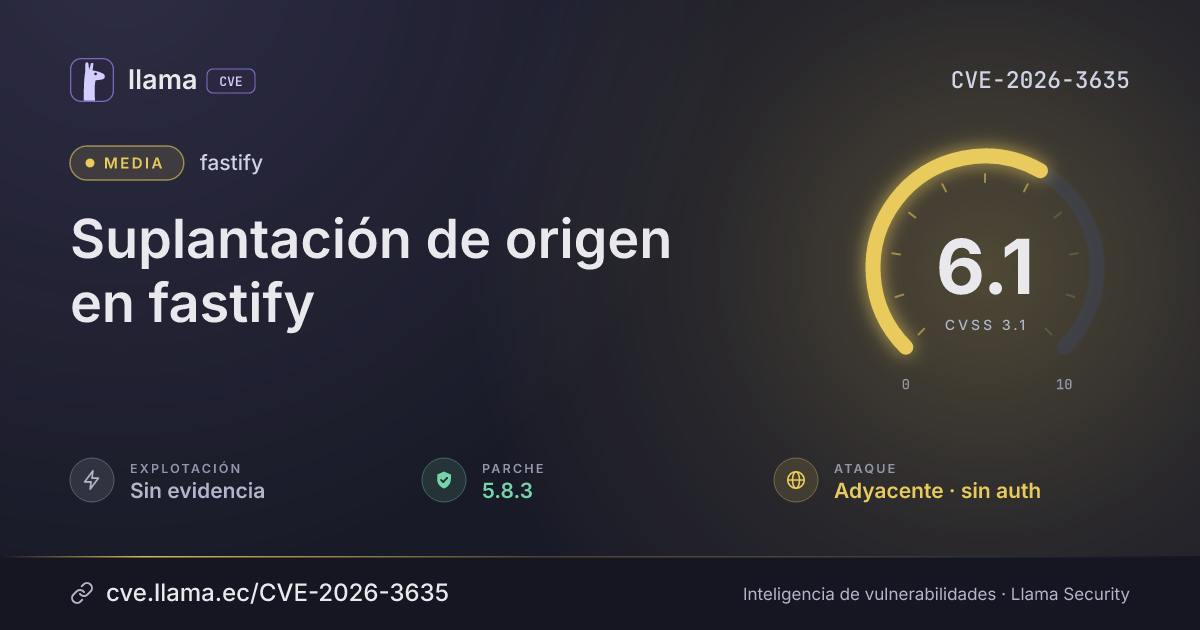
CVE-2026-3635
fastify source spoofing
Texto original en inglés · Ver en español
CVSS:3.1/AV:A/AC:H/PR:N/UI:N/S:C/C:H/I:N/A:N
Fuente: CNA
Ciclo de vida de la vulnerabilidad
| Fecha | Fase | Evento | Detalle |
|---|---|---|---|
| Divulgación | Publicada | CVE-2026-3635 divulgada · CVSS 6.1 (CNA) | |
| Remediación | Parche 5.8.3 | fastify · 0 d desde divulgación | |
| Divulgación | Evaluación SSVC | CISA-ADP · explotación ninguna | |
| Divulgación | Modificada | Última actualización del registro | |
| Monitoreo | Detectada | Ingresó al índice |
Summary When trustProxy is configured with a restrictive trust function (e.g., a specific IP like trustProxy: '10.0.0.1', a subnet, a hop count, or a custom function), the request.protocol and request.host getters read X-Forwarded-Proto and X-Forwarded-Host headers from any connection — including connections from untrusted IPs. This allows an attacker connecting directly to Fastify (bypassing the proxy) to spoof both the protocol and host seen by the application. Affected Versions fastify <= 5.8.2 Impact Applications using request.protocol or request.host for security decisions (HTTPS enforcement, secure cookie flags, CSRF origin checks, URL construction, host-based routing) are affected when trustProxy is configured with a restrictive trust function. When trustProxy: true (trust everything), both host and protocol trust all forwarded headers — this is expected behavior. The vulnerability only manifests with restrictive trust configurations.
Desglose de métricas
Rangos afectados
Estado del parche por paquete
| Paquete / producto | Estado | Corregida en | Desde divulgación | Última versión |
|---|---|---|---|---|
npmfastify |
Corregida | 5.8.3 | 0 d | 5.12.8 no afectada |
5.8.3Arsenal público
Sin exploits, módulos ni PoC públicos conocidos a la fecha de verificación.
https://github.com/fastify/fastify/security/advisories/GHSA-444r-cwp2-x5xfhttps://cna.openjsf.org/security-advisories.htmlhttps://www.cve.org/CVERecord?id=CVE-2026-3635Las referencias externas se muestran para copiar: cve.llama.ec no lo redirige a otros sitios.