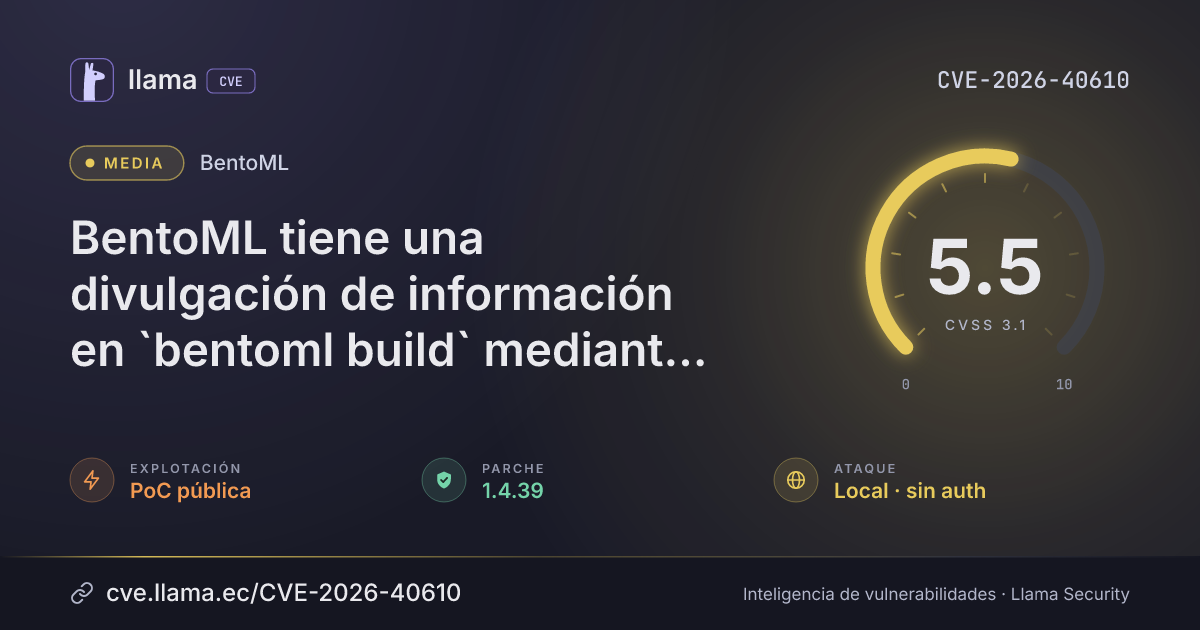
CVE-2026-40610
BentoML has Information Disclosure in bentoml build via symlink traversal in the build context
CVSS:3.1/AV:L/AC:L/PR:N/UI:R/S:U/C:H/I:N/A:N
Fuente: CNA
Ciclo de vida de la vulnerabilidad
| Fecha | Fase | Evento | Detalle |
|---|---|---|---|
| Remediación | Parche 1.4.39 | bentoml · -15 d desde divulgación | |
| Divulgación | Publicada | CVE-2026-40610 divulgada · CVSS 5.5 (CNA) | |
| Divulgación | Evaluación SSVC | CISA-ADP · explotación PoC pública | |
| Divulgación | Modificada | Última actualización del registro | |
| Monitoreo | Detectada | Ingresó al índice |
BentoML is a Python library for building online serving systems optimized for AI apps and model inference. In versions 1.4.38 and prior, the build packaging workflow follows attacker-controlled symlinks inside the build context and copies the referenced file contents into the generated Bento artifact. If a victim builds an untrusted repository or other attacker-supplied build context, the attacker can place a symlink such as loot.txt -> /tmp/outside-marker.txt or a link to a more sensitive local file. When bentoml build runs, BentoML dereferences the symlink and packages the target file contents into the Bento. The leaked file can then propagate further through export, push, or containerization workflows. An attacker can exfiltrate local files from the build host into the Bento artifact, exposing secrets such as cloud credentials, SSH keys, API tokens, environment files, or other sensitive local configurations. Because Bento artifacts are commonly exported, uploaded, stored, or containerized after build, the leaked file contents can spread beyond the original build machine. This issue has been fixed in version 1.4.39.
Desglose de métricas
Rangos afectados
Estado del parche por paquete
| Paquete / producto | Estado | Corregida en | Desde divulgación | Última versión |
|---|---|---|---|---|
pypibentoml |
Corregida | 1.4.39 | -15 d | 1.4.40 no afectada |
1.4.39Arsenal público
Sin exploits, módulos ni PoC públicos conocidos a la fecha de verificación.
https://github.com/bentoml/BentoML/security/advisories/GHSA-mcfx-4vc6-qgxvhttps://github.com/bentoml/BentoML/commit/5fb7cd41f92e2a56b45391284cf15b9ac9963a1fhttps://github.com/bentoml/BentoML/releases/tag/v1.4.39Las referencias externas se muestran para copiar: cve.llama.ec no lo redirige a otros sitios.