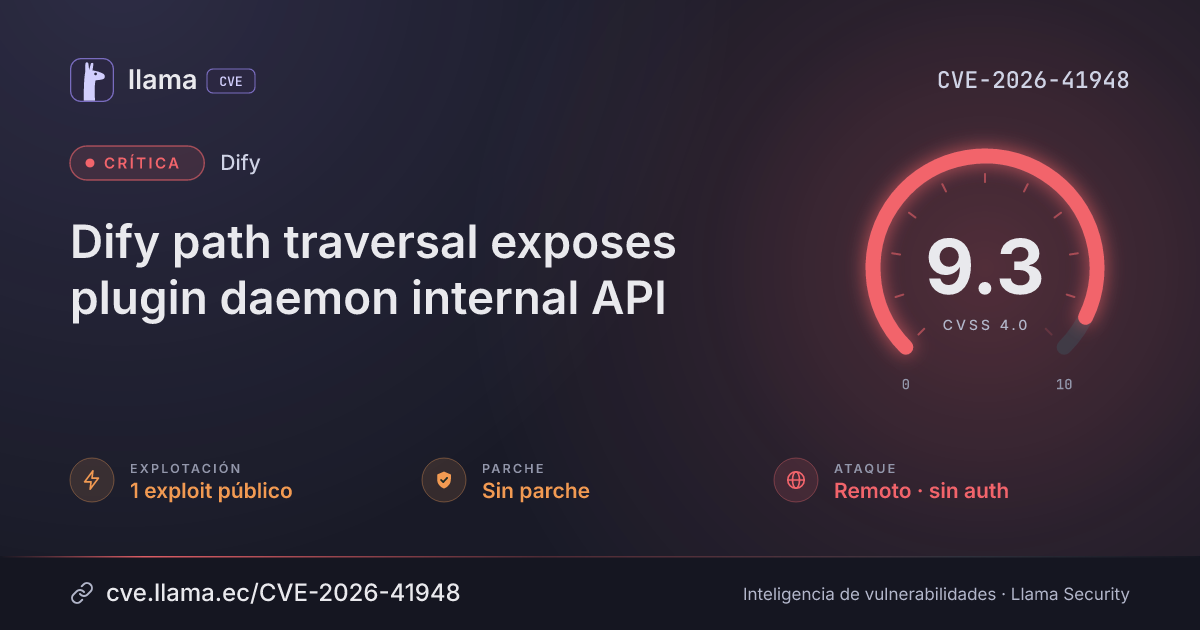
CVE-2026-41948
Dify path traversal exposes plugin daemon internal API
Remote attackers without logins can reach internal debug endpoints if they know a victim's tenant UUID.
CVSS:4.0/AV:N/AC:L/AT:N/PR:N/UI:N/VC:H/VI:H/VA:L/SC:N/SI:N/SA:N
Fuente: CNA
Ciclo de vida de la vulnerabilidad
| Fecha | Fase | Evento | Detalle |
|---|---|---|---|
| Divulgación | Publicada | CVE-2026-41948 divulgada · CVSS 9.3 (CNA) | |
| Divulgación | Evaluación SSVC | CISA-ADP · explotación PoC pública | |
| Explotación | Umbral EPSS | La probabilidad de explotación supera el 10 % | |
| Monitoreo | Detectada | Ingresó al índice | |
| Divulgación | Modificada | Última actualización del registro | |
| Monitoreo | Fuente: OSV | Registro visto por primera vez en OSV | |
| Monitoreo | Verificada | Última verificación contra las fuentes |
Dify contains a path traversal flaw that lets a remote attacker, without logging in, escape their tenant path in requests forwarded to the Plugin Daemon's internal REST API and reach internal endpoints such as debug interfaces. The attack requires knowing the victim tenant's UUID.
Affects Dify 1.14.1 and earlier, including Dify Cloud, which allows free self-registration so attacker accounts are easy to create. No fixed version is listed in the checked facts.
Descripción original del registro (VulnCheck)
Dify version 1.14.1 and prior contain a path traversal vulnerability that allows authenticated users to manipulate requests forwarded to the Plugin Daemon's internal REST API by exploiting insufficient URL path sanitization. Attackers can traverse out of their authorized tenant path using unencoded dot sequences in task identifiers or manipulated filename parameters to access internal endpoints such as debug interfaces, requiring only knowledge of the victim tenant's UUID. NOTE: Dify Cloud allows unauthenticated free self-registration, making account creation trivially accessible to any attacker.
Condiciones y alcance
Desglose de métricas
Rangos afectados
Estado del parche por paquete
| Paquete / producto | Estado | Corregida en | Desde divulgación | Última versión |
|---|---|---|---|---|
dify |
Sin parche | — | — | — |
Arsenal público
https://github.com/langgenius/dify/pull/35796https://www.zafran.io/resources/difytap-zafran-discovers-how-attackers-can-silently-wiretap-ai-data-across-tenants-on-a-platform-powering-1m-appshttps://huntr.com/bounties/35b7ad59-e35d-443f-bf77-387bfb932ec0https://github.com/projectdiscovery/nuclei-templates/blob/main/http/cves/2026/CVE-2026-41948.yamlhttps://www.vulncheck.com/advisories/dify-path-traversal-via-plugin-daemon-internal-api-accessLas referencias externas se muestran para copiar: cve.llama.ec no lo redirige a otros sitios.