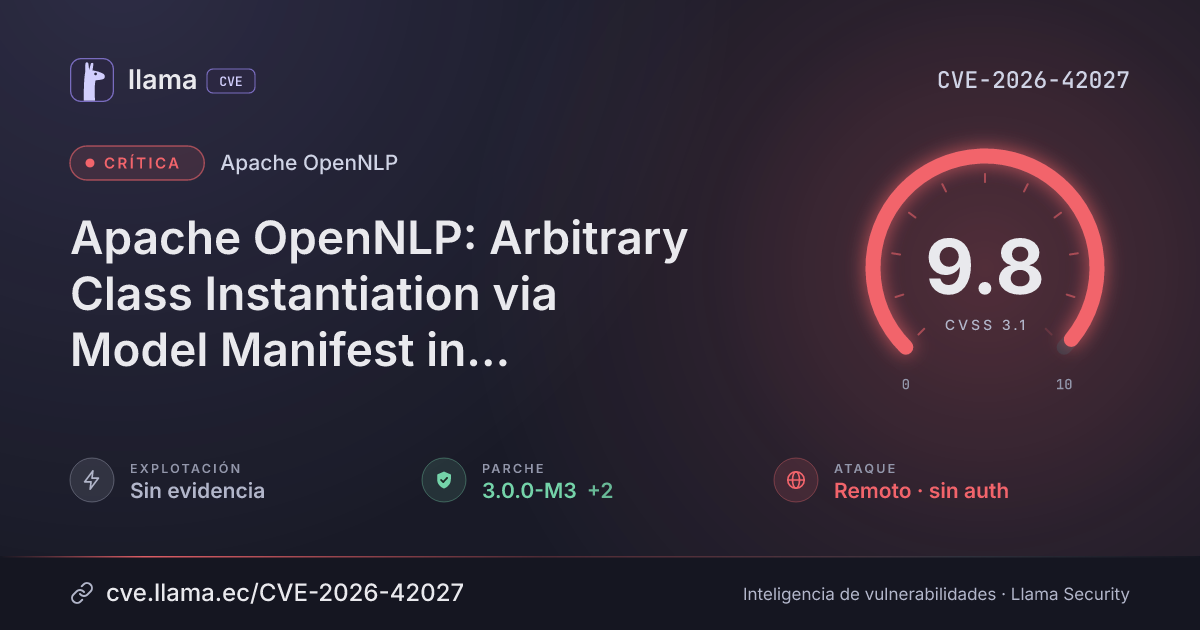
CVE-2026-42027
Apache OpenNLP: Arbitrary Class Instantiation via Model Manifest in ExtensionLoader
CVSS:3.1/AV:N/AC:L/PR:N/UI:N/S:U/C:H/I:H/A:H
Fuente: CISA-ADP
CVSS:3.1/AV:N/AC:H/PR:N/UI:R/S:U/C:H/I:H/A:HCiclo de vida de la vulnerabilidad
| Fecha | Fase | Evento | Detalle |
|---|---|---|---|
| Remediación | Parche 2.5.9 | org.apache.opennlp:opennlp-tools · -6 d desde divulgación | |
| Remediación | Parche 3.0.0-M3 | org.apache.opennlp:opennlp-tools · -6 d desde divulgación | |
| Divulgación | Publicada | CVE-2026-42027 divulgada · CVSS 9.8 (CISA-ADP) | |
| Divulgación | Evaluación SSVC | CISA-ADP · explotación ninguna | |
| Remediación | Parche 1.9.5 | org.apache.opennlp:opennlp-tools · 45 d desde divulgación | |
| Divulgación | Modificada | Última actualización del registro | |
| Monitoreo | Detectada | Ingresó al índice |
Arbitrary Class Instantiation via Model Manifest in Apache OpenNLP ExtensionLoader Versions Affected: before 1.9.5, before 2.5.9, before 3.0.0-M3 Description: The ExtensionLoader.instantiateExtension(Class, String) method loads a class by its fully-qualified name via Class.forName() and invokes its no-arg constructor, with the class name sourced from the manifest.properties entry of a model archive. The existing isAssignableFrom check correctly rejects classes that are not subtypes of the expected extension interface (BaseToolFactory for factory=, ArtifactSerializer for serializer-class-*), but the check runs after Class.forName() has already loaded and initialized the named class. Class.forName() with default initialization semantics executes the target class's static initializer before returning, so an attacker who can supply a crafted model archive can cause the static initializer of any class on the classpath to run during model loading, regardless of whether that class passes the subsequent type check. Exploitation requires a class with attacker-useful side effects in its static initializer (for example, JNDI lookup, outbound network I/O, or filesystem access) to be present on the classpath, so this is not a drop-in remote code execution; however, the attack surface grows as third-party model distribution becomes more common (community model repositories, Hugging Face-style sharing), where users routinely load model files from origins they do not control. A secondary, narrower vector affects deployments that ship legitimate BaseToolFactory or ArtifactSerializer subclasses with side-effecting no-arg constructors: a malicious manifest can name such a class and force its constructor to run during model load. Mitigation: * 2.x users should upgrade to 2.5.9. * 3.x users should upgrade to 3.0.0-M3. Note: The fix introduces a package-prefix allowlist that is consulted before Class.forName() is invoked, so the static initializer of a disallowed class is never executed. Classes under the opennlp. prefix remain permitted by default. Deployments that load models referencing factories or serializers outside opennlp.* must opt those packages in, either programmatically via ExtensionLoader.registerAllowedPackage(String) before the first model load, or by setting the OPENNLP_EXT_ALLOWED_PACKAGES system property to a comma-separated list of allowed package prefixes. Users who cannot upgrade immediately should ensure that all model files are sourced from trusted origins and should audit their classpath for classes with side-effecting static initializers or constructors, particularly any that perform JNDI lookups, network requests, or filesystem operations during class initialization.
Desglose de métricas
Rangos afectados
Estado del parche por paquete
| Paquete / producto | Estado | Corregida en | Desde divulgación | Última versión |
|---|---|---|---|---|
mavenorg.apache.opennlp:opennlp-tools |
Corregida | 1.9.5, 2.5.9, 3.0.0-M3 | 45 d · -6 d · -6 d | 2.5.12 no afectada |
1.9.52.5.93.0.0-M3Arsenal público
Sin exploits, módulos ni PoC públicos conocidos a la fecha de verificación.
https://access.redhat.com/errata/RHSA-2026:65126https://lists.apache.org/thread/ltlo4powjfc0w2w2yyl1o5tc7q1gcb2yhttp://www.openwall.com/lists/oss-security/2026/05/01/20https://bugzilla.redhat.com/show_bug.cgi?id=2466527https://access.redhat.com/security/cve/CVE-2026-42027https://security.access.redhat.com/data/csaf/v2/vex/2026/cve-2026-42027.jsonLas referencias externas se muestran para copiar: cve.llama.ec no lo redirige a otros sitios.