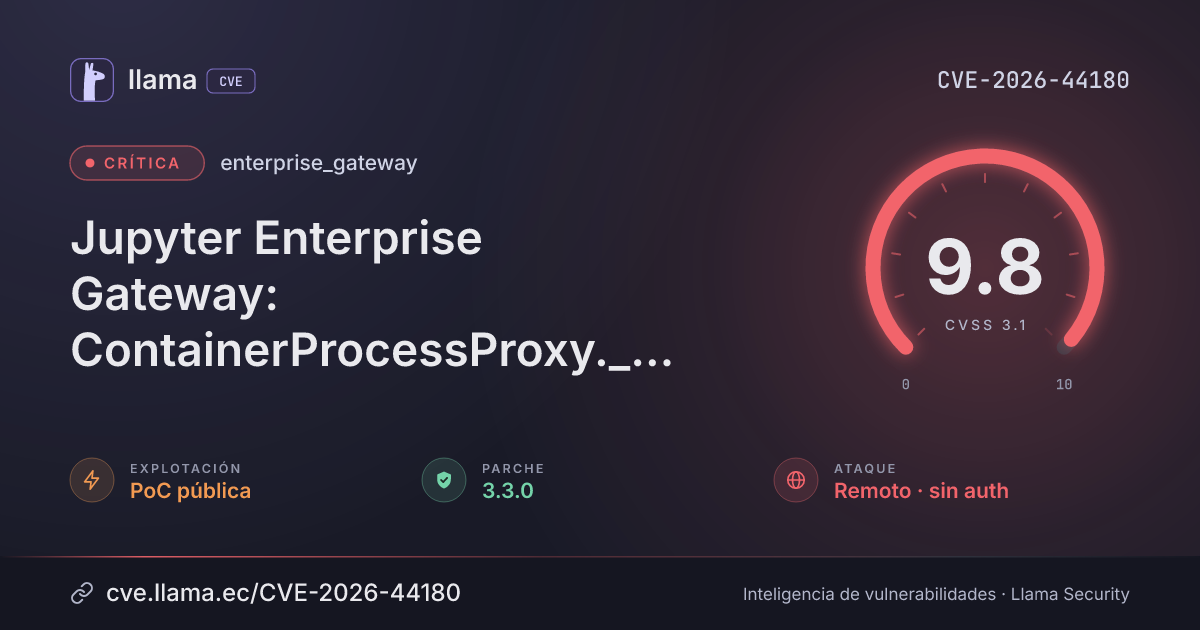
CVE-2026-44180
Jupyter Enterprise Gateway: ContainerProcessProxy._enforce_prohibited_ids can be Bypassed
CVSS:3.1/AV:N/AC:L/PR:N/UI:N/S:U/C:H/I:H/A:H
Fuente: CNA
Ciclo de vida de la vulnerabilidad
| Fecha | Fase | Evento | Detalle |
|---|---|---|---|
| Remediación | Parche 3.3.0 | jupyter-enterprise-gateway · -45 d desde divulgación | |
| Divulgación | Publicada | CVE-2026-44180 divulgada · CVSS 9.8 (CNA) | |
| Divulgación | Evaluación SSVC | CISA-ADP · explotación PoC pública | |
| Divulgación | Modificada | Última actualización del registro | |
| Monitoreo | Detectada | Ingresó al índice |
Jupyter Enterprise Gateway launches remote Jupyter Notebook kernels across distributed clusters like Apache Spark, Kubernetes, and Docker Swarm. Versions 2.0.0rc1 and above prior to 3.3.0 have a prohibited UID and GID feature that by default prevents launching kernels with UID or GID 0 (root), and this restriction can be bypassed using a specially crafted KERNEL_UID or KERNEL_GID value. This input validation vulnerability allows running Jupyter kernels as root, which can be dangerous as it allows more attack surface, and may lead to container escapes, compromising the worker node and all workloads running on it. Repeated exploitation can compromise all worker nodes, and thus the entire Kubernetes cluster. It is possible to specify volume mounts, so one vector for a container escape is to use a hostPath R/W volume mount, use this UID/GID bypass to run as root, and then gain code execution in the underlying worker node by creating a crontab entry in the mounted host file system. This issue has been fixed in version 3.0.0.
Desglose de métricas
Rangos afectados
Estado del parche por paquete
| Paquete / producto | Estado | Corregida en | Desde divulgación | Última versión |
|---|---|---|---|---|
pypijupyter-enterprise-gateway |
Corregida | 3.3.0 | -45 d | 3.4.0 no afectada |
3.3.0Arsenal público
Sin exploits, módulos ni PoC públicos conocidos a la fecha de verificación.
https://github.com/jupyter-server/enterprise_gateway/security/advisories/GHSA-chq7-94j8-cj28https://github.com/jupyter-server/enterprise_gateway/releases/tag/v3.3.0Las referencias externas se muestran para copiar: cve.llama.ec no lo redirige a otros sitios.