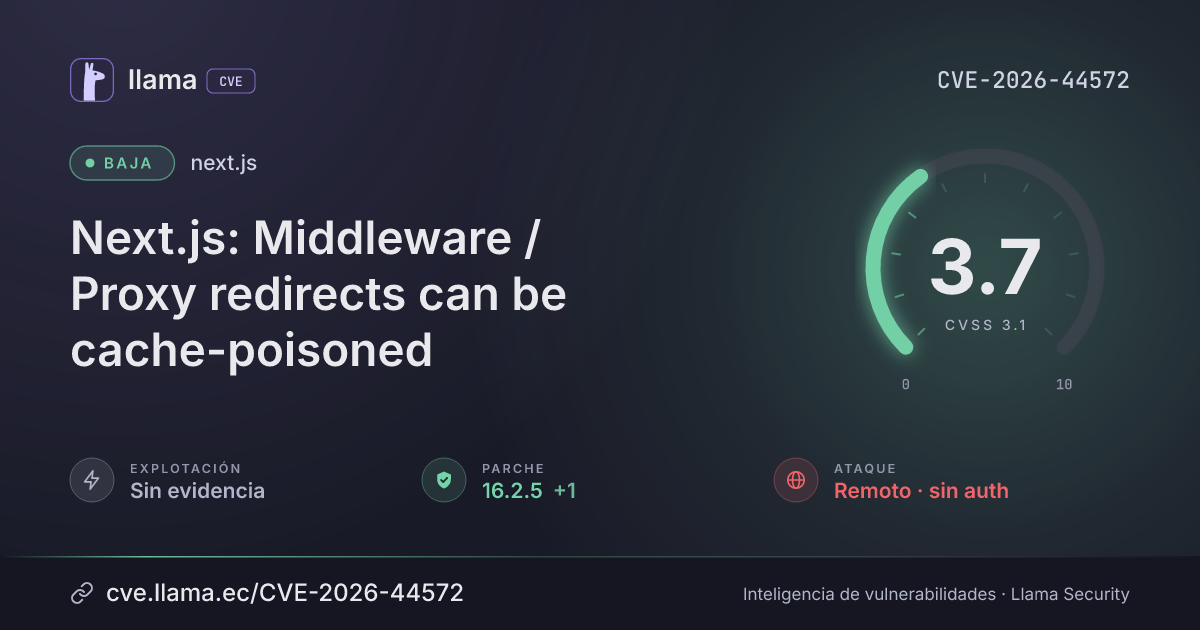
CVE-2026-44572
Next.js: Middleware / Proxy redirects can be cache-poisoned
CVSS:3.1/AV:N/AC:H/PR:N/UI:N/S:U/C:N/I:N/A:L
Fuente: CNA
CVSS:3.1/AV:N/AC:H/PR:N/UI:N/S:U/C:N/I:N/A:HCiclo de vida de la vulnerabilidad
| Fecha | Fase | Evento | Detalle |
|---|---|---|---|
| Remediación | Parche 15.5.16 | next · -7 d desde divulgación | |
| Remediación | Parche 16.2.5 | next · -7 d desde divulgación | |
| Divulgación | Publicada | CVE-2026-44572 divulgada · CVSS 3.7 (CNA) | |
| Divulgación | Evaluación SSVC | CISA-ADP · explotación ninguna | |
| Divulgación | Modificada | Última actualización del registro | |
| Monitoreo | Detectada | Ingresó al índice | |
| Monitoreo | Verificada | Última verificación contra las fuentes |
Next.js is a React framework for building full-stack web applications. From 12.2.0 to before 15.5.16 and 16.2.5, an external client could send a x-nextjs-data header on a normal request to a path handled by middleware that returns a redirect. When that happened, the middleware/proxy could treat the request as a data request and replace the standard Location redirect header with the internal x-nextjs-redirect header. Browsers do not follow x-nextjs-redirect, so the response became an unusable redirect for normal clients. If the application was deployed behind a CDN or reverse proxy that caches 3xx responses without varying on this header, a single attacker request could poison the cached redirect response for the affected path. Subsequent visitors could then receive a cached redirect response without a Location header, causing a denial of service for that redirect path until the cache entry expired or was purged. This vulnerability is fixed in 15.5.16 and 16.2.5.
Desglose de métricas
Rangos afectados
Estado del parche por paquete
| Paquete / producto | Estado | Corregida en | Desde divulgación | Última versión |
|---|---|---|---|---|
npmnext |
Corregida | 15.5.16, 16.2.5 | -7 d · -7 d | 16.4.6 no afectada |
15.5.1616.2.5Arsenal público
Sin exploits, módulos ni PoC públicos conocidos a la fecha de verificación.
https://github.com/vercel/next.js/security/advisories/GHSA-3g8h-86w9-wvmqLas referencias externas se muestran para copiar: cve.llama.ec no lo redirige a otros sitios.