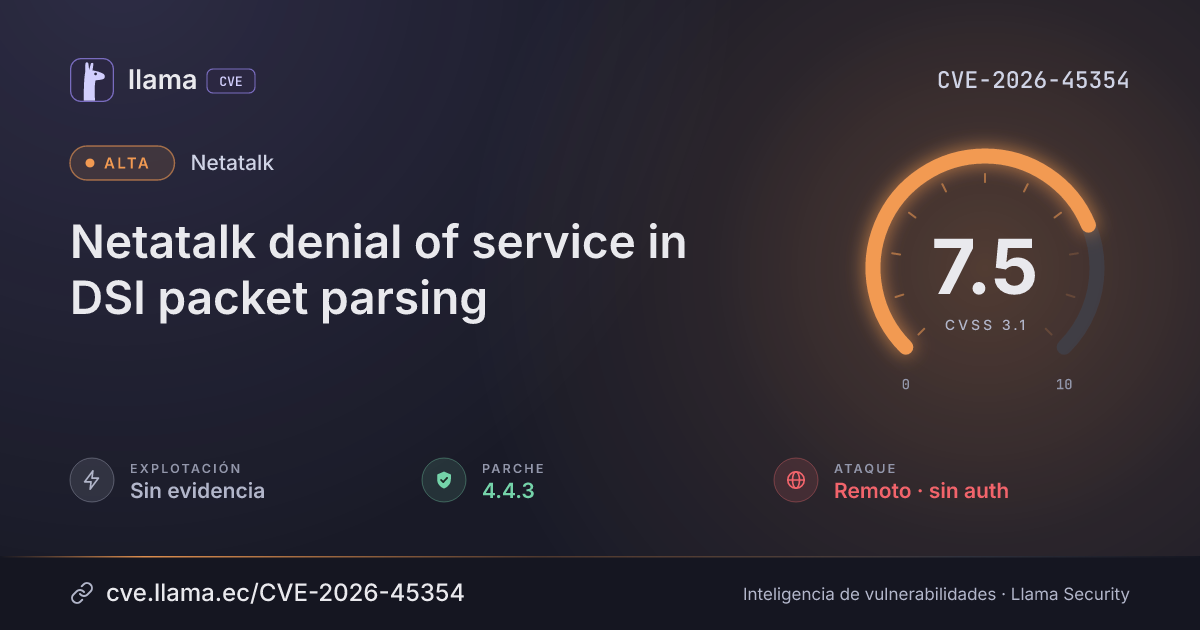
CVE-2026-45354
Netatalk denial of service in DSI packet parsing
A remote attacker without login can send crafted packets that close sessions or hang the service.
Texto original en inglés · Ver en español
CVSS:3.1/AV:N/AC:L/PR:N/UI:N/S:U/C:N/I:N/A:H
Fuente: CNA
Ciclo de vida de la vulnerabilidad
| Fecha | Fase | Evento | Detalle |
|---|---|---|---|
| Divulgación | Publicada | CVE-2026-45354 divulgada · CVSS 7.5 (CNA) | |
| Monitoreo | Detectada | Ingresó al índice | |
| Monitoreo | Fuente: NIST NVD | Registro visto por primera vez en NIST NVD | |
| Monitoreo | Verificada | Última verificación contra las fuentes |
Netatalk, a file server suite for Unix-like systems, has a flaw in how it parses incoming DSI protocol packets. A remote attacker who does not need to log in can send crafted packets that desynchronize the protocol stream, which can close sessions, corrupt protocol state, or cause an endless read that makes the service unavailable.
Affects Netatalk releases before 4.4.3 through a pre-authentication DSI protocol desync. Fixed in Netatalk 4.4.3.
Descripción original del registro (GitHub_M)
Netatalk is a Free and Open Source file server suite for Unix-like operating systems. Prior to 4.4.3, libatalk/dsi/dsi_stream.c interprets the dsi_code and dsi_doff union field as a data offset for all DSI command types instead of limiting that interpretation to DSIWrite. An unauthenticated client can send a non-WRITE DSIFUNC_CMD packet with a nonzero dsi_code smaller than dsi_len, causing dsi_stream_receive to consume only the dsi_code number of payload bytes and leave attacker-controlled bytes in the readahead buffer. The residual bytes become the next DSI header, allowing protocol desynchronization that can close sessions, corrupt protocol state, or trigger an infinite-read denial of service. This issue is fixed in version 4.4.3.
Condiciones y alcance
Desglose de métricas
Rangos afectados
Estado del parche por paquete
| Paquete / producto | Estado | Corregida en | Desde divulgación | Última versión |
|---|---|---|---|---|
netatalk |
Corregida | 4.4.3 | — | — |
4.4.3Arsenal público
Sin exploits, módulos ni PoC públicos conocidos a la fecha de verificación.
https://github.com/Netatalk/netatalk/security/advisories/GHSA-x7mm-865g-6jp3https://github.com/Netatalk/netatalk/commit/032d1f1a987d40c26d31ac6c424b129f6697c6f5https://github.com/Netatalk/netatalk/commit/b80892b6cc15c98a2eec2c8339b09295ebc2417fhttps://github.com/Netatalk/netatalk/releases/tag/netatalk-4-4-3Las referencias externas se muestran para copiar: cve.llama.ec no lo redirige a otros sitios.