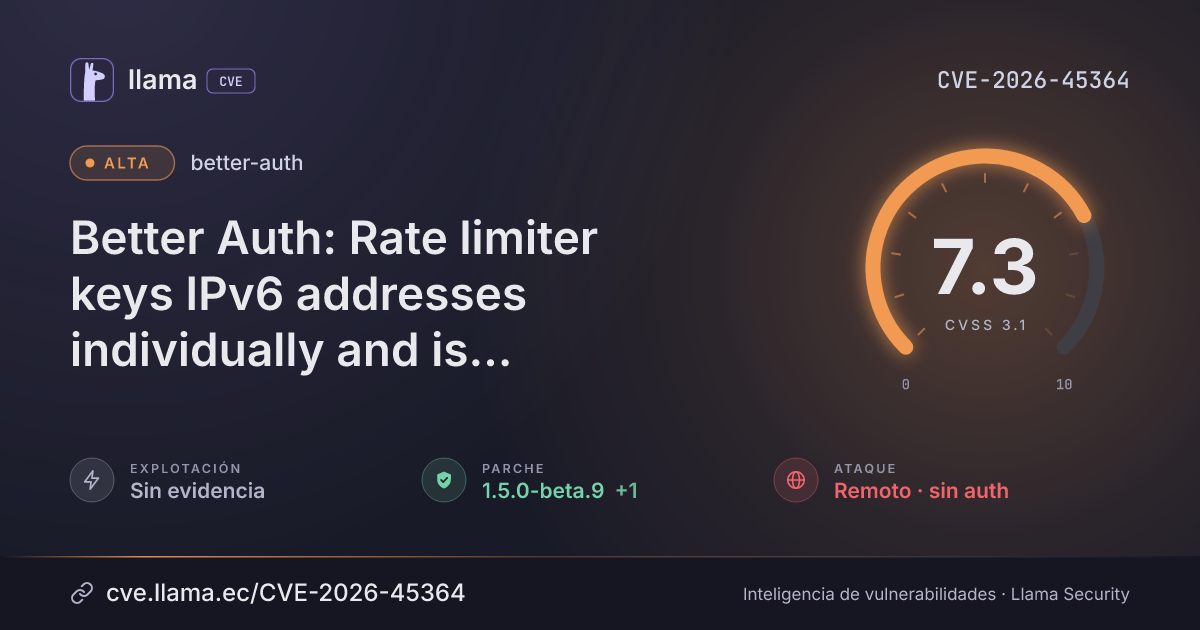
CVE-2026-45364
Better Auth: Rate limiter keys IPv6 addresses individually and is bypassable via prefix rotation
CVSS:3.1/AV:N/AC:L/PR:N/UI:N/S:U/C:L/I:L/A:L
Fuente: CNA
Ciclo de vida de la vulnerabilidad
| Fecha | Fase | Evento | Detalle |
|---|---|---|---|
| Remediación | Parche 1.4.17 | better-auth · -127 d desde divulgación | |
| Remediación | Parche 1.5.0-beta.9 | better-auth · -127 d desde divulgación | |
| Divulgación | Publicada | CVE-2026-45364 divulgada · CVSS 7.3 (CNA) | |
| Divulgación | Evaluación SSVC | CISA-ADP · explotación ninguna | |
| Divulgación | Modificada | Última actualización del registro | |
| Monitoreo | Detectada | Ingresó al índice |
Better Auth is an authentication and authorization library for TypeScript. Prior to 1.4.17 and 1.5.0-beta.9, Better Auth's HTTP rate limiter keyed each request by the exact textual IP address it received in x-forwarded-for (or the configured IP-bearing header). IPv6 clients controlling a typical /64 allocation could rotate through 2^64 distinct source addresses without exhausting the per-address counter, defeating rate limiting on /sign-in/email, /sign-up/email, /forget-password, and every other path the limiter protects. The same bug allowed a single client to vary the textual encoding of one IPv6 address (uppercase, compression, IPv4-mapped, hex-encoded IPv4-in-IPv6) and produce multiple distinct keys. This vulnerability is fixed in 1.4.17 and 1.5.0-beta.9.
Desglose de métricas
Rangos afectados
Estado del parche por paquete
| Paquete / producto | Estado | Corregida en | Desde divulgación | Última versión |
|---|---|---|---|---|
npmbetter-auth |
Corregida | 1.4.17, 1.5.0-beta.9 | -127 d · -127 d | 1.7.25 no afectada |
1.4.171.5.0-beta.9Arsenal público
Sin exploits, módulos ni PoC públicos conocidos a la fecha de verificación.
https://github.com/better-auth/better-auth/security/advisories/GHSA-p6v2-xcpg-h6xwhttps://github.com/better-auth/better-auth/pull/7470https://github.com/better-auth/better-auth/pull/7509https://github.com/better-auth/better-auth/commit/43e719bcc0c223c7079fa0c611a9cf7ea1188254https://github.com/better-auth/better-auth/commit/57af0f7b910dcf7b1a5c0615d10b9bd56bb69befLas referencias externas se muestran para copiar: cve.llama.ec no lo redirige a otros sitios.