llamaCVEVulnerability Intelligence
/
kestra

CVE-2026-45807

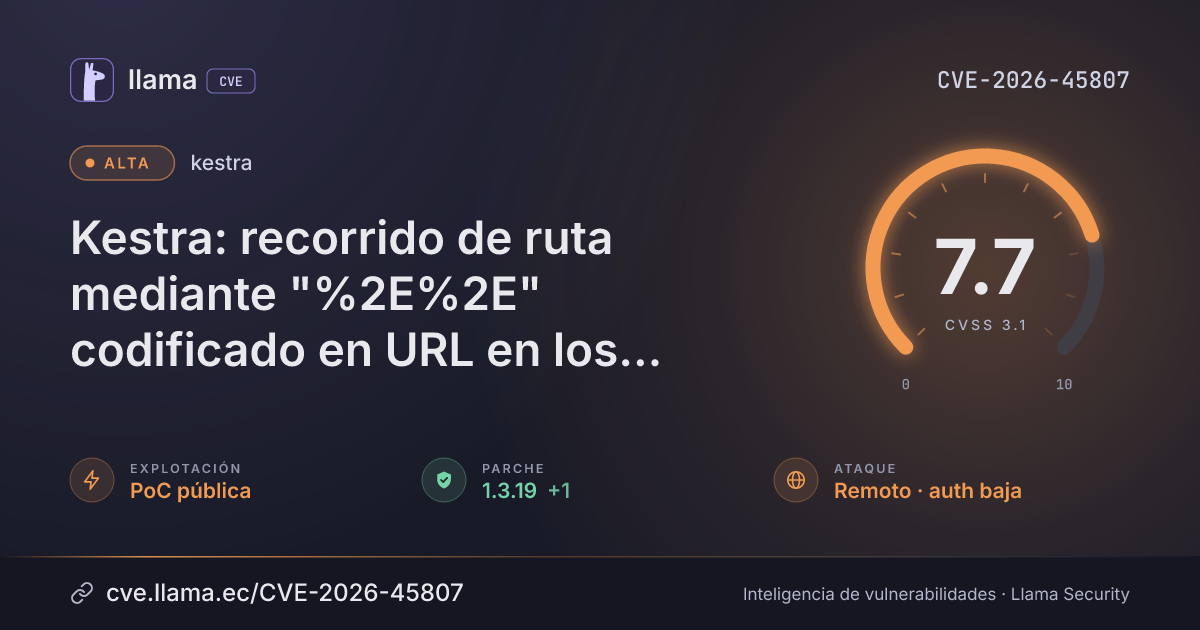
Kestra: Path traversal via URL-encoded "%2E%2E" in execution and namespace file endpoints allows arbitrary file read

Texto original en inglés · Ver en español

Solo en configuraciones específicasParche disponiblepath traversal
Descargar PNG JSON
CVSS 3.1
7.7
Alta
CVSS:3.1/AV:N/AC:L/PR:L/UI:N/S:C/C:H/I:N/A:N Fuente: CNA
ExplotaciónPoC públicaSSVC: PoC · no figura en CISA KEV
Exploits públicos0CISA-ADP reporta PoC; aún sin enlace público
Parche2 versiones1.0.43 · 1.3.19
Exposición147 dDesde la divulgación, 26 jun 2026, 3:57 p. m.
Detección143 dDesde la divulgación hasta su ingreso al índice
Decisión SSVCSeguir de cerca
Monitorear y programar la remediación
Existe PoC pública, no automatizable e impacto técnico parcial. Hay versiones corregidas disponibles.
Ojo de llama: esto puede escalar.Tu yo del futuro te agradecerá revisarla hoy.
Timeline

Ciclo de vida de la vulnerabilidad

Hoy
Divulgación
Publicada
Evaluación SSVC +1
Explotación
Remediación
Monitoreo
Detectada
Fuente: OSV +1
26 jun 26
29 jun 26
17 nov 26
19 nov 26
21 nov 26
26 jun 26
2 ago 26
8 sept 26
15 oct 26
21 nov 26
FechaFaseEventoDetalle
Divulgación Publicada CVE-2026-45807 divulgada · CVSS 7.7 (CNA)
Divulgación Evaluación SSVC CISA-ADP · explotación PoC pública
Divulgación Modificada Última actualización del registro
Monitoreo Detectada Ingresó al índice
Monitoreo Fuente: OSV Registro visto por primera vez en OSV
Monitoreo Verificada Última verificación contra las fuentes
Resumen

Kestra is an open-source, event-driven orchestration platform. Prior to 1.0.43 and 1.3.19, several Kestra API endpoints accept a kestra:// URI from the client and pass it through StorageInterface.parentTraversalGuard before reading the underlying file from the local storage backend. The guard only inspects the literal URI.toString(), so a URL-encoded .. written as %2E%2E slips through. The downstream code then calls URI.getPath(), which decodes %2E%2E back to .., and the resulting path is handed to Paths.get(...) without normalization. The OS resolves the .. segments at open(2) time, so an authenticated user with a single execution can read any file the Kestra process has access to on the host filesystem (/etc/passwd, mounted secrets, other tenants' execution outputs, etc.). This vulnerability is fixed in 1.0.43 and 1.3.19.

Affects Kestra 1.x releases up to 1.3.18 and 1.0.42 that ship the current parentTraversalGuard implementation. Fixed in 1.0.43 and 1.3.19.

¿Qué significa?A path traversal flaw in the execution and namespace file endpoints accepts URL-encoded "%2E%2E" sequences, which lets an authenticated user read files outside the storage tree on the Kestra host. The advisory gives /etc/passwd, mounted secrets and other tenants' execution outputs as examples.
¿Quién está afectado?The advisory says Kestra versions up to 1.3.18 and 1.0.42, the 1.x releases that ship the current parentTraversalGuard implementation, are likely affected. The attacker must hold EXECUTION:READ on at least one execution, so check the installed Kestra version against those releases and review which accounts have that permission.
¿Qué hacer?Upgrade to 1.0.43 on the 1.0.x line or to 1.3.19 on the 1.x line starting at 1.1.0.
Contexto

Condiciones y alcance

Condiciones necesarias para que el fallo sea explotable
01
Kestra versions up to 1.3.18 and 1.0.42 (1.x releases that ship the current parentTraversalGuard implementation)“Likely affected on all 1.x.x releases that ship the current parentTraversalGuard implementation.”
02
The attacker must be an authenticated user holding EXECUTION:READ on at least one execution“Any authenticated user that holds EXECUTION:READ on at least one of their own executions”
¿Quién debe revisar?Teams running Kestra OSS (io.kestra:kestra-core) 1.x up to 1.3.18 or 1.0.42, where users hold EXECUTION:READ on executions
No protegeFixing only one controller does not close the other four sites.
Vector CVSS 3.1

Desglose de métricas

Opción resaltada = valor del vector · izquierda = peor caso · CNA
Vector de ataqueAV:N
RedAdyacenteLocalFísica
ComplejidadAC:L
BajaAlta
PrivilegiosPR:L
NingunoBajosAltos
InteracciónUI:N
NingunaRequerida
AlcanceS:C
CambiadoSin cambio
ConfidencialidadC:H
AltoBajoNinguno
IntegridadI:N
AltoBajoNinguno
DisponibilidadA:N
AltoBajoNinguno
Score de explotaciónQué tan fácil y probable es que la exploten
10.0/ 10Muy alto
Vector 8.7 (muy fácil) · +1.3 por PoC pública.
Versiones

Rangos afectados

Afectada Corregida
io.kestra:kestra-core≤ 1.3.18
io.kestra:kestra-core≤ 1.0.42
kestra< 1.0.43
kestra≥ 1.1.0 < 1.3.19
1.0.42
1.0.43
1.1.0
1.3.18
1.3.19
Remediación

Estado del parche por paquete

Paquete / productoEstadoCorregida enDesde divulgaciónÚltima versión
kestra
Corregida 1.0.43, 1.3.19 — —
Versiones corregidas1.0.431.3.19
Explotación

Arsenal público

Sin exploits, módulos ni PoC públicos conocidos a la fecha de verificación.

Referencias
Fabricantehttps://github.com/kestra-io/kestra/security/advisories/GHSA-3529-p4wf-xp79

Las referencias externas se muestran para copiar: cve.llama.ec no lo redirige a otros sitios.