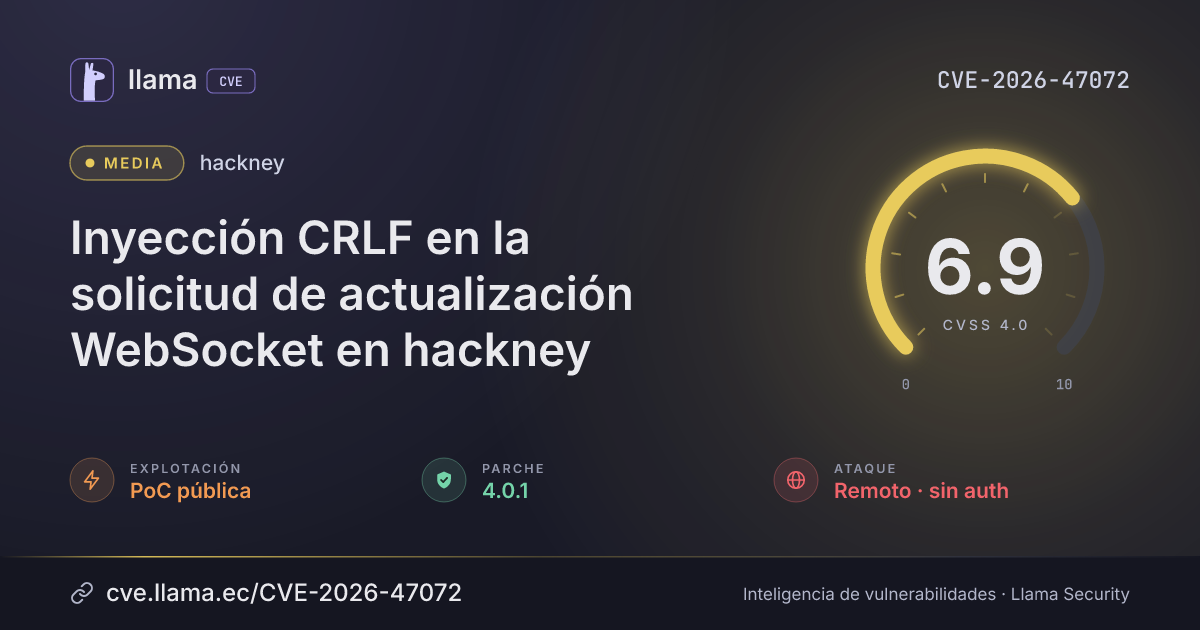
CVE-2026-47072
CRLF injection in WebSocket upgrade request in hackney
CVSS:4.0/AV:N/AC:L/AT:P/PR:N/UI:N/VC:N/VI:L/VA:N/SC:N/SI:H/SA:N
Fuente: CNA
CVSS:3.1/AV:N/AC:L/PR:N/UI:N/S:U/C:N/I:H/A:NCiclo de vida de la vulnerabilidad
| Fecha | Fase | Evento | Detalle |
|---|---|---|---|
| Divulgación | Publicada | CVE-2026-47072 divulgada · CVSS 6.9 (CNA) | |
| Divulgación | Evaluación SSVC | CISA-ADP · explotación PoC pública | |
| Divulgación | Modificada | Última actualización del registro | |
| Monitoreo | Detectada | Ingresó al índice | |
| Monitoreo | Verificada | Última verificación contra las fuentes |
Improper Neutralization of CRLF Sequences ('CRLF Injection') vulnerability in benoitc hackney allows HTTP Request/Response Splitting. The WebSocket upgrade code in src/hackney_ws.erl copies the host, path, headers (ExtraHeaders), and protocols options from the caller-supplied opts map into the internal #ws_data{} record in init/1 and then splices them verbatim into the raw HTTP/1.1 upgrade request by binary concatenation in do_handshake/1. No CRLF or NUL stripping is performed at any of these four injection sites. An attacker who controls any of these options — for example by forwarding URL components or header values from untrusted input into hackney_ws:start_link/1 — can inject arbitrary HTTP headers into the outbound WebSocket upgrade request, leading to header injection, credential spoofing toward the upstream server, log and cache poisoning, or request smuggling via intermediary proxies. This issue affects hackney: from 2.0.0 before 4.0.1.
Desglose de métricas
Rangos afectados
Estado del parche por paquete
| Paquete / producto | Estado | Corregida en | Desde divulgación | Última versión |
|---|---|---|---|---|
hackney |
Corregida | 4.0.1 | — | — |
4.0.1Arsenal público
Sin exploits, módulos ni PoC públicos conocidos a la fecha de verificación.
https://github.com/benoitc/hackney/security/advisories/GHSA-f9vr-g2g2-x9fghttps://github.com/benoitc/hackney/commit/52310ca807e7b48441ba0e9129171f535313fdd1https://cna.erlef.org/cves/CVE-2026-47072.htmlhttps://osv.dev/vulnerability/EEF-CVE-2026-47072Las referencias externas se muestran para copiar: cve.llama.ec no lo redirige a otros sitios.