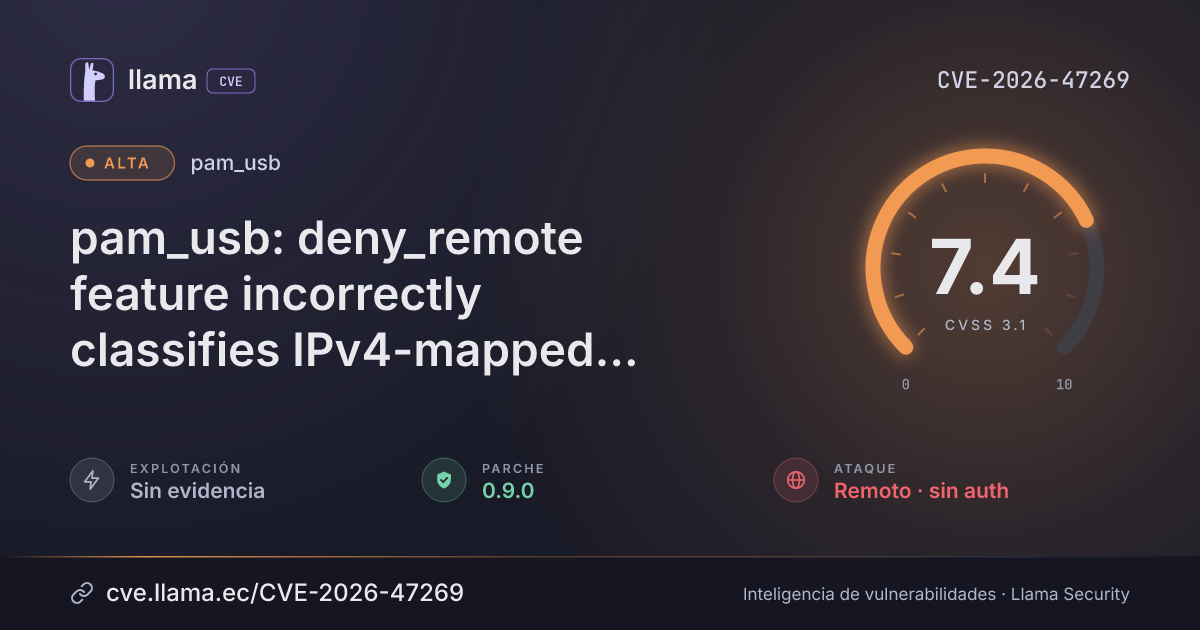
CVE-2026-47269
pam_usb: deny_remote feature incorrectly classifies IPv4-mapped IPv6 remote connections as local
CVSS:3.1/AV:N/AC:H/PR:N/UI:N/S:U/C:H/I:H/A:N
Fuente: CNA
Ciclo de vida de la vulnerabilidad
| Fecha | Fase | Evento | Detalle |
|---|---|---|---|
| Divulgación | Publicada | CVE-2026-47269 divulgada · CVSS 7.4 (CNA) | |
| Divulgación | Evaluación SSVC | CISA-ADP · explotación ninguna | |
| Divulgación | Modificada | Última actualización del registro | |
| Monitoreo | Detectada | Ingresó al índice |
pam_usb provides hardware authentication for Linux using ordinary removable media. Prior to 0.9.0, pam_usb's deny_remote feature checks utmpx ut_addr_v6 to detect whether an authentication request originates from a remote session. The outer guard was if (utent->ut_addr_v6[0] != 0), which only tests the first 32-bit word of the 128-bit address field. IPv4-mapped IPv6 addresses (::ffff:x.x.x.x) store the IPv4 address in ut_addr_v6[3] with ut_addr_v6[0] == 0. On systems where the SSH daemon listens on :: (IPv6 wildcard) with AddressFamily any -- common on Ubuntu and Debian -- incoming IPv4 connections are recorded in utmpx as IPv4-mapped IPv6 addresses. The outer check evaluates to false, the remote-detection block is skipped entirely, and the session is treated as local. deny_remote=true does not block the authentication. An attacker with physical access to a registered USB device can authenticate over SSH on an affected system as if they were sitting at a local terminal, bypassing the deny_remote restriction. This vulnerability is fixed in 0.9.0.
Desglose de métricas
Rangos afectados
Estado del parche por paquete
| Paquete / producto | Estado | Corregida en | Desde divulgación | Última versión |
|---|---|---|---|---|
pam_usb |
Corregida | 0.9.0 | — | — |
0.9.0Arsenal público
Sin exploits, módulos ni PoC públicos conocidos a la fecha de verificación.
https://github.com/mcdope/pam_usb/security/advisories/GHSA-jmmj-qhrq-w45ghttps://github.com/mcdope/pam_usb/commit/804fe24eae3d742d8be05fd015e36abc3c7d94e5Las referencias externas se muestran para copiar: cve.llama.ec no lo redirige a otros sitios.