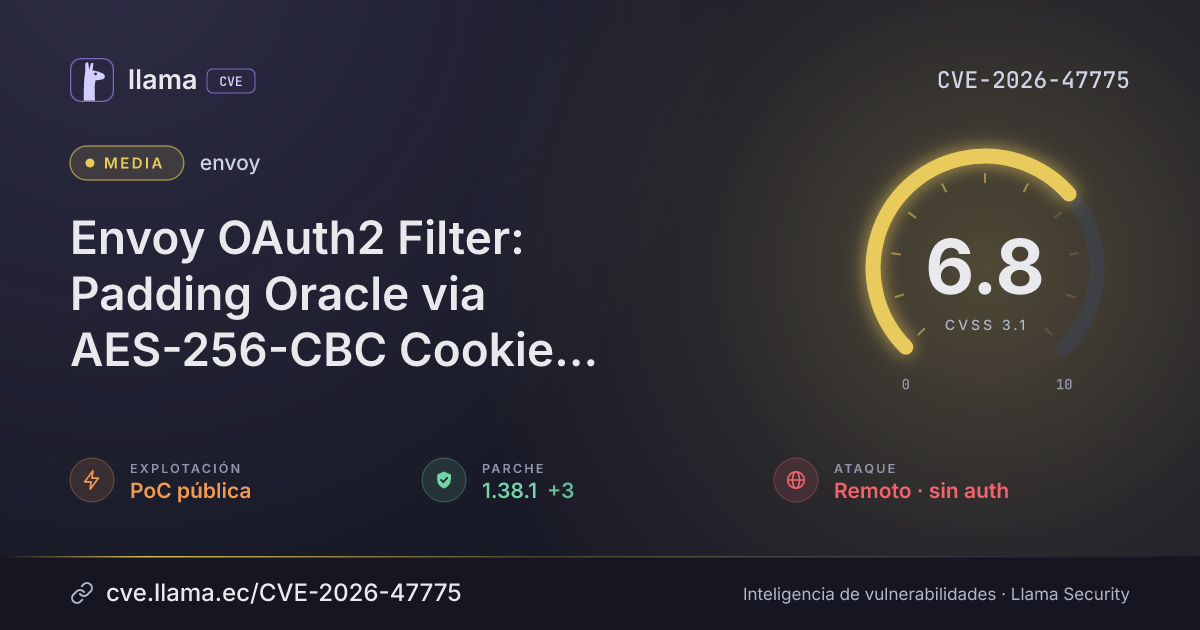
CVE-2026-47775
Envoy OAuth2 Filter: Padding Oracle via AES-256-CBC Cookie Decryption
CVSS:3.1/AV:N/AC:H/PR:N/UI:R/S:U/C:H/I:H/A:N
Fuente: CNA
Ciclo de vida de la vulnerabilidad
| Fecha | Fase | Evento | Detalle |
|---|---|---|---|
| Divulgación | Publicada | CVE-2026-47775 divulgada · CVSS 6.8 (CNA) | |
| Divulgación | Evaluación SSVC | CISA-ADP · explotación PoC pública | |
| Divulgación | Modificada | Última actualización del registro | |
| Monitoreo | Detectada | Ingresó al índice | |
| Monitoreo | Fuente: OSV | Registro visto por primera vez en OSV | |
| Monitoreo | Verificada | Última verificación contra las fuentes |
Envoy is an open source edge and service proxy designed for cloud-native applications. Prior to 1.35.11, 1.36.7, 1.37.3, and 1.38.1, the OAuth2 HTTP filter's encrypt()/decrypt() functions use AES-256-CBC without an authentication tag (no HMAC, no AEAD). The /callback endpoint returns HTTP 302 on successful decryption and HTTP 401 on padding failure, creating a padding oracle. An attacker who obtains the encrypted CodeVerifier cookie can recover the plaintext PKCE code_verifier in ~6,200 requests (~100 seconds), then exchange it with a stolen authorization code to obtain the victim's access token. This vulnerability is fixed in 1.35.11, 1.36.7, 1.37.3, and 1.38.1.
Desglose de métricas
Rangos afectados
Estado del parche por paquete
| Paquete / producto | Estado | Corregida en | Desde divulgación | Última versión |
|---|---|---|---|---|
envoy |
Corregida | 1.35.11, 1.36.7, 1.37.3, 1.38.1 | — | — |
1.35.111.36.71.37.31.38.1Arsenal público
Sin exploits, módulos ni PoC públicos conocidos a la fecha de verificación.
https://github.com/envoyproxy/envoy/security/advisories/GHSA-396h-jpq4-vc7pLas referencias externas se muestran para copiar: cve.llama.ec no lo redirige a otros sitios.