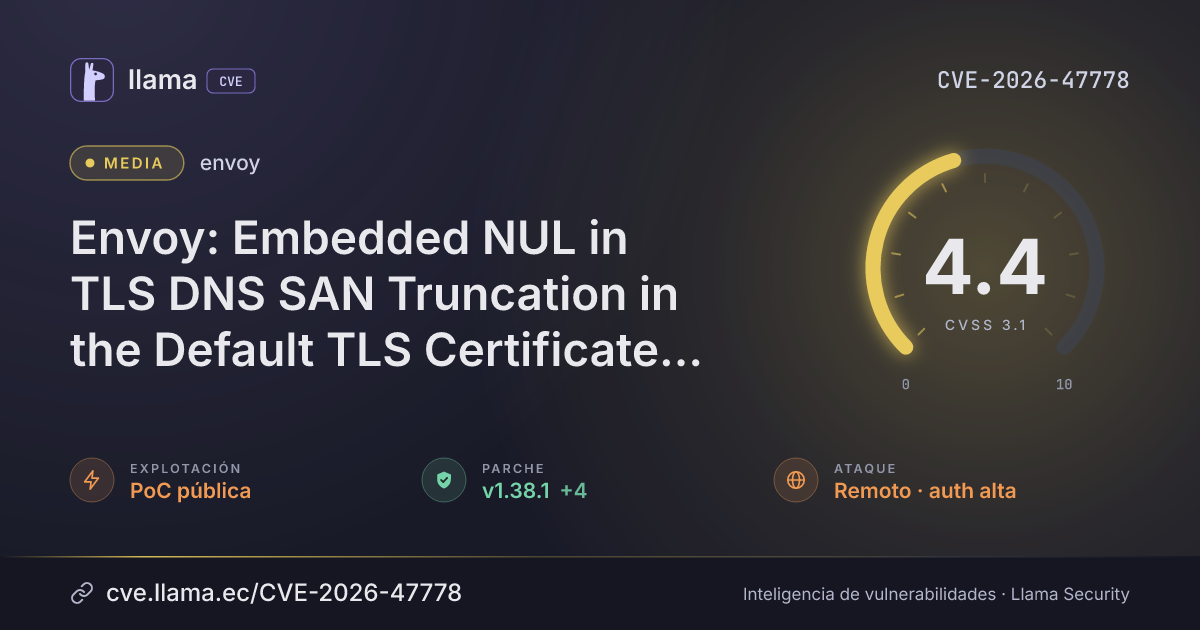
CVE-2026-47778
Envoy: Embedded NUL in TLS DNS SAN Truncation in the Default TLS Certificate Validator. (Auth Bypass)
CVSS:3.1/AV:N/AC:H/PR:H/UI:N/S:U/C:H/I:N/A:N
Fuente: CNA
Ciclo de vida de la vulnerabilidad
| Fecha | Fase | Evento | Detalle |
|---|---|---|---|
| Remediación | Parche v1.38.1 | github.com/envoyproxy/envoy · -22 d desde divulgación | |
| Divulgación | Publicada | CVE-2026-47778 divulgada · CVSS 4.4 (CNA) | |
| Divulgación | Evaluación SSVC | CISA-ADP · explotación PoC pública | |
| Divulgación | Modificada | Última actualización del registro | |
| Monitoreo | Detectada | Ingresó al índice | |
| Monitoreo | Fuente: OSV | Registro visto por primera vez en OSV | |
| Monitoreo | Verificada | Última verificación contra las fuentes |
Envoy is an open source edge and service proxy designed for cloud-native applications. Prior to 1.35.11, 1.36.7, 1.37.3, and 1.38.1, a structural flaw was identified in DefaultCertValidator::verifySubjectAltName where the extracted DNS SAN string is cast to a C-style string using .c_str() before being passed to the Utility::dnsNameMatch() algorithm. If the attacker serves a certificate with a dNSName SAN containing an embedded NUL byte, the helper Utility::generalNameAsString captures the complete string including the NUL. However, when .c_str() evaluates it, implicit conversion to absl::string_view inside dnsNameMatch relies on strlen(), prematurely truncating the evaluation context. Envoy evaluates trucated string against the exact required config_san match and returns true, thereby successfully validating the string with the Nul byte for an upstream routing. This vulnerability is fixed in 1.35.11, 1.36.7, 1.37.3, and 1.38.1.
Desglose de métricas
Rangos afectados
Estado del parche por paquete
| Paquete / producto | Estado | Corregida en | Desde divulgación | Última versión |
|---|---|---|---|---|
gogithub.com/envoyproxy/envoy |
Corregida | v1.38.1 | -22 d | v1.40.2 no afectada |
1.35.111.36.71.37.31.38.1v1.38.1Arsenal público
Sin exploits, módulos ni PoC públicos conocidos a la fecha de verificación.
https://github.com/envoyproxy/envoy/security/advisories/GHSA-f8x4-rw5x-f3r7Las referencias externas se muestran para copiar: cve.llama.ec no lo redirige a otros sitios.