llamaCVEVulnerability Intelligence
/
envoy

CVE-2026-48743

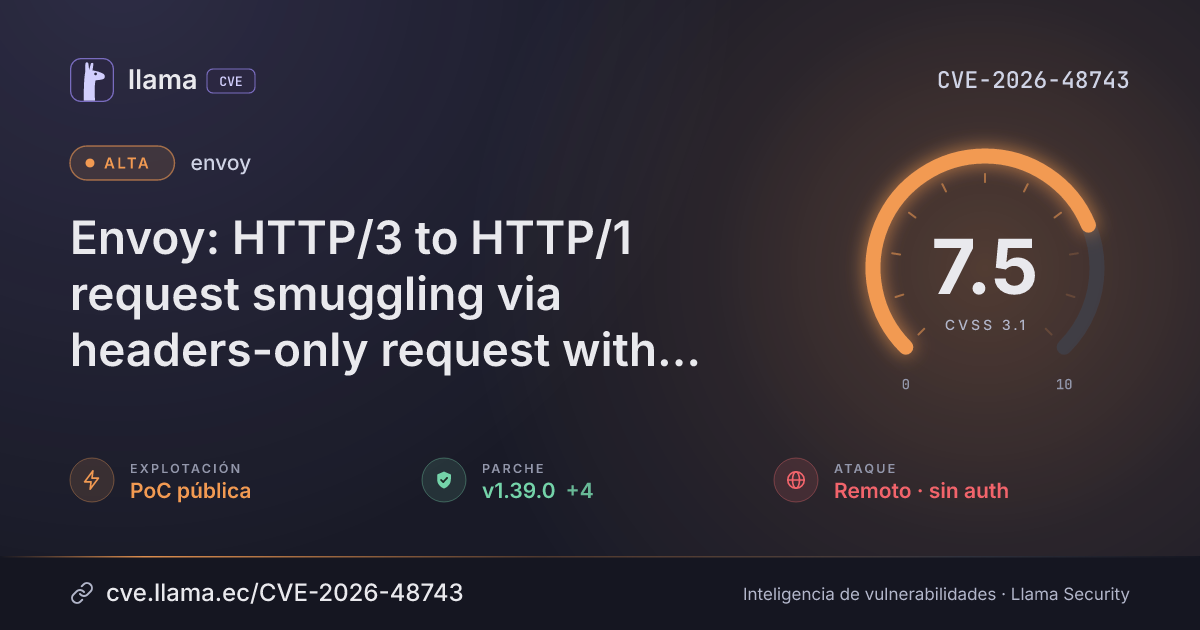
Envoy: HTTP/3 to HTTP/1 request smuggling via headers-only request with nonzero Content-Length

UnclearParche disponibleHTTP request smuggling
Descargar PNG JSON
CVSS 3.1
7.5
Alta
CVSS:3.1/AV:N/AC:H/PR:N/UI:N/S:C/C:L/I:H/A:N Fuente: CNA
ExplotaciónPoC públicaSSVC: poc · no figura en CISA KEV
Exploits públicos0Ninguno conocido
Parche5 versionesPrimer parche a 18 d de la divulgación
Exposición145 dDesde la divulgación, 26 jun 2026, 12:34 p. m.
Detección143 dDesde la divulgación hasta su ingreso al índice
Decisión SSVCSeguir de cerca
Monitorear y programar la remediación
Existe PoC pública, no automatizable e impacto técnico parcial. Hay versiones corregidas disponibles.
Timeline

Ciclo de vida de la vulnerabilidad

Hoy
Divulgación
Publicada
Evaluación SSVC +1
Explotación
Remediación
Parche v1.39.0
Monitoreo
Detectada
Fuente: OSV +1
26 jun 26
29 jun 26
14 jul 26
17 nov 26
18 nov 26
19 nov 26
26 jun 26
2 ago 26
7 sept 26
14 oct 26
19 nov 26
FechaFaseEventoDetalle
Divulgación Publicada CVE-2026-48743 divulgada · CVSS 7.5 (CNA)
Divulgación Evaluación SSVC CISA-ADP · explotación PoC pública
Divulgación Modificada Última actualización del registro
Remediación Parche v1.39.0 github.com/envoyproxy/envoy · 18 d desde divulgación
Monitoreo Detectada Ingresó al índice
Monitoreo Fuente: OSV Registro visto por primera vez en OSV
Monitoreo Verificada Última verificación contra las fuentes
Resumen

Envoy is an open source edge and service proxy designed for cloud-native applications. Prior to 1.35.11, 1.36.7, 1.37.3, and 1.38.1, Envoy can translate a downstream HTTP/3 request that is complete at the transport layer (HEADERS with FIN / headers-only close) but still carries a nonzero Content-Length into a complete upstream HTTP/1 request with unresolved body debt. In an HTTP/1 upstream deployment where the origin replies before reading the declared body and keeps the connection reusable, the beginning of the next Envoy-generated upstream request can be consumed as the first request's body. The remaining bytes are then parsed by the origin as a new HTTP/1 request. This was reproduced as a route-bypass/desync: direct /pwn was denied by Envoy, but the second downstream H3 stream received the response for backend-parsed GET /pwn HTTP/1.1. This vulnerability is fixed in 1.35.11, 1.36.7, 1.37.3, and 1.38.1.

Affects Envoy with downstream HTTP/3 routed to an upstream HTTP/1 cluster whose origin sends an early response before reading the declared body. Fixed in 1.35.11, 1.36.7, 1.37.3 and 1.38.1.

¿Qué significa?An attacker can cause an HTTP/1 upstream origin to process a request different from the one Envoy routed and authorized. This is request smuggling and a route or policy bypass.
¿Quién está afectado?The bug needs downstream HTTP/3 enabled, a route to an upstream HTTP/1 cluster, an origin that sends an early response before consuming the declared request body, and an upstream HTTP/1 connection that stays reusable after that response. Check the Envoy version against the affected ranges (1.35.0 to before 1.35.11, 1.36.0 to before 1.36.7, 1.37.0 to before 1.37.3, and 1.38.0 to before 1.38.1) and check whether HTTP/3 is enabled on the downstream listener.
¿Qué hacer?Upgrade to the fixed release for the affected branch: 1.35.11, 1.36.7, 1.37.3, or 1.38.1.
Contexto

Condiciones y alcance

Condiciones necesarias para que el fallo sea explotable
01
Downstream HTTP/3 is enabled.“downstream HTTP/3 enabled”
02
The route goes to an upstream HTTP/1 cluster.“upstream HTTP/1 cluster”
03
The upstream origin sends an early response before consuming the declared request body.“upstream origin can send an early response before consuming the declared”
04
The upstream HTTP/1 connection stays reusable after that response.“upstream HTTP/1 connection remains reusable after that response”
¿Quién debe revisar?Teams running Envoy 1.35 to 1.38 with downstream HTTP/3 enabled and an upstream HTTP/1 cluster.
Vector CVSS 3.1

Desglose de métricas

Opción resaltada = valor del vector · izquierda = peor caso · CNA
Vector de ataqueAV:N
RedAdyacenteLocalFísica
ComplejidadAC:H
BajaAlta
PrivilegiosPR:N
NingunoBajosAltos
InteracciónUI:N
NingunaRequerida
AlcanceS:C
CambiadoSin cambio
ConfidencialidadC:L
AltoBajoNinguno
IntegridadI:H
AltoBajoNinguno
DisponibilidadA:N
AltoBajoNinguno
Versiones

Rangos afectados

Afectada Corregida Última
github.com/envoyproxy/envoy≥ 1.35 < 1.39
envoy≥ 1.35.0 < 1.35.11
envoy≥ 1.36.0 < 1.36.7
envoy≥ 1.37.0 < 1.37.3
envoy≥ 1.38.0 < 1.38.1
1.35
1.35.0
1.35.11
1.36.0
1.36.7
1.37.0
1.37.3
1.38.0
1.38.1
1.39
v1.40.2
Remediación

Estado del parche por paquete

Paquete / productoEstadoCorregida enDesde divulgaciónÚltima versión
gogithub.com/envoyproxy/envoy
Corregida v1.39.0 18 d v1.40.2 no afectada
Versiones corregidas1.35.111.36.71.37.31.38.1v1.39.0
Explotación

Arsenal público

Sin exploits, módulos ni PoC públicos conocidos a la fecha de verificación.

Referencias
Fabricantehttps://github.com/envoyproxy/envoy/security/advisories/GHSA-8phg-2h2q-jgxf

Las referencias externas se muestran para copiar: cve.llama.ec no lo redirige a otros sitios.