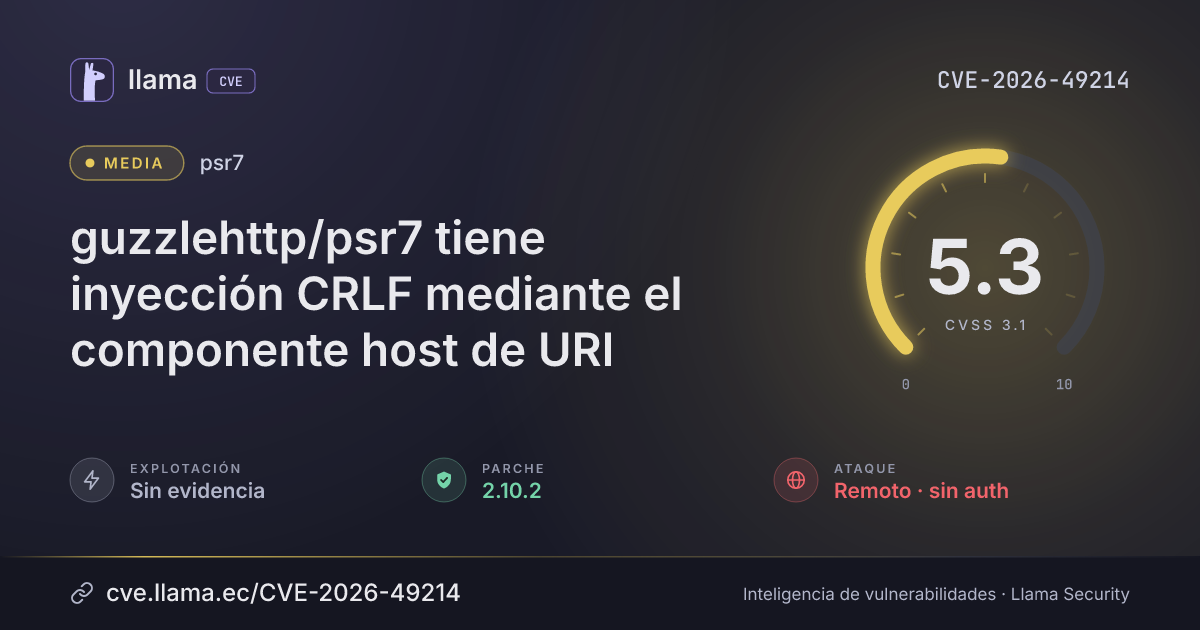
CVE-2026-49214
guzzlehttp/psr7 has CRLF Injection via URI Host Component
Texto original en inglés · Ver en español
CVSS:3.1/AV:N/AC:L/PR:N/UI:N/S:U/C:N/I:L/A:N
Fuente: CNA
Ciclo de vida de la vulnerabilidad
| Fecha | Fase | Evento | Detalle |
|---|---|---|---|
| Divulgación | Publicada | CVE-2026-49214 divulgada · CVSS 5.3 (CNA) | |
| Divulgación | Evaluación SSVC | CISA-ADP · explotación ninguna | |
| Divulgación | Modificada | Última actualización del registro | |
| Monitoreo | Detectada | Ingresó al índice |
guzzlehttp/psr7 is a PSR-7 HTTP message library implementation in PHP. Versions prior to 2.10.2 did not reject ASCII control characters, whitespace, or DEL in first-party URI host components. A vulnerable flow is: First, an application accepts a user-controlled URL. Second, the URL is used to construct a PSR-7 `Uri` or `Request`. Third, the host component contains CRLF or another header-unsafe character. Fourth, the host is copied into the PSR-7 `Host` header when no explicit `Host` header is provided. Finally, the request is serialized or sent by an HTTP client that does not independently reject the malformed host. In that flow, an attacker can cause the serialized request to contain additional attacker-controlled header lines. For example, a host containing `"\r\nX-Injected: yes"` can cause the generated `Host` header to span multiple HTTP header lines. Applications are affected when they use user-controlled URLs for outbound HTTP requests, URL forwarding, proxying, crawling, webhook delivery, or similar request-dispatch flows. In deployments involving HTTP/1.1 connection reuse, proxies, gateways, or load balancers, this malformed request may also contribute to request smuggling or cache poisoning, depending on how downstream components parse the request. The issue is patched in `2.10.2` and later. `1.x` is end-of-life and will not receive a patch. As a workaround, validate and reject all untrusted URI strings before constructing PSR-7 `Uri` or `Request` instances. Reject input containing ASCII control characters, whitespace, or DEL, including CRLF, tab, space, NUL, or DEL characters. Applications that forward requests should also ensure the final HTTP client or serializer rejects invalid URI and header data before writing requests to the network.
Desglose de métricas
Rangos afectados
Estado del parche por paquete
| Paquete / producto | Estado | Corregida en | Desde divulgación | Última versión |
|---|---|---|---|---|
psr7 |
Corregida | 2.10.2 | — | — |
2.10.2Arsenal público
Sin exploits, módulos ni PoC públicos conocidos a la fecha de verificación.
https://github.com/guzzle/psr7/security/advisories/GHSA-hq7v-mx3g-29hwLas referencias externas se muestran para copiar: cve.llama.ec no lo redirige a otros sitios.