llamaCVEVulnerability Intelligence
/
js-toml

CVE-2026-49293

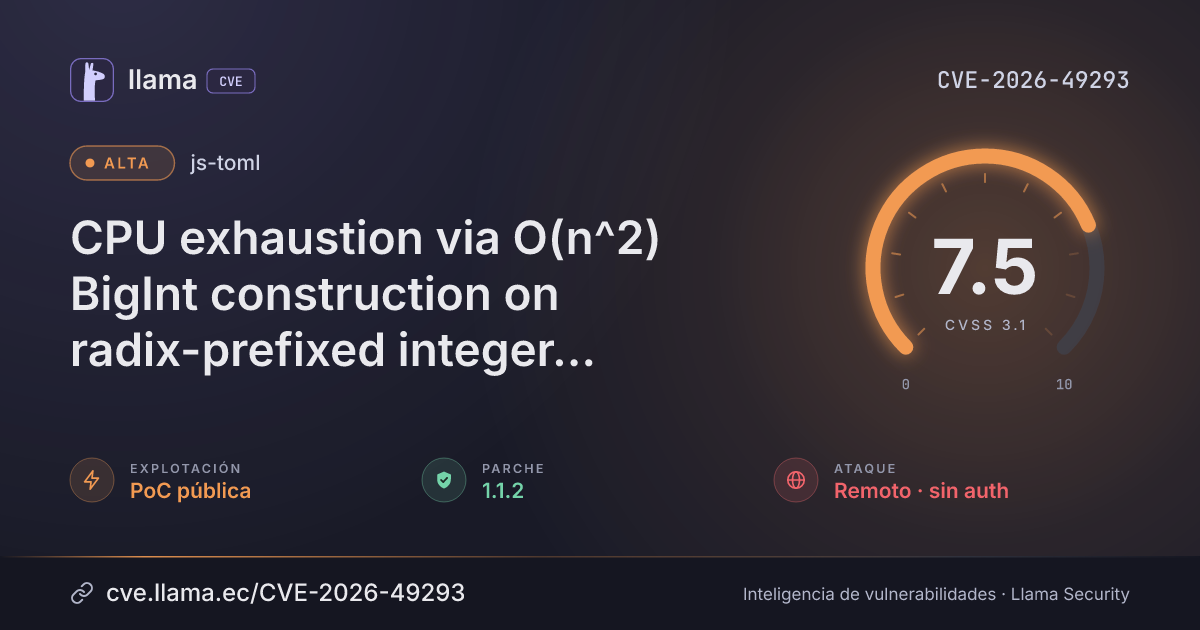
CPU exhaustion via O(n^2) BigInt construction on radix-prefixed integer literals

Afecta la configuración por defectoParche disponibledenial of service
Descargar PNG JSON
CVSS 3.1
7.5
Alta
CVSS:3.1/AV:N/AC:L/PR:N/UI:N/S:U/C:N/I:N/A:H Fuente: CNA
ExplotaciónPoC públicaSSVC: PoC · no figura en CISA KEV
Exploits públicos0CISA-ADP reporta PoC; aún sin enlace público
Parche1 versiónPrimer parche a -22 d de la divulgación
Exposición154 dDesde la divulgación, 19 jun 2026, 1:14 p. m.
Detección136 dDesde la divulgación hasta su ingreso al índice
Decisión SSVCSeguir de cerca
Monitorear y programar la remediación
Existe PoC pública, automatizable e impacto técnico parcial. Hay versiones corregidas disponibles.
Revisa tus logs de la semana con la lupa.Esto amerita una regla de detección, por si acaso.
Timeline

Ciclo de vida de la vulnerabilidad

Hoy
Divulgación
Publicada
Evaluación SSVC
Modificada
Explotación
Remediación
Parche 1.1.2
Monitoreo
Detectada
Verificada
28 may 26
19 jun 26
22 jun 26
3 nov 26
4 nov 26
16 nov 26
21 nov 26
28 may 26
11 jul 26
25 ago 26
8 oct 26
21 nov 26
FechaFaseEventoDetalle
Remediación Parche 1.1.2 js-toml · -22 d desde divulgación
Divulgación Publicada CVE-2026-49293 divulgada · CVSS 7.5 (CNA)
Divulgación Evaluación SSVC CISA-ADP · explotación PoC pública
Monitoreo Detectada Ingresó al índice
Divulgación Modificada Última actualización del registro
Monitoreo Verificada Última verificación contra las fuentes
Resumen

js-toml is a TOML parser for JavaScript, fully compliant with the TOML 1.0.0 Spec. Versions up to and including 1.1.1 parse hexadecimal / octal / binary integer literals via a hand-written `parseBigInt` loop that multiplies a `BigInt` accumulator by the radix once per input digit. Each iteration performs a `BigInt * BigInt` operation on an accumulator that grows linearly with the number of digits already consumed, so the whole loop is O(n²) in the literal length. The lexer regex places no upper bound on the literal length, so a single TOML document containing one ~500 kB hex literal pins one CPU core for ~40 seconds on a modern laptop (Apple M-series, Node v22). Memory amplification is bounded but CPU amplification is severe and grows quadratically: doubling the literal length quadruples the work. A caller that invokes `load()` on attacker-controlled TOML (configuration upload endpoints, CI/CD systems ingesting third-party `*.toml`, IDE plugins, build tools) is exposed to a single-request CPU exhaustion DoS. Version 1.1.2 fixes the issue.

js-toml 1.1.1 and earlier are affected through the default load() path when a radix-prefixed integer literal exceeds Number.MAX_SAFE_INTEGER. Fixed in 1.1.2.

¿Qué significa?A crafted TOML document with a hex, octal, or binary integer literal whose value is larger than Number.MAX_SAFE_INTEGER makes the parser build the BigInt in quadratic time. One request can block the event loop and tie up a CPU core.
¿Quién está afectado?js-toml versions 1.1.1 and earlier are affected. The issue is on the default load() path and needs no options or configuration, but the literal's value must exceed Number.MAX_SAFE_INTEGER. To check a project, look at the js-toml version it resolves to, for example with npm ls js-toml.
¿Qué hacer?Upgrade js-toml to 1.1.2, the first published release that carries the fix.
Contexto

Condiciones y alcance

Condiciones necesarias para que el fallo sea explotable
01
Affected js-toml versions are 1.1.1 and earlier.“Versions: >= 0.0.0, <= 1.1.1”
02
The radix-prefixed (hex, octal or binary) integer literal's value must exceed Number.MAX_SAFE_INTEGER.“whose value exceeds Number.MAX_SAFE_INTEGER”
03
The vulnerable path is the default code path for load(), with no options or configuration needed.“No options or configuration are required to trigger it.”
MitigaciónCap accepted TOML input below 1 kB, which keeps the issue at LOW severity.
Vector CVSS 3.1

Desglose de métricas

Opción resaltada = valor del vector · izquierda = peor caso · CNA
Vector de ataqueAV:N
RedAdyacenteLocalFísica
ComplejidadAC:L
BajaAlta
PrivilegiosPR:N
NingunoBajosAltos
InteracciónUI:N
NingunaRequerida
AlcanceS:U
CambiadoSin cambio
ConfidencialidadC:N
AltoBajoNinguno
IntegridadI:N
AltoBajoNinguno
DisponibilidadA:H
AltoBajoNinguno
Score de explotaciónQué tan fácil y probable es que la exploten
10.0/ 10Muy alto
Vector 10.0 (muy fácil) · sin evidencia de explotación.
Versiones

Rangos afectados

Afectada Corregida Última
js-toml< 1.1.2
1.1.2
2.0.1
Remediación

Estado del parche por paquete

Paquete / productoEstadoCorregida enDesde divulgaciónÚltima versión
npmjs-toml
Corregida 1.1.2 -22 d 2.0.1 no afectada
Versiones corregidas1.1.2
Explotación

Arsenal público

Sin exploits, módulos ni PoC públicos conocidos a la fecha de verificación.

Referencias
Fabricantehttps://github.com/sunnyadn/js-toml/security/advisories/GHSA-wp3c-266w-4qfq
Otrahttps://github.com/sunnyadn/js-toml/commit/1e45ca56ba12e98508f8aae3e31c4aff7603d711
Otrahttps://github.com/sunnyadn/js-toml/releases/tag/v1.1.2
Otrahttps://github.com/sunnyadn/js-toml/commit/1abcb31dc7b1fa88e4c848a8d108891cfbb96fa2
Otrahttps://github.com/sunnyadn/js-toml/releases/tag/v1.1.1

Las referencias externas se muestran para copiar: cve.llama.ec no lo redirige a otros sitios.