CVE-2026-49457
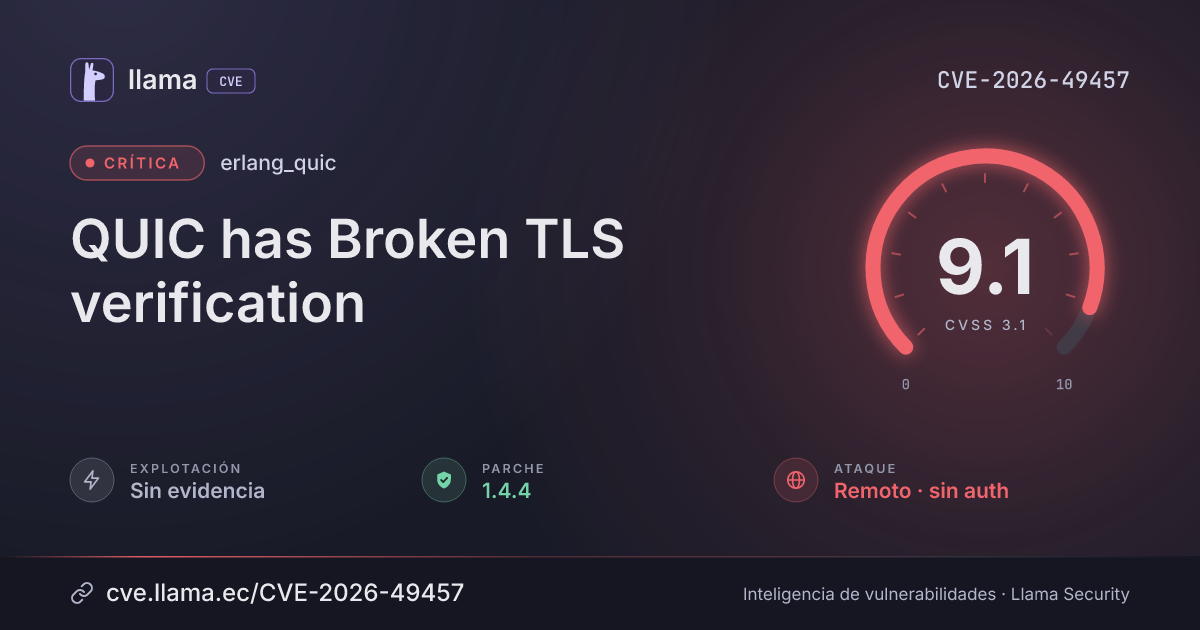
QUIC has Broken TLS verification
CVSS:3.1/AV:N/AC:L/PR:N/UI:N/S:U/C:H/I:H/A:N
Fuente: CNA
Ciclo de vida de la vulnerabilidad
| Fecha | Fase | Evento | Detalle |
|---|---|---|---|
| Divulgación | Publicada | CVE-2026-49457 divulgada · CVSS 9.1 (CNA) | |
| Divulgación | Evaluación SSVC | CISA-ADP · explotación ninguna | |
| Divulgación | Modificada | Última actualización del registro | |
| Monitoreo | Detectada | Ingresó al índice |
erlang_quic is a pure Erlang QUIC implementation. Prior to version 1.4.4, the QUIC client did not authenticate the server during the TLS 1.3 handshake. The CertificateVerify signature was not checked, the certificate chain was not validated, and the hostname was not compared against the certificate, so `verify` was effectively a no-op on the client. A man-in-the-middle on the network path could present any certificate and impersonate any server, defeating the confidentiality and integrity of the connection. HTTP/3 uses the same client and was equally affected. Handshakes authenticated by a PSK (session resumption) are not affected, because the peer is authenticated by the PSK binder and no certificate is sent. This is fixed in 1.4.4. The client now verifies the CertificateVerify signature, validates the certificate chain against the trust store (`cacerts` option, the operating system store by default), and checks the hostname. Client `verify` now defaults to on; set `verify => false` to accept any certificate (for example a self-signed test server). No known workarounds are available before 1.4.4. `verify => true` had no effect, and inspecting the certificate after connecting does not help because without the signature check the peer is never proven to own the certificate it presents.
Desglose de métricas
Rangos afectados
Estado del parche por paquete
| Paquete / producto | Estado | Corregida en | Desde divulgación | Última versión |
|---|---|---|---|---|
erlang_quic |
Corregida | 1.4.4 | — | — |
1.4.4Arsenal público
Sin exploits, módulos ni PoC públicos conocidos a la fecha de verificación.
https://github.com/benoitc/erlang_quic/security/advisories/GHSA-2r8v-p65x-3663Las referencias externas se muestran para copiar: cve.llama.ec no lo redirige a otros sitios.