llamaCVEVulnerability Intelligence
/
Kestra

CVE-2026-49869

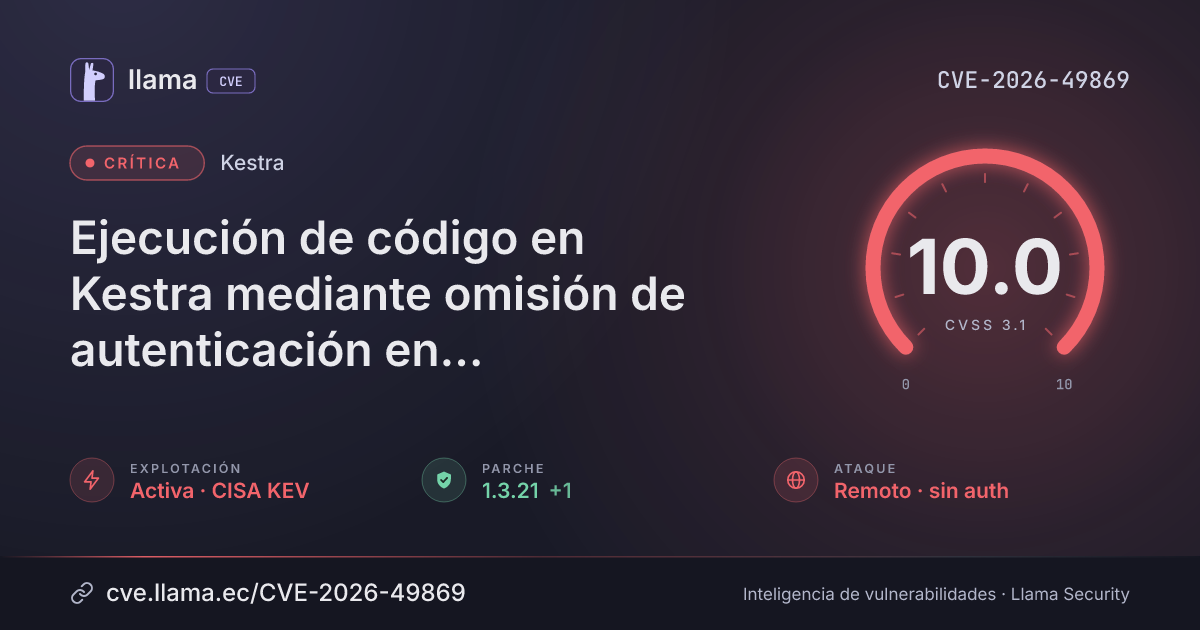
Kestra code execution via auth bypass in AuthenticationFilter

An unauthenticated attacker on the network can run arbitrary commands as root in a worker container.

Texto original en inglés · Ver en español

CISA KEV · explotación activaCrítica · en CISA KEVParche disponibleOS command injection
Descargar PNG JSON
CVSS 3.1
10.0
Crítica
CVSS:3.1/AV:N/AC:L/PR:N/UI:N/S:C/C:H/I:H/A:H Fuente: CNA
ExplotaciónActivaEn CISA KEV desde 2 sept 2026
Exploits públicos32 fuentes
Parche2 versiones1.0.45 · 1.3.21
Exposición147 dDesde la divulgación, 26 jun 2026, 3:58 p. m.
Detección118 dDesde la divulgación hasta su ingreso al índice
Decisión SSVCActuar
Parchear de inmediato
Explotación activa (CISA KEV), automatizable e impacto técnico total. Plazo KEV: 5 sept 2026.
Si tu WAF reza, que rece ahora.Rota credenciales, revisa logs y luego me agradeces.
Timeline

Ciclo de vida de la vulnerabilidad

Hoy
Divulgación
Publicada
Evaluación SSVC
Modificada
Explotación
CISA KEV
Remediación
Plazo KEV
Monitoreo
Detectada
Fuente: OSV
Fuente: Nuclei templates +2
26 jun 26
1 sept 26
2 sept 26
3 sept 26
5 sept 26
22 oct 26
19 nov 26
20 nov 26
21 nov 26
26 jun 26
2 ago 26
8 sept 26
15 oct 26
21 nov 26
FechaFaseEventoDetalle
Divulgación Publicada CVE-2026-49869 divulgada · CVSS 10 (CNA)
Divulgación Evaluación SSVC CISA-ADP · explotación activa
Explotación CISA KEV Agregada al catálogo de vulnerabilidades explotadas
Divulgación Modificada Última actualización del registro
Remediación Plazo KEV Fecha límite de remediación para agencias federales (EE. UU.)
Monitoreo Detectada Ingresó al índice
Monitoreo Fuente: OSV Registro visto por primera vez en OSV
Monitoreo Fuente: Nuclei templates Registro visto por primera vez en Nuclei templates
Monitoreo Fuente: PoC-in-GitHub Registro visto por primera vez en PoC-in-GitHub
Monitoreo Verificada Última verificación contra las fuentes
Resumen
Resumen generado por IA · CC-BY 4.0 · 11 nov 2026

Kestra, an open-source orchestration platform, has an authentication bypass that lets an attacker create and run arbitrary workflows, giving them remote code execution as root inside the Kestra worker container. It can be reached remotely over the network without logging in, and because the bug is listed in CISA's catalog of known exploited vulnerabilities, attacks are happening.

Affects Kestra OSS 1.3.20 and earlier with Basic Auth enabled (the default) and the default script execution plugins. Fixed in 1.0.45 and 1.3.21.

¿Qué significa?A flaw in Kestra's AuthenticationFilter lets an unauthenticated attacker get past login. They can then create and run arbitrary workflows, which gives remote code execution as root inside the Kestra worker container. It also allows access to internal services through SSRF, and reading, modifying or deleting resources, including logs.
¿Quién está afectado?Kestra OSS 1.3.20 and earlier is affected, specifically instances with Basic Auth enabled, which is the default authentication mode. The advisory notes that script execution plugins, installed by default, turn the bypass into code execution. The fixed ranges are before 1.0.45, and from 1.1.0 before 1.3.21. Check the running Kestra version and the authentication setting in the configuration.
¿Qué hacer?Upgrade to Kestra 1.0.45 or 1.3.21 or later, depending on the release line in use. The facts give no workaround.
Descripción original del registro (GitHub_M)

Kestra is an open-source, event-driven orchestration platform. Prior to 1.0.45 and 1.3.21, AuthenticationFilter in Kestra OSS uses request.getPath().endsWith("/configs") to whitelist the public configuration endpoint from Basic Auth. Because the check is a suffix match rather than an exact path match, any API path whose last segment is configs bypasses authentication entirely. An unauthenticated remote attacker can exploit this to create and execute arbitrary workflows without credentials. Because Kestra ships with script execution plugins (plugin-script-shell, plugin-script-python, etc.) enabled by default, this directly results in unauthenticated Remote Code Execution as root inside the Kestra worker container. This vulnerability is fixed in 1.0.45 and 1.3.21.

Contexto

Condiciones y alcance

Condiciones necesarias para que el fallo sea explotable
01
Kestra OSS version 1.3.20 or earlier (before the 1.0.45 and 1.3.21 fixes)“Affected versions <= 1.3.20”
02
Basic Auth enabled, which is the default authentication mode for Kestra OSS“Any Kestra OSS instance with Basic Auth enabled”
03
Script execution plugins are present, as they are enabled by default, which turns the bypass into code execution“Kestra ships with script execution plugins installed by default.”
¿Quién debe revisar?Teams running Kestra OSS 1.3.20 or earlier with Basic Auth enabled (the default). Reachable from any network position, not just internet-facing instances.
Vector CVSS 3.1

Desglose de métricas

Opción resaltada = valor del vector · izquierda = peor caso · CNA
Vector de ataqueAV:N
RedAdyacenteLocalFísica
ComplejidadAC:L
BajaAlta
PrivilegiosPR:N
NingunoBajosAltos
InteracciónUI:N
NingunaRequerida
AlcanceS:C
CambiadoSin cambio
ConfidencialidadC:H
AltoBajoNinguno
IntegridadI:H
AltoBajoNinguno
DisponibilidadA:H
AltoBajoNinguno
Score de explotaciónQué tan fácil y probable es que la exploten
10.0/ 10Muy alto
Vector 10.0 (muy fácil) · sin evidencia de explotación.
Versiones

Rangos afectados

Afectada Corregida
kestra< 1.0.45
kestra≥ 1.1.0 < 1.3.21
1.0.45
1.1.0
1.3.21
Remediación

Estado del parche por paquete

Paquete / productoEstadoCorregida enDesde divulgaciónÚltima versión
kestra
Corregida 1.0.45, 1.3.21 — —
Versiones corregidas1.0.451.3.21
Explotación

Arsenal público

Exploit-DB
—
0
Metasploit
—
0
Nuclei
http/cves/2026/CVE-2026-49869.yaml
1
PoC en GitHub
Ap0dexMe0/CVE-2026-49869 · EQSTLab/CVE-2026-49869
2
Ver los 2 repositorios de GitHub
Ap0dexMe0/CVE-2026-49869
EQSTLab/CVE-2026-49869

Los repositorios públicos incluyen exploits, escáneres, laboratorios y reglas de detección. No ejecute código de terceros sin revisarlo en un entorno aislado.

Acción requerida por CISAApply mitigations in accordance with vendor instructions, ensuring compliance with CISA’s BOD 26-04 Prioritizing Security Updates Based on Risk (see URL in Notes) guidance and CISA’s “Forensics Triage Requirements” (see URL in Notes). Follow applicable BOD 26-04 guidance for cloud services or discontinue use of the product if mitigations are unavailable. Stakeholders are responsible for evaluating each asset's internet exposure and ensuring adherence to BOD 26-04 patching guidelines.
Referencias
Fabricantehttps://github.com/kestra-io/kestra/security/advisories/GHSA-5vc5-wxxq-3fjx
CISA KEVhttps://www.cisa.gov/known-exploited-vulnerabilities-catalog?field_cve=CVE-2026-49869
Exploithttps://github.com/projectdiscovery/nuclei-templates/blob/main/http/cves/2026/CVE-2026-49869.yaml
Exploithttps://github.com/Ap0dexMe0/CVE-2026-49869
Exploithttps://github.com/EQSTLab/CVE-2026-49869

Las referencias externas se muestran para copiar: cve.llama.ec no lo redirige a otros sitios.